📌 Homemade Croissant Cubes
Posted 28 March 2026 by: Admin
The croissant cube is the pastry I recommend to those who want to impress without waking up at five in the morning. Three ingredients. One technique you’ll master in a single try.
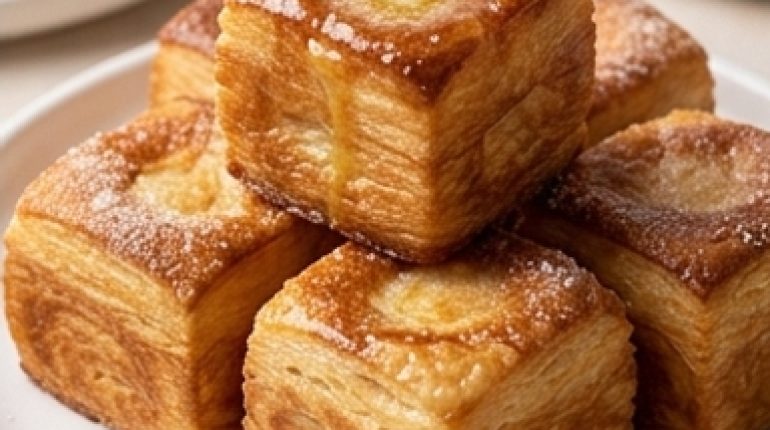
Straight out of the oven, they boast a deep golden hue — the exact shade of light caramel before it turns to amber — with slightly darker edges where the butter caramelized upon contact with the heat. The surface is shiny, slightly crunchy under the finger. Cut one in half: the inside reveals an architecture of airy, tender layers that gently PEEL away. The smell filling the kitchen is that of warm butter mixed with freshly baked puff pastry — simple, direct, and unstoppable.
Why you’ll love this recipe
Ingredient Notes
Only three ingredients: leavened puff pastry, sugar, and melted butter — simplicity at its best.
- Leavened puff pastry : This is the fundamental difference from classic puff pastry. The leavened version contains yeast, which allows it to swell during baking and give that airy texture typical of pastries. You can find it in supermarkets in the refrigerated bakery section — the block version is often better quality than the pre-rolled one, as the layers are more distinct. Avoid unleavened puff pastry: you will get much denser cubes without the softness.
- Melted butter : Use a butter with at least 82% fat content. Churn or high-quality butter gives a much more present nutty flavor to the finish. Melt it gently without boiling it: you want it liquid and warm, not scalding — otherwise, it softens the crust instead of glazing it.
- Sugar : Classic white sugar works very well for the finish. If you want more surface caramelization, replace it with brown sugar. And if you find pearl sugar, try it: it doesn’t melt completely during baking and gives a slight crunch that really changes the tasting experience.
Why cold dough is your best ally
Leavened puff pastry is fickle as soon as the kitchen heats up. If it exceeds 20°C in the room, work fast or put the dough back in the fridge for ten minutes between each step. On a lightly floured surface, roll it out with steady pressure from the center toward the edges — no nervous back-and-forth avec with the rolling pin. Aim for a thickness of about 4 mm: thin enough for the layers to unfold, thick enough for the cubes to have body. The dough should retain a slight elastic resistance under your fingers. This is the sign that the gluten and yeast are still active, that everything is fine.
Shaping: the part everyone imagines is complicated
Cut 5 cm squares with a very sharp blade — a blade that pulls on the dough destroys the flakiness, so sharpen before starting. To form the cubes, take each square and roll it gently starting from one corner, without tightening too much. The idea isn’t to make a perfect roll, but a small compact structure that will expand during proofing and baking. Tighten too hard and the layers stick: your cubes will be dense. Too loose, and they bloom open. You’ll learn it in two or three tries, no more.
Proofing, that moment when you do nothing and everything really happens
Thirty minutes under a clean tea towel. This is the step everyone is tempted to shorten because it’s invisible. Big mistake. During this half-hour, the yeast does its silent work: the cubes swell by about a third, the layers separate, and the final texture becomes possible. If your kitchen is cool, put the pan in a turned-off oven with just the light on. At the end of the proofing, the cubes should look slightly wobbly if you move the pan — like a soft jelly. That’s the signal that the proofing is successful.
The butter finish: the gesture that separates the good from the great
As soon as they come out of the oven — not two minutes later, right away — brush each cube with the melted butter. You’ll hear a slight whisper, almost a sizzle, when the butter touches the still-hot surface. Then the sugar, a light and steady rain. The warm butter partially melts the grains on the surface, creating a thin shiny film that hardens slightly as it cools. If you wait until the cubes cool, the butter slides off without adhering and the result is much less generous.
Tips & Tricks
- Work with cold dough. If it becomes soft and sticky to the touch, put it back in the refrigerator for ten minutes before continuing — warm dough loses its flakiness and the cubes will be much less airy when baked.
- To monitor the baking without opening the oven every five minutes, watch the color through the glass: as long as the tops are pale, there’s a way to go. When you see that light caramel gold appear, they are ready or very close to it.
- For an even more decadent version, slide a dark chocolate square (about 5 g) into the center of each dough square before rolling it. It melts during baking and creates a melty core with no extra effort.
Can I use classic puff pastry instead of leavened puff pastry?
No, they are not interchangeable. Classic puff pastry does not contain yeast, it will not rise during baking and will result in much denser and drier cubes. Leavened puff pastry (or croissant dough) is essential to get that characteristic softness. You can find it in the refrigerated bakery section of supermarkets.
My cubes hardly rise during proofing, what’s wrong?
The problem is almost always temperature: if your kitchen is too cold (below 18°C), the yeast doesn’t activate properly. Place the pan in a turned-off oven with just the light on — the residual heat (about 25-28°C) is ideal for proofing. Also, avoid over-handling or heating the dough during shaping, which kills the yeast.
How do I store the croissant cubes and how long do they last?
At room temperature in an airtight container, they stay good for 1 to 2 days. In the refrigerator, up to 3 days, but they will lose their crunch. To refresh them, put them in the oven at 160°C for 5 minutes — they regain their almost-original texture.
Can I freeze homemade croissant cubes?
Yes, after complete baking and total cooling. Freeze them flat on a tray first, then group them in a freezer bag. To enjoy them, thaw them directly in the oven at 160°C for 8 to 10 minutes — never in the microwave, which would make them rubbery.
How can I get even more pronounced surface caramelization?
Replace white sugar with brown sugar or sprinkle with pearl sugar before baking — it resists heat and creates a slightly crunchy crust. You can also brush the cubes with a mixture of melted butter and honey right out of the oven for an even shinier and more caramelized result.
How do I prevent the cubes from sticking to the pan?
Butter the pan generously before placing the cubes, or line it with parchment paper. Always leave a slight space between each cube — if they touch before proofing, they will fuse together during baking and will be difficult to separate cleanly.
Homemade Croissant Cubes
French
Breakfast & Brunch
Flaky and soft cubic pastries, prepared with three ingredients and baked in 20 minutes. Perfect for a gourmet breakfast or brunch.
Ingredients
- 1 sheet (approx. 250g) leavened puff pastry (croissant dough), cold
- 50g (4 tbsp) white sugar (or brown sugar for more caramelization)
- 40g (3 tbsp) melted butter, for finishing
- a little butter or parchment paper for the pan
Instructions
- 1Preheat the oven to 180°C (fan oven). Butter a square or rectangular pan or line it with parchment paper.
- 2Roll out the cold leavened puff pastry on a lightly floured surface to about 4 mm thickness, using steady pressure from the roller from the center to the edges.
- 3Cut squares of about 5 cm per side using a sharp knife or a pastry cutter.
- 4Roll each square gently from one corner to the opposite, without tightening too much, to form a small compact structure.
- 5Place the cubes in the pan, leaving 1 to 2 cm of space between each to allow for expansion.
- 6Cover with a clean tea towel and let rise for 30 minutes at room temperature (or in a turned-off oven with the light on if the kitchen is cool).
- 7Bake for 20 minutes until you get a light caramel golden color on the tops.
- 8Immediately after taking them out of the oven, brush each cube with melted butter, then sprinkle with sugar. Let cool for 5 minutes before serving.
Notes
• Storage: at room temperature in an airtight container (1-2 days) or in the refrigerator (up to 3 days). Reheat for 5 minutes at 160°C to restore crunch.
• Chocolate version: slide a dark chocolate square (5g) into the center of each dough square before rolling. It melts during baking and creates a melty core.
• Savory version: omit the sugar and top with grated cheese and dried herbs — perfect for an appetizer.
Nutrition Facts (per serving, estimated)
| 195 kcalCalories | 3gProtein | 21gCarbs | 11gFat |