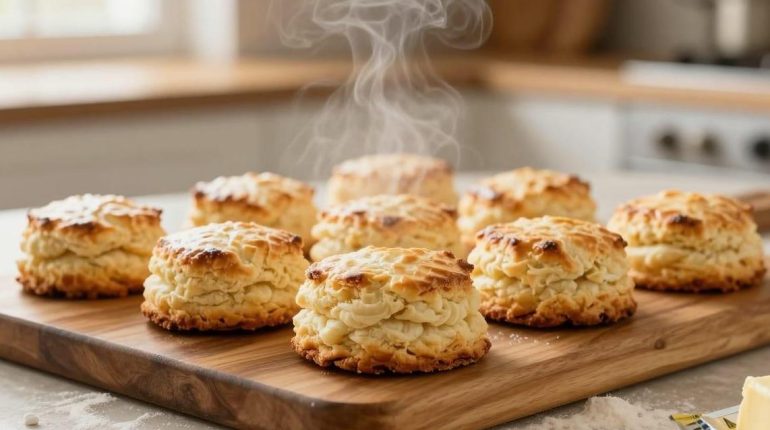
📌 Homemade biscuits: why cold butter and cake flour change everything to achieve a flaky texture
Posted 1 February 2026 by: Admin
The Secrets Of An Irresistible Homemade Biscuit
The aroma of freshly baked biscuits instantly transforms an ordinary kitchen into a gourmet sanctuary. This unique sensory experience is the first decisive reason to abandon industrial versions: the incomparable freshness of homemade creations reveals flavors that industrial packaging cannot preserve.
Beyond olfactory pleasure, home baking offers total creative freedom. Aromatic herbs, aged cheeses, exotic spices: each biscuit becomes an expression of personal preferences, impossible to reproduce with standardized products. This personalization is accompanied by absolute control over nutritional quality. No more indecipherable additives and hydrogenated fats – you select every ingredient, guaranteeing a transparent healthy option.
The economic argument finally convinces the skeptics. A homemade batch costs significantly less than its commercial equivalent, especially when prepared in quantity. Basic ingredients – flour, butter, milk – remain accessible, turning this culinary pleasure into a choice that is as rational as it is emotional.
These four pillars – aromatic freshness, limitless creativity, nutritional mastery, and substantial savings – redefine the biscuit as much more than a simple side dish. It remains to be understood how apparently ordinary ingredients create that much-sought-after flaky texture.
Key Ingredients Decoded
This culinary alchemy relies on five components whose interaction determines the final success. All-purpose flour forms the structural base thanks to its ideal protein balance. Purists can, however, experiment with cake flour to accentuate the airiness, or opt for a specialized biscuit flour that guarantees optimal flakiness.
Unsalted butter represents the absolute secret of the desired texture. Its cold temperature is crucial: cut into ice-cold cubes, it creates steam pockets during baking that delicately separate the layers of dough. Shortening or lard offer interesting textural alternatives, but butter remains unsurpassed for aromatic richness.
Leavening agents – baking powder and baking soda – require impeccable freshness to develop their full effectiveness. An expired product condemns the biscuits to remain sadly flat. Cold milk provides the necessary moisture, while buttermilk introduces a subtle acidity that tenderizes the crumb while creating a distinctive flavor note.
Salt and sugar complete the equation in measured doses: the former enhances flavors, the latter promotes an appetizing golden color. This technical understanding of ingredients naturally prepares for the practical implementation of a proven recipe.
The Classic Recipe Revealed
Six ingredients are enough to produce professional-quality biscuits: 2 cups of all-purpose flour, 1 tablespoon of baking powder, 1 teaspoon of salt, 1 tablespoon of granulated sugar, 1/2 cup of cold unsalted butter cut into cubes, and 3/4 cup of refrigerated milk or buttermilk. These proven proportions guarantee the perfect balance between structure and tenderness.
The methodology requires rigorous precision from the moment the oven is preheated. Incorporating the ice-cold butter into the flour mixture requires a delicate touch: work quickly with your fingers or a pastry cutter until you obtain a grainy texture resembling coarse sand. Visible pieces of butter are not a mistake, but the promise of future flaky layers.
Adding the cold liquid requires a light hand. Mix just enough to form a cohesive dough – over-kneading activates the gluten and produces dense, rubbery biscuits. On a lightly floured surface, gently roll out the dough to about 2 centimeters thick. A round cutter pressed vertically, without twisting, preserves the clean edges that promote an even rise.
Baking at high temperature – generally 220°C – instantly sears the dough, creating that characteristic golden crust while the interior remains soft. Fifteen minutes are usually enough to reach visual perfection. These mastered fundamentals open the way to countless creative variations.
Variations And Customization Tips
The basic recipe tolerates bold fat substitutions: shortening generates an ultra-flaky but neutral-tasting texture, while lard – traditional in the American South – imparts an authentic flavor and incomparable friability. Some bakers combine butter and shortening to marry aromatic richness with structural lightness.
Savory variations transform these biscuits into true gastronomic creations. Incorporate 3/4 cup of grated sharp cheddar and a tablespoon of chopped chives directly into the dough. Fresh herbs – rosemary, thyme, basil – are integrated in subtle touches of one to two teaspoons. For a spicy version, a hint of cayenne pepper or smoked paprika revolutionizes the flavor profile without compromising the texture.
Maximum flakiness is obtained by an ancestral technique: roll out the dough into a rectangle, fold it in three, turn it a quarter turn, then repeat the operation twice. These successive folds create trapped layers of butter that literally explode during baking.
Optimal storage: wrapped airtight, these biscuits keep for two days at room temperature. To extend their shelf life, freeze them raw on a tray before transferring them to a bag – bake them directly from frozen, adding three minutes to the initial time. Reheating in the oven at 175°C for five minutes miraculously restores their original crispness.