Follow us
10 June 2026

Homemade Bibimbap Bowl with Chili-Garlic Beef

Prep Time
15 minutes
Cook Time
20 minutes
Total Time
35 minutes
Servings
4 servings

Have you ever stared into your fridge on a weekday evening, wondering how to make something truly good without spending the whole night? That’s exactly why this homemade bibimbap bowl exists. Fragrant rice, spicy beef, crunchy vegetables, and a runny egg—ready in 35 minutes, and honestly better than you’d expect.
Advertisement
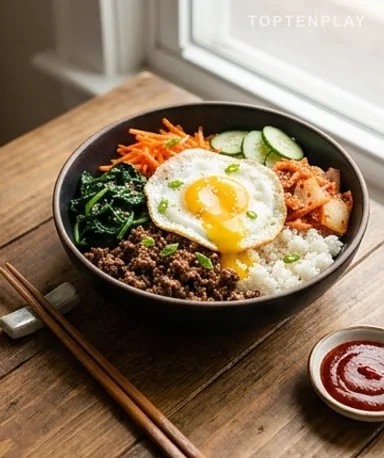
Final result
The complete bowl with its runny egg ready to be mixed—the real way to eat it.

The first thing that strikes you when you set this bowl on the table is the color. The dark green of the spinach contrasts with the bright red of the glazed beef, the orange carrot ribbons, and the pearly white of jasmine rice. As you get closer, the aroma of toasted sesame rises from the still-warm spinach, mixed with the sweet-spicy heat of the chili sauce that has caramelized in the pan. And then there’s the egg—that still-trembling yolk placed in the center, waiting to be broken to coat everything in a creamy richness that completely changes the texture of every bite.


Why you’ll love this recipe

A truly complete bowl : Protein, vegetables, carbs, and healthy fats all in one container. No need to juggle multiple dishes or calculate nutritional balance—it’s all there.
Every component has its texture : The beef is tender and glazed, the spinach silky, the carrots and cucumber keep their crunch. Nothing is mushy or uniform, and that’s what makes every bite interesting until the last.
Kimchi does all the work : A spoonful of well-fermented kimchi replaces pickles, acidity, and spiciness all at once. No need for half a dozen condiments on the table for the bowl to be complex.
Adaptable to an empty fridge : Fresh vegetables can be easily swapped based on what’s left: blanched broccoli, grated zucchini, frozen edamame—the bowl principle absorbs everything without losing its identity.
Ready before it gets cold : Thirty-five minutes from start to finish, even from scratch. With leftover rice already cooked, it’s more like 20 minutes.

Ingredient Notes

Ingredients

Everything you need for 4 generously filled bowls, with fresh vegetables that provide crunch.

  • Jasmine rice : It absorbs all the juices from the beef and egg and holds the bowl together. Jasmine is preferable to basmati here because it’s slightly sticky and more fragrant, allowing it to hold without collapsing. Leftover rice reheated in a pan with a drop of oil is even better—less moist, and it develops a slight golden crust that changes the texture.
  • Fresh spinach : It wilts down while still offering slight resistance, unlike frozen spinach which releases too much water and drowns the bowl. Its role is twofold: provide greenery and serve as a silky bed that soaks up the sesame oil. Start with a generous amount—6 cups reduce to almost nothing in a minute of cooking.
  • Ground beef (5-10% fat) : It’s here for practicality and value: cooks quickly, absorbs the sauce well, and is easy to distribute among four bowls. Too-lean beef will be dry and grainy once glazed; aim for 5-10% fat to keep it tender. Ground turkey or chicken also works, though the texture will be slightly less dense.
  • Chili-garlic sauce : This gives the beef its character—spiciness, umami, and a slight sweetness that caramelizes on contact with the hot pan. Brands vary greatly in intensity, so taste before adding. If you can’t find it, a mix of sambal oelek and crushed garlic works well.
  • Toasted sesame oil : Half a teaspoon is enough to perfume the spinach with a very recognizable toasted nutty aroma. The classic mistake is to heat it directly in the pan—it burns in seconds and loses all its interest. Always add it off the heat, onto hot food, to gently release its flavors.
  • Kimchi : It simultaneously plays the role of pickles, acidity, and fermentation. A good store-bought kimchi that is well-fermented—slightly fizzy when you open the jar—works perfectly; no need to make it at home. If you don’t have any, carrots quickly marinated in rice vinegar with a pinch of red pepper give a decent result, but without the fermented depth that kimchi brings.

The rice, the real base

The rice isn’t just a neutral base in this bowl—it’s what ties everything together. Jasmine has a slight floral scent and a slightly sticky texture that allows it to absorb the juices from the beef and egg without turning into mush. Cook it with a water-to-rice ratio of 1.5 to 1, and let it rest for 5 minutes off the heat, lid on, before serving. Many skip this resting step, but it allows steam to finish cooking evenly and prevents the bottom from sticking. If you have leftover rice from the day before in the fridge, this is the perfect time to use it: it’s less moist, reheats in two minutes in a pan with a drizzle of oil, and develops a slight golden crust on the bottom that adds another dimension to the bowl.

The rice, the real base
The ground beef takes barely 5 minutes to cook and absorbs the sweet-savory chili-garlic sauce well.

Sesame spinach

Cooking the spinach takes two minutes, no more, and it’s done over high heat. Pour the oil into a large pan or wok heated well, add the spinach all at once—it will sizzle loudly upon contact with the hot surface. Stir quickly with a spatula or tongs: in less than a minute, 6 cups of fresh spinach reduce to a handful, dark green and glossy. Remove immediately from the heat to prevent it from releasing too much water, salt lightly, then pour the sesame oil directly over it while it’s still hot. The residual heat releases the toasted nutty aromas of the oil without burning it. Keep the pan for the beef—no need to wash it between.

The caramelizing beef

Return the pan to high heat, without adding oil if the beef is slightly fatty. Crumble the ground beef directly in and resist the urge to stir it immediately—let it sear for 90 seconds without moving. This first sear without stirring gives it color rather than boiling it in its juices. Once the meat is almost cooked, pour in the chili-garlic sauce, soy sauce, and brown sugar. At this precise moment, the pan smells of spicy caramel and the steam stings the eyes a bit—a sign that the sauce is reducing and clinging to the meat. Stir well to coat every piece of beef with this glossy lacquer and cook for another minute. The result should be moist and shiny, not swimming in a pool of brown liquid.

Fresh vegetables and kimchi

While the beef cooks, prepare the vegetables—no cooking here, and that’s precisely what makes them valuable. Grate the carrot coarsely so it keeps a slightly fibrous texture rather than melting under the teeth. Slice the cucumber into thin rounds or half-moons, and chop the green onions into small rings. The goal is to keep maximum crunch to contrast with the tender beef and silky spinach. For the kimchi, don’t rinse or drain it—its slightly fermented brine is exactly what brings the lively acidity to the bowl. Take a few spoonfuls directly from the jar for each portion, and place it next to the other vegetables rather than mixing it in right away.

The egg and final assembly

The egg is the last thing to cook, and it should arrive hot on the bowl. In a small non-stick pan lightly oiled over medium heat, crack the egg gently and cover with a lid or plate. In about two minutes, the white is set and opaque, but the yolk still resists slightly under fingertip pressure—that’s when to stop. Assemble the bowls in this order: rice at the bottom, then the toppings arranged in separate quarters—spinach, glazed beef, grated carrot, cucumber, green onions, kimchi. Place the egg in the center. You eat this bowl by mixing it vigorously from the first spoonful: the runny yolk binds the rice and spinach, the beef sauce perfumes everything else, and each spoonful contains a bit of everything without any ingredient overwhelming.

The egg and final assembly
The key: a very hot pan so the beef caramelizes rather than boils in its juices.

Tips & Tricks
  • Cook the rice first and cover it while you prepare the rest—it stays warm easily for 20 minutes, and you avoid having to synchronize timings at the last minute.
  • Don’t overcrowd the pan for the beef: if doubling the recipe, do two batches instead of one. Overcrowded beef doesn’t sear; it boils in its own juice, and you lose all the caramelization that gives the sauce its character.
  • Taste the chili-garlic sauce before measuring the amount—intensity varies greatly between brands. If it’s very strong, reduce to 1 tablespoon and compensate with an extra tablespoon of soy sauce to maintain the sauce volume.
  • If preparing in advance, keep each component separate in the fridge and assemble the bowls on demand. The beef and spinach reheat in two minutes in a pan, the rice too—the egg, however, must always be cooked at the last moment.
Close-up
This runny egg yolk mixing into the fragrant rice, that’s what makes all the difference.
FAQs

Can I replace the ground beef with another meat?

Yes, ground beef is easily replaceable in this bowl. Ground chicken or turkey work very well—the texture is a bit drier, so add a drizzle of sesame oil at the end to compensate. Finely sliced shiitake or portobello mushrooms sautéed over high heat make a convincing vegetarian version with comparable umami.

Is the kimchi really essential?

Kimchi is hard to perfectly replace because it brings acidity, fermentation, and spiciness all at once. If you don’t have any, carrots quickly marinated in rice vinegar with a pinch of red pepper and salt for 10 minutes make a decent alternative. But if you have an Asian supermarket nearby, it’s worth the trip—a good store-bought, well-fermented kimchi works perfectly.

How can I prepare this bowl in advance?

All components except the egg can be prepared in advance and stored separately in the fridge for up to 3 days. The beef and spinach reheat in 2 minutes in a pan, the rice in 3 minutes with a little water to moisten it before covering. The egg is the only exception—it must be cooked at the last minute to keep the runny yolk.

What’s the difference from a traditional bibimbap?

Traditional bibimbap uses marinated sliced beef (bulgogi), separately seasoned blanched vegetables (namul), gochujang paste, and sometimes a sizzling stone bowl (dolsot) that crisps the rice on the bottom. This version is an accessible interpretation: ground beef instead of marinated beef, kimchi instead of gochujang, fresh raw vegetables instead of namul. The spirit—a colorful bowl that you mix—is the same, but the ingredients are easier to find.

How do I get a perfectly runny egg?

The key is to cover the pan as soon as you crack the egg: the steam cooks the top of the white without having to flip it, preserving the yolk intact and trembling. Medium heat, 2 minutes maximum, and remove as soon as the white is completely opaque. If you prefer a soft-boiled egg, 6 minutes in boiling water followed by a cold water bath before peeling gives an equally creamy result.

Can I use another type of rice?

Jasmine is ideal for its slightly sticky texture that absorbs the juices from the beef and egg yolk well. Short-grain rice (sushi type) also works, even better if you like a more compact rice. Basmati is less suitable: its long, separate grains absorb the sauce less well. In any case, leftover rice from the day before reheated in a pan with a drizzle of oil remains the best option—less moist, slightly crispy.

Homemade Bibimbap Bowl with Chili-Garlic Beef

Homemade Bibimbap Bowl with Chili-Garlic Beef

Easy
Korean
Main dish

Prep Time
15 minutes
Cook Time
20 minutes
Total Time
35 minutes
Servings
4 servings

A revisited and accessible Korean bowl: jasmine rice, sesame spinach, ground beef glazed in chili-garlic sauce, crunchy vegetables, kimchi, and a runny egg. Colorful, balanced, and ready in 35 minutes.

Ingredients

  • — Rice —
  • 265g uncooked jasmine rice (yields about 800g cooked)
  • — Sesame Spinach —
  • ½ tbsp neutral cooking oil
  • 215g fresh spinach (about 6 large handfuls)
  • 1 tsp toasted sesame oil
  • ¼ tsp salt
  • — Chili-Garlic Beef —
  • 225g ground beef (5-10% fat)
  • 2 tbsp chili-garlic sauce
  • 1 tbsp soy sauce
  • 1 tbsp brown sugar
  • — Vegetables and Garnishes —
  • 1 carrot (155g), coarsely grated
  • 1 English cucumber, thinly sliced into rounds
  • 2 green onions, sliced
  • 6 tbsp kimchi (about 90g)
  • — Eggs —
  • 4 eggs
  • 1 tsp cooking oil (for frying eggs)

Instructions

  1. 1Cook the jasmine rice according to package instructions with a water-to-rice ratio of 1.5 to 1. Remove from heat and let rest for 5 minutes with the lid on before serving.
  2. 2Heat ½ tbsp oil in a large pan or wok over high heat. Add the spinach all at once and stir quickly for 1 minute until wilted and dark green. Remove from heat, add the sesame oil and salt, mix, and set aside.
  3. 3In the same pan over high heat, crumble the ground beef and let it sear for 90 seconds without touching it to develop color. Stir and finish cooking. Pour in the chili-garlic sauce, soy sauce, and brown sugar; mix well to coat each piece and let caramelize for 1 minute. The beef should be glossy and glazed. Set aside.
  4. 4Meanwhile, coarsely grate the carrot, slice the cucumber into rounds or half-moons, and slice the green onions. Set aside with the kimchi—no cooking needed.
  5. 5In a small non-stick pan lightly oiled over medium heat, crack an egg, cover, and cook for about 2 minutes until the white is opaque but the yolk is still runny. Repeat for the remaining 3 eggs, or cook two at a time if the pan allows.
  6. 6Divide the rice among 4 bowls. Arrange the toppings in separate quarters around the center: spinach, beef, carrot, cucumber, green onions, and kimchi. Place an egg in the center of each bowl. Mix vigorously before the first bite so the yolk coats everything.

Notes

• Leftover rice is recommended: less moist, it develops a slight golden crust in a pan with a drizzle of oil in 2-3 minutes, which significantly improves the bowl’s texture.

• To double the recipe, cook the beef in two batches—an overcrowded pan won’t sear and the beef boils in its juice instead of caramelizing.

• Vegetarian substitution: replace the beef with 200g of finely sliced shiitake or portobello mushrooms, sautéed over very high heat with the same sauces.

• Storage: the components (except eggs) keep separately in the fridge for up to 3 days. Reheat the beef and spinach in a pan, the rice with a little water in the microwave.

Nutrition Facts (per serving, estimated)

530 kcalCalories 25gProtein 65gCarbs 18gFat
Advertisement
Share on Facebook