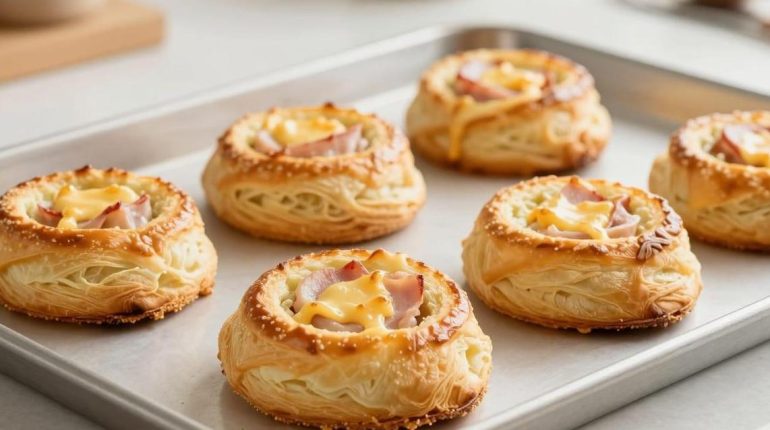
📌 Ham and cheese puff pastry rolls: the tight cylinder technique that guarantees perfect baking in 18 minutes
Posted 13 February 2026 by: Admin
Recipe Essentials: A Simple Base With Accessible Ingredients
This recipe for ham and cheese puff pastry rolls relies on remarkable accessibility: four main ingredients are enough to achieve a result worthy of a professional caterer. The base consists of a sheet of thawed puff pastry, ready to be filled with cooked ham (one cup, diced or sliced depending on the desired texture) and one cup of shredded cheese. The egg, used for the wash, completes this minimalist list.
The choice of cheese remains intentionally open: Swiss for its creamy sweetness, cheddar for its bolder character, or any other variety according to preference. This flexibility transforms a simple recipe into a field of culinary experimentation, without requiring exotic or expensive ingredients.
The strength of these pinwheels lies in their effort-to-result ratio: no dough to prepare yourself, no endless list of rare spices, just everyday products assembled intelligently. The ham can come from leftovers, the cheese from the refrigerator drawer, and the puff pastry keeps easily in the freezer.
This minimalist approach guarantees quick preparation, ideal for an improvised appetizer or a stress-free starter. The mentioned optional ingredients—mustard, herbs, spices—are only possible enrichments, never obligations, thus preserving the fundamental accessibility of the recipe.
Customizable Variations: Mustard, Herbs, and Spices
Beyond this minimalist base, the recipe reveals its true creative potential through the options mentioned as “flavor extras.” Mustard, applied in a thin layer on the dough before the filling, radically transforms the taste profile by bringing a tangy note that contrasts with the sweetness of the melted cheese. This simple addition is enough to take the rolls from a neutral register to a bolder, almost gourmet version.
Fresh or dried herbs—basil, thyme, oregano—can be integrated directly into the filling or sprinkled on the cheese before rolling. This technique allows the recipe to be adapted according to the occasion: Mediterranean with basil, Provençal with herbs de Provence, or autumnal with rosemary. Each variation subtly modifies the balance without requiring technical adjustments.
Spices constitute the third path of exploration. Smoked paprika, cracked black pepper, or Espelette pepper add an extra dimension without complicating the preparation. The interest lies in their free dosage: a pinch for lovers of delicate flavors, a generous layer for bold palates.
This flexibility transforms a single recipe into an adaptable culinary platform, where each creation can reflect current preferences or match the rest of the menu. The optional nature of these enrichments preserves the initial accessibility while offering a field of experimentation for those wishing to personalize their creation.
The Choice of Cheese: Swiss, Cheddar, or Alternative
This creative latitude finds its most decisive expression in the cheese selection, where three distinct paths are available to the cook. Swiss cheese, with its melting texture and slightly nutty taste, is the classic option that guarantees a balanced result. Its ability to liquefy without becoming greasy ensures optimal cohesion between the layers of puff pastry.
Cheddar, offered as a bolder alternative, radically modifies the taste experience. Its more pronounced profile and orange color transform the rolls into a robust version, particularly suited to palates seeking pronounced intensity. Its sharper flavor interacts differently with the ham, creating a contrast rather than a soft harmony.
Beyond these two explicit references, the mention “or your choice” totally opens up the field of possibilities. Gruyère for a sweet-savory note, aged Comté for a fruity character, mozzarella for a stringy texture, or even a blue cheese for assumed boldness: each variety imprints its signature on the final product.
This total openness reveals the very philosophy of the recipe: an invariable technical structure that welcomes infinite variations according to available resources or current desires. The choice of cheese ceases to be a constraint to become the main lever of personal expression, transforming each batch into a unique creation while preserving the simplicity of implementation.
Preparation: Egg Wash for a Perfect Finish
Beyond compositional choices, the technical success of these rolls relies on a precise but often neglected gesture: the egg wash. This step, which uses the single egg from the ingredient list, transcends its apparent simplicity to become the determining factor of the final visual appearance. Brushing the surface before baking causes a chemical reaction between the egg proteins and the oven heat, generating that characteristic amber hue that signals professionalism and appetence.
Without this intervention, the pastries would come out pale and dull, technically cooked but visually disappointing. The beaten egg works like an edible varnish that caramelizes slightly on the surface, creating that shiny contrast between the golden exterior and the internal flaky layers. This protective layer also seals in moisture while ensuring a crispy crust.
The mention of “egg wash” in the instructions highlights that it is not a simple negligent brushing, but a codified technique that requires a homogeneous beating of the egg and a uniform application with a brush. Every uncovered millimeter will remain matte, immediately revealing forgotten areas after baking.
This preparatory step announces the transition to the detailed instructions promised “on the next page,” suggesting that the egg wash is only the prelude to a shaping and baking process that will transform these four basic ingredients into a successful culinary creation.