📌 Hallway sinks: why this ingenious hygienic solution from the 1890s-1930s has disappeared from our homes
Posted 7 February 2026 by: Admin
The Little-Known Origin Of Hallway Sinks
In old houses, a small solitary sink installed in the hallway often intrigues visitors. Far from being a plumbing error, this installation reveals a deliberate and ingenious architectural design. Between the years 1890 and 1930, while indoor plumbing remained a privilege reserved for a minority, these strategically positioned basins met an essential daily need.
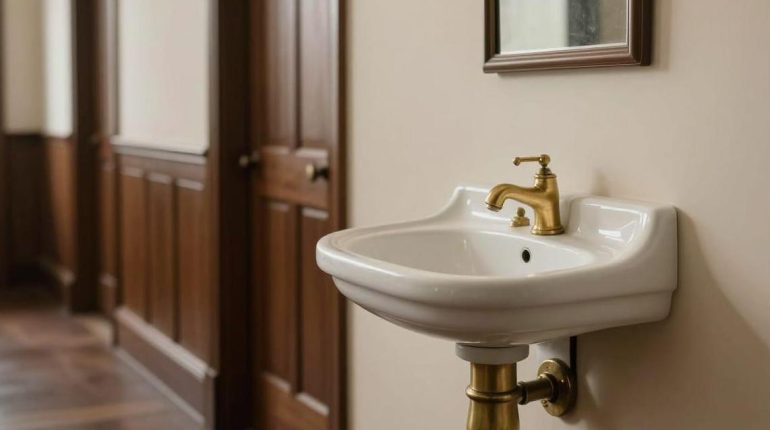
Named “washstands,” these sinks constituted the main hygiene station for families and guests alike. In an era when the single bathroom was generally located upstairs, their placement in the entrance or hall transformed these transition zones into true sanitary airlocks. This location allowed for getting rid of urban dust or garden soil as soon as the threshold was crossed, performing a quick wash before meals without climbing stairs, and offering visitors an accessible water point without entering private family spaces.
This architectural solution testified to a deep reflection on domestic organization. By judiciously positioning these installations between the exterior and the interior, the designers of the time optimized daily hygiene while preserving the privacy of the home. A subtle balance between practicality and social propriety.
A Strategically Positioned Hygienic Station
This thoughtful placement of the sink responded to a precise sanitary logic. The typical configuration of homes at the time imposed major constraints: with a single bathroom located on the upper floor, every daily hygiene need required a trip up the stairs. The hallway sink intelligently bypassed this waste of time and energy.
Its role as a hygienic barrier proved crucial in industrial cities where coal dust and urban residues clung to clothes and hands. Upon returning from work, school, or shopping, a simple detour to this water point was enough to eliminate dirt before it dispersed into the living areas. For families growing a vegetable garden, this station allowed for removing soil without crossing the entire house.
The social dimension of this installation also deserved consideration. Receiving a visitor implied offering them access to facilities without forcing them to enter the bedrooms or the family floor. This hall sink thus preserved an invisible boundary between hospitality and domestic intimacy, a cardinal value of an era where social conventions strictly governed spatial organization.
This simple solution embodied a design philosophy where every architectural element responded to a specific need, without superfluity or waste of space.
The Golden Age Of The Hallway Sink (1890-1930)
This philosophy of practical efficiency reached its peak during the four decades that marked the transition to domestic modernity. Between 1890 and 1930, builders systematically integrated these installations into their plans, testifying to an architectural consensus on their necessity. The progressive standardization of indoor plumbing made technically possible what common sense dictated functionally.
The design of these hygienic stations reflected a deliberate sobriety: two separate taps for hot and cold water, a small oval or rectangular mirror fixed to the wall, and a porcelain or varnished wood shelf for soap. No superfluous ornamentation weighed down the ensemble. This simplicity was not synonymous with aesthetic poverty but with a perfect match between form and function.
These installations embodied the spirit of an era where every square meter had to justify its existence by its concrete utility. Architects designed the home as an integrated system where circulation, hygiene, and social life were harmoniously articulated. The hallway sink was an essential cog in this domestic machinery, as indispensable as it was discreet.
This period represented the apotheosis of a residential design largely forgotten today, but whose pragmatic logic could inspire certain contemporary reflections on the optimization of living space.
Decline And Modern Potential Of This Installation
The advent of the multi-room bathroom and the democratization of water points in every bedroom gradually relegated these sinks to the rank of architectural curiosities. Successive renovations have often removed them, judged as cumbersome or outdated in the face of new design standards favoring open spaces. This disappearance marks the end of a home design where the hygienic transition constituted a formalized step between the exterior and the interior.
Yet, this simple solution embodied a remarkably effective response to the daily sanitary challenges of a pivotal era. At a time when spatial optimization is once again a priority in compact urban housing, and where hygienic awareness has considerably increased, the concept deserves re-examination. A water point strategically positioned near the entrance could be used to wash hands upon returning from outdoor activities, avoiding the spread of contamination to living spaces.
Some contemporary architects are intuitively rediscovering this logic by integrating basins into the vestibules or mudrooms of recent constructions. Without knowing it, they are reactivating a functional principle over a century old, adapted to current sanitary concerns. The hallway sink was not just a vestige of the past: it perhaps anticipated certain necessities of our present.