📌 Ghee: why this Indian clarified butter is more digestible and versatile than ordinary butter
Posted 19 February 2026 by: Admin
Ghee, an Ingredient at the Heart of Indian Cuisine
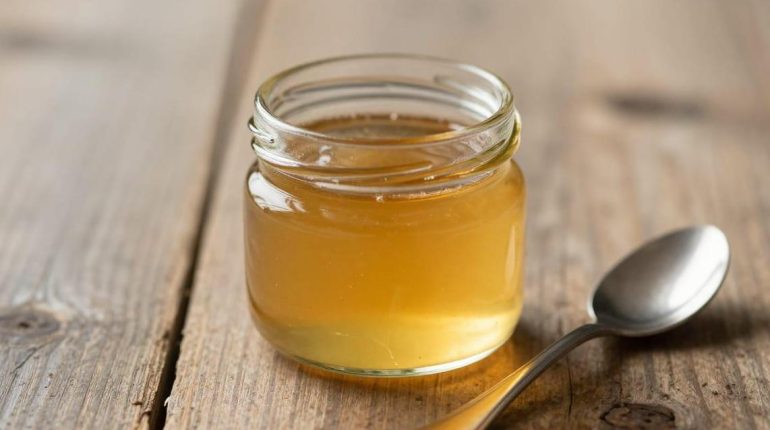
Behind the aromatic richness of Indian rice lies an ingredient often overlooked: ghee, or clarified butter. Obtained by slowly melting butter to separate the water and milk proteins, ghee has a more concentrated, nuttier flavor and superior heat resistance compared to ordinary butter.
In this recipe, it plays a central role from the first minute of cooking. Precisely 2 ½ tablespoons structure the entire dish: one part to sauté the cumin and coat the rice, the rest to brown the garnishes in parallel.
For those who do not have it, 50g of classic butter is an accessible alternative. However, this substitution remains a compromise: ordinary butter still contains whey and water, which modifies the reaction to heat and diminishes the characteristic notes that ghee imparts to the rice.
It is precisely this aromatic depth that distinguishes authentic Indian basmati rice from simple boiled rice. Ghee is not a detail of the recipe — it is the gustatory signature. And it is precisely to preserve this identity that the choice of other ingredients was thought out with the same rigor.
An Accessible Recipe: Simple Ingredients, Savory Result
While ghee imposes its character, it is part of a remarkably short list of ingredients: only 8 elements are enough to compose this authentic Indian dish. A simplicity that contrasts with the popular idea of exotic cuisine being necessarily complex.
The base is one glass of basmati rice, cooked in two glasses of water — a precise ratio, ensuring an airy texture without excess moisture. Cumin brings an earthy and warm touch, characteristic of the flavors of the Indian subcontinent.
What truly distinguishes this recipe is the balance between salty and sweet: raisins provide a discreet sweetness, while cashews introduce crunch and a buttery roundness. The onion, sautéed in ghee, melts into the dish to harmoniously bind the flavors.
No ingredient is superfluous. Each fulfills a precise function — textural, aromatic, or gustatory — in a culinary architecture designed with economy. This simplicity is precisely what makes the recipe reproducible at home, without requiring an entire gourmet grocery aisle.
Less than ten elements, 35 minutes flat: ghee rice demonstrates that authenticity and accessibility are not incompatible. One must simply master the techniques that, at each cooking stage, transform these ordinary ingredients into something exceptional.
Step-by-Step Technique: The Gestures That Make the Difference
It is precisely in the execution that everything is decided. These eight ingredients only reach their full potential through a precise technique, carried out simultaneously on two burners.
First foundational gesture: bring two glasses of water to a boil in a saucepan. In parallel, in a second saucepan, heat 1 ½ tablespoons of ghee. This is where the decisive step occurs — the one that radically distinguishes this dish from ordinary boiled rice.
The cumin joins the hot ghee first. A few seconds are enough for the heat to release its essential oils and reveal its toasted aromas. The basmati rice follows immediately, coated in this fragrant fat, and cooks for one minute while stirring continuously. The goal is precise: each grain must become translucent, a sign that it has absorbed the ghee and that its starch is ready to capture the water without clumping.
This principle of toasting — coating the rice before adding any liquid — guarantees an airy final texture, grain by grain, as opposed to sticky rice.
The rest of the preparation takes 25 minutes of cooking, for a complete result in less than 35 minutes. A mastery of heat and timing that transforms simple gestures into a memorable recipe — provided you know a few adjustments that allow you to adapt this dish to all situations.
Tips, Variations, and Tricks to Enhance This Indian Rice
These 35 minutes of mastered cooking deserve some strategic adjustments to guarantee an impeccable result, whatever the situation.
Ghee remains the signature ingredient of this recipe. Its substitution with 50g of classic butter is technically possible, but it diminishes the characteristic aromatic depth of the dish: ghee, stripped of its lactose and proteins, withstands much higher heating temperatures, releasing nutty notes impossible to reproduce with ordinary butter. A nuance that changes the overall tasting experience.
Cashews and raisins are not simple garnishes. The former bring crunch and a plant-based creaminess; the latter introduce a periodic sweetness that balances the power of the toasted cumin. Together, they create that texture-flavor contrast typical of Indian cuisine.
Salt adjustment deserves attention: basmati rice absorbs a lot of flavor during cooking. It is better to salt progressively and taste at the end of cooking rather than at the beginning.
Regarding adaptability, the cumin can be slightly increased to intensify the spicy profile, and the raisins replaced by cranberries for a more tangy version. The structure of the recipe remains intact — it is its robustness that makes it a dish as accessible as it is authentic.