📌 Forgotten History: How the 1856 Mechanical Egg Beater Transformed the Chore of Mixing in the Kitchen
Posted 13 February 2026 by: Admin
The Viral Enigma That Captivated Social Media
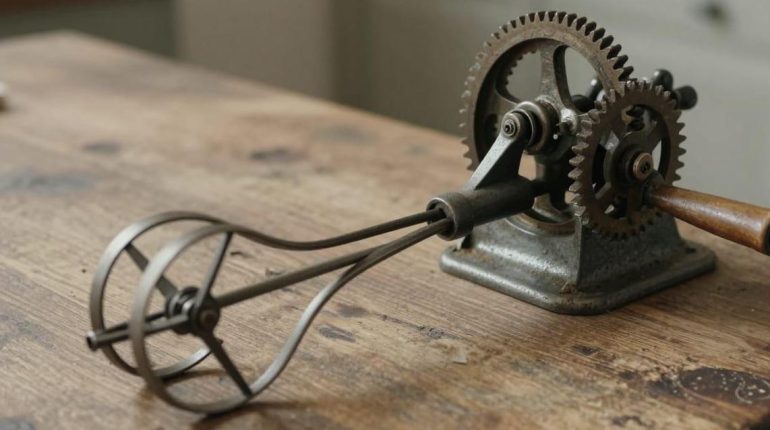
A simple photograph was enough to trigger a wave of collective curiosity. The image showed a rusty, enigmatic object: a crank connected to two rotating metal arms by a system of visible gears. No cables, no buttons, just raw mechanical ingenuity. Thousands of internet users immediately wondered: agricultural equipment? Medical instrument? Vestige of a vanished trade?
Speculations multiplied for hours. Some mentioned a 19th-century industrial tool, others leaned toward a forgotten scientific device. The design oscillated between obvious functionality and mysterious use, captivating as much by its form as by its strangeness.
The revelation surprised everyone: it was a mechanical egg beater, the direct ancestor of the modern electric mixer. What had started as a guessing game transformed into a collective reflection on domestic history. Comments poured in: memories of grandparents owning similar tools, astonishment at the physical effort that cooking once required.
The object became much more than a curiosity. It now embodied the invisible work behind daily gestures, those discrete innovations that shaped homes without ever making headlines. A collective amnesia had just been lifted, reminding us that modern comfort rests on centuries of struggle to lighten the burden of domestic labor.
Kitchens Before the Mechanical Revolution: Invisible and Exhausting Work
This collective surprise reveals how much we have forgotten the physical reality of kitchens of the past. Before the 1850s, preparing a meal mobilized considerable energy, far beyond what we imagine today.
All mixing was done manually. Massive wooden spoons, robust forks, rudimentary metal whisks: this was the available arsenal. Obtaining a smooth cake batter or stiff egg whites required fifteen to twenty minutes of sustained effort. The arm had to maintain a constant rhythm, without weakening, at the risk of compromising the final texture.
This laborious task remained invisible, undervalued despite its essential nature. Kneading bread, beating eggs for a sponge cake, emulsifying a sauce: so many repetitive gestures that structured the days, particularly those of women and domestic staff. In large houses or commercial kitchens, the burden became overwhelming. Some domestic workers spent hours every day preparing doughs and mixtures.
The rise of pastry-making in the 19th century accentuated this problem. Recipes became more refined, demanding airier textures and more stable emulsions. Culinary complexity progressed, but tools remained primitive. The gap between gastronomic ambition and physical capacity widened dangerously.
It was in this tension between the desire to create and physical exhaustion that a solution would emerge, driven by inventors aware that cooking deserved better than simple muscular endurance.
1856: The Invention That Transformed Kitchens Forever
This tension would find its resolution thanks to a man whose name remains largely unknown: Ralph Collier. In 1856, this inventor filed the patent for a revolutionary device: the first functional mechanical egg beater.
Its mechanism relied on an ingenious principle. A crank operated a system of gears that multiplied the force exerted, transforming a simple rotary motion into the rapid rotation of two metal whisks. The user turned the handle at a moderate speed while the beaters whirled several times faster, reproducing and amplifying the human gesture with unprecedented efficiency.
The impact was immediate in the homes that adopted the tool. A task requiring twenty minutes of intense effort was now completed in five minutes, without exhaustion. Egg whites rose with a regularity impossible to achieve manually. Batters gained homogeneity. This innovation was not a superfluous luxury: it responded to decades of crushing daily labor.
Collier was not alone. Other inventors quickly perfected the concept, adding variations and improvements. But his patent marks the decisive turning point: domestic mechanization ceased to be a chimera and became a concrete reality.
This technological breakthrough heralded a broader transformation, that of ordinary objects destined to silently rewrite the history of daily life.
When Ordinary Objects Tell the Extraordinary Story of Progress
This silent transformation of the mechanical beater illustrates a broader phenomenon: kitchens are time capsules. Within their walls coexist inventions that have revolutionized food, domestic work, and family dynamics without ever claiming particular glory.
Refrigeration redefined food safety and home supply. Ovens transformed culinary practices. Seemingly banal tools like peelers, graters, or whisks refined efficiency through successive touches, each improvement imperceptibly lightening the daily burden.
Unlike spectacular industrial breakthroughs, these domestic innovations emerge from repetitive exhaustion rather than spectacle. Their impact remains deeply personal: they shape routines, traditions, and relationships. When the photo of the rusty beater circulated online, many internet users spontaneously evoked memories: grandparents handling these cranks, gestures passed down from generation to generation, objects carefully preserved despite technical obsolescence.
The viral object turned into a symbol of the invisible work hidden behind modern comfort. Each familiar appliance embodies centuries of struggle to lighten once-overwhelming tasks. This collective awareness reminds us that progress is not measured only by major publicized inventions, but also by the hundreds of simplified gestures that, added together, have freed up time, energy, and opened up unsuspected possibilities.