📌 Fish Scotch Eggs: The seafood and quail egg version that reinvents the British appetizer
Posted 21 February 2026 by: Admin
A Refined Franco-British Fusion Recipe
The scotch egg, that traditional British ball consisting of a hard-boiled egg wrapped in sausage meat, undergoes an unexpected reinterpretation here that propels it to the heights of gastronomy. Exit the meat: make way for cod or whiting, enhanced by Scottish scallops. This seafood version radically transforms the DNA of classic pub food into an exceptional bite worthy of refined tables.
The audacity lies in the choice of quail eggs, which replace chicken eggs to create miniature portions of formidable elegance. Each bite thus becomes a concentrate of delicacy, perfectly calibrated for the aperitif. The creamy texture of the white fish contrasts with the runny heart of the egg, while the crispy breading provides the essential crunch.
The accompaniment plays the consistency card: a herb mayonnaise or Béarnaise style sauce extends this Franco-British fusion. The 12-piece format is the perfect ally for receptions where you want to impress without sacrificing conviviality. This creation bears witness to an often overlooked culinary truth: the best innovations are born from the dialogue between apparently incompatible traditions.
Preparing the Stuffing: The Balance Between Sea and Creaminess
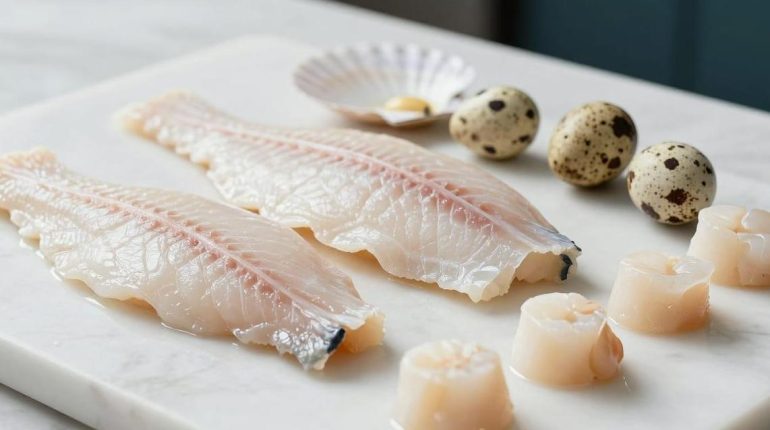
This marine alchemy relies on a precise dosage: 100g of white fish alongside 40g of Scottish scallops. The cod or whiting, previously cooked, must imperatively cool completely before being blended with the scallops. This cooling step is non-negotiable: it conditions the final texture, preventing residual heat from causing the emulsion to turn during blending.
The food processor transforms these noble meats into a preparation of perfect homogeneity. The addition of an egg white acts as a structural binder, while 5cl of thick crème fraîche brings that characteristic softness that will delicately coat the quail egg. This creaminess contrasts with the natural firmness of the seafood, creating a stuffing that can be worked without crumbling.
The seasoning is measured but decisive: a pinch of salt reveals the iodized sweetness, while Espelette pepper introduces that subtle hint of heat that awakens the whole without ever dominating. This silky stuffing, the true beating heart of the recipe, must now wrap each quail egg with precision. The success of the coating will determine the final balance between external crunch and internal melting.
The Three-Step Breading Technique
Once the stuffing is mastered, the breading process resembles an immutable culinary ritual, the very one that transforms the simple into the exceptional. Each quail egg coated in its marine shell passes through three successive baths, according to a logic as old as it is effective: flour, beaten eggs, breadcrumbs.
The flour constitutes the first barrier, slightly drying the surface to guarantee adhesion. The two beaten eggs then form that sticky layer indispensable, true ambassadors of cohesion between stuffing and final coating. This is where the difference is made: traditional fine breadcrumbs offer a tight and golden crust, while Japanese panko, with its irregular flakes, promises a crispy, airy, almost soufflé-like texture.
Frying in a neutral oil brought to optimal temperature suffers no approximation. Three minutes are enough to metamorphose these bites into golden jewels, their heart remaining tender while the exterior cracks under the tooth. This brevity of execution contrasts with the meticulous preparation: a balance typical of haute cuisine, where every second counts. The white vinegar, discreetly integrated into the preparation, brings that imperceptible acidity which reveals the marine flavors without ever imposing itself. These scotch eggs now await their final setting: a herb mayonnaise that will complete the experience.
Time and Organization: An Accessible Recipe
Thirty minutes of preparation for twelve exceptional bites: this ratio defies the usual codes of refined gastronomy. Where some culinary creations require hours of labor, these fish scotch eggs fit into a mastered, almost domesticated temporality. The cooking itself only mobilizes three minutes of intense vigilance, that fleeting moment when the bubbling oil operates its golden transformation.
This efficiency relies on methodical organization: cooking and cooling the fish beforehand, quick blending of the stuffing, coating the quail eggs according to the established protocol. Each step follows naturally, without downtime or superfluous complexity. The white vinegar, discreet but essential, integrates into the preparation without lengthening the process, adding that tangy touch which balances the marine creaminess.
The final service consecrates this philosophy of accessibility: a herb or Béarnaise mayonnaise, prepared in advance or store-bought, accompanies these bites without imposing additional constraints. Thirty-three minutes flat to host with elegance, to impress without exhausting oneself. This fusion recipe demonstrates that sophistication and practicality are not opposites, but dialogue, provided one accepts to rethink the traditional balances between time invested and result obtained.