📌 Family economy: this 5-ingredient stew fed families in times of crisis
Posted 23 February 2026 by: Admin
The Survival Recipe That Fed a Generation
This family recipe passed down by a grandfather who lived through difficult times embodies the economic resilience of families faced with the necessity of feeding their own with limited resources. Poor Man’s Stew represents much more than a simple stew: it bears witness to an era when every dollar counted and when culinary ingenuity allowed five basic ingredients to be transformed into a substantial meal for six people.
The minimalist composition of this dish reveals a proven domestic strategy. No exotic spices, no rare vegetables, only products available in any neighborhood grocery store: ground beef, potatoes, carrots, onion, and tomato sauce. This pragmatic approach guaranteed that the meal remained preparable even when the family budget reached its limits.
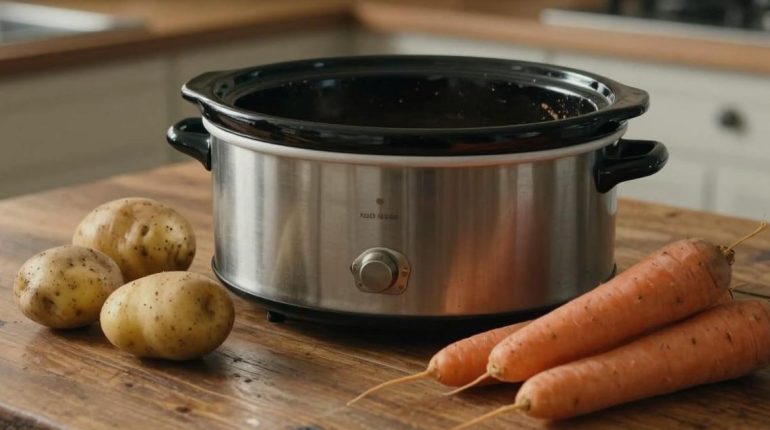
The use of the slow cooker adds an additional economic dimension. This slow cooking allows preparation to start in the morning and results in a hot dish in the evening, without constant supervision or excessive energy consumption. A perfect solution for families where every member contributed to the collective income and where no one could afford to spend hours at the stove.
This recipe inherited from times of crisis remains fully relevant today thanks to its exceptional value for money, proving that lessons in frugality cross generations without losing their effectiveness.
Strategic Ingredients for a Domestic Economy
This economy of means relies on a shopping list designed to maximize nutritional intake without waste. The 80-85% lean ground beef constitutes the unique protein source of the dish, a choice that is not insignificant: this percentage of lean meat retains just enough fat to develop flavor during browning while limiting costs, unlike leaner meats sold at premium prices.
The four russet potatoes and four medium carrots form the substantial base of the stew. These root vegetables, among the cheapest per kilo, swell during cooking and transform one pound of meat into six generous portions. Their nutritional density compensates for the modesty of the initial investment.
The yellow onion and two 15-ounce cans of tomato sauce complete the arsenal. No superfluous ingredients, no decorative elements: each component plays a precise nutritional role. The tomato sauce provides the acidity that tenderizes the meat and vegetables, while the onion delivers its natural sweetness over the hours of cooking.
This rigorous selection illustrates a timeless truth: economic cooking does not mean deprivation, but rational optimization of available resources. Every dollar spent translates directly into substance and flavor, without detours through costly artifices.
The Cooking Technique That Transforms Simple Into Substantial
The success of this stew depends less on the ingredients than on the method that metamorphoses them. The initial browning of the ground beef for 6 to 8 minutes over medium-high heat is the first critical step: this rapid caramelization develops the Maillard compounds that anchor the aromatic depth of the dish. Excess fat is removed with a spoon, leaving only a thin film to carry the flavors.
The layered arrangement reveals a precise thermal logic. The vegetables occupy the bottom of the slow cooker where the heat concentrates, ensuring their complete cooking. The browned meat covers them uniformly, guaranteeing every portion served. The tomato sauce crowns the whole without water dilution, a vital detail often overlooked.
During slow cooking, the potatoes and carrots release their natural moisture, creating a concentrated broth that the tomato sauce progressively thickens into a creamy and rich sauce. This chemical transformation occurs without intervention, as the slow cooker maintains a constant temperature that tenderizes the fibers without disintegrating them.
One or two delicate stirs are enough, just enough to mix the sauce with the lower layers without breaking the potato cubes. This restraint preserves the distinct texture of each vegetable while allowing the flavors to merge harmoniously. The final result far exceeds the sum of its modest components.
Final Assembly for Optimal Cooking
The 5 to 6-quart slow cooker is not chosen at random: this precise volume allows the ingredients to stack without excessive compression, ensuring homogeneous thermal circulation. The vegetables spread in a uniform layer at the bottom capture the rising heat, while the browned meat is methodically distributed on top, guaranteeing each portion its quota of protein without unbalanced zones.
The tomato sauce poured in a steady stream coats the whole in a protective veil that will seal the flavors during the hours to come. Contrary to classic culinary reflexes, no water interferes with this process: the natural moisture of the vegetables will be more than enough to create the necessary broth.
The minimal mixing, only one or two circular movements, aims for a delicate balance. Just enough sauce must be drawn toward the lower layers so that it permeates the meat and vegetables, without breaking the potato cubes which are still firm. This restraint distinguishes the rustic but structured stew from a formless mush.
Once the strategic layering is complete, the lid closes on a pre-programmed alchemy. The following hours will silently transform these ordinary ingredients into a comforting dish, while daily life continues around the slow cooker. The simplicity of the assembly hides a thermal sophistication that asks for only one thing: time.