📌 Failed potatoes: why high temperature creates this half-raw, half-mushy texture
Posted 22 February 2026 by: Admin
Technical Causes Of Cooking Imbalance
When a potato has a decomposed exterior while its core remains firm, the culprit reveals itself to be a brutal thermal imbalance. Excessive heat causes accelerated cooking of the surface, whose cells disintegrate rapidly, while the temperature struggles to penetrate the density of the tuber.
The very structure of the potato explains this difficulty. Full of starch and particularly compact, it requires a prolonged cooking time to allow the heat to progress to the center. Under the effect of too high a temperature, the water contained in the outer layers evaporates prematurely. Yet this moisture plays a crucial role: transformed into steam, it should normally cook the tuber from the inside. Its early disappearance condemns the core to remain raw.
The phenomenon intensifies with the intensity of the heat. The more aggressive the heat source, the wider the gap between a crumbling periphery and an intact core. The external cellular structure, subjected to a violent thermal assault, loses its cohesion long before the temperature reaches the center. This unbalanced progression of heat is the root of the problem, transforming what should be uniform cooking into a disappointing two-speed result.
The Cutting Error That Ruins Everything
Beyond temperature issues, an insidious error regularly sabotages cooking: uneven pieces. When potatoes are cut without respecting a uniform size, each fragment follows its own cooking rhythm. Small cubes quickly reach their disintegration point while large blocks still require long minutes for the heat to reach their core.
This time lag creates an inextricable situation. Either you remove the pot from the heat preserving the integrity of the large pieces, and you get mini-cubes turned into mush. Or you wait until the voluminous pieces are finally cooked, condemning the small ones to total disintegration. In both cases, the hoped-for homogeneity vanishes.
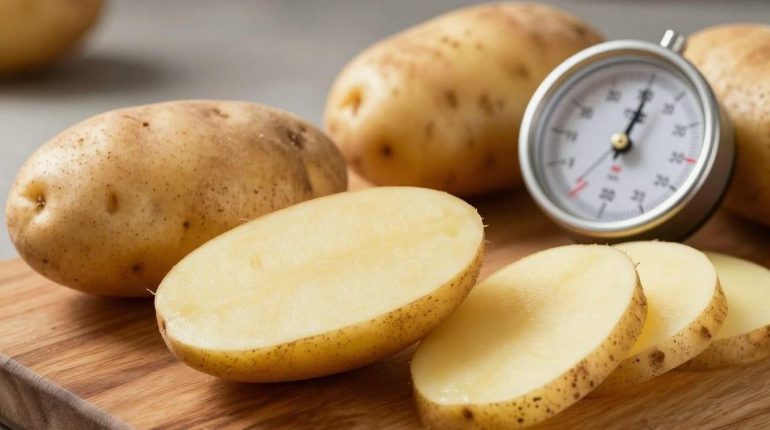
The solution lies in meticulous cutting. For a successful mash, aim for 2.5-centimeter cubes, measured with precision. This regularity guarantees that each piece will absorb heat at the same rate, eliminating the frustrating contrast between overcooked and undercooked elements. Uniformity is not an aesthetic detail: it is the technical foundation of a consistent texture. Without this cutting discipline, even a perfectly controlled temperature will not be enough to correct the imbalance. The geometry of your pieces directly determines the success of your preparation.
Varietal Choice: A Decisive Parameter
But even with irreproachable cutting, the problem persists if the selected variety does not match your cooking method. Not all potatoes are equal: their starch content dictates their behavior towards heat. Russets, rich in starch, develop an airy texture ideal for mashes and fries, but this lightness hides a fragility. Subjected to prolonged cooking, they disintegrate, their cellular structure giving way long before the core reaches the right temperature.
Conversely, waxy varieties like Red Bliss or Yukon Gold contain less starch and more moisture. Their dense flesh resists boiling better, keeping its shape even after long minutes in boiling water. This resilience makes them perfect for salads or stews, where the integrity of the piece matters as much as its cooking.
Using a Russet for a dish requiring sustained boiling condemns the exterior to liquefy while the interior remains firm. Conversely, trying to mash a waxy variety requires forceful crushing that produces a sticky paste rather than a velvety texture. Each variety has its optimal function, and ignoring this specificity transforms cooking into a battle lost in advance. Before lighting the fire, identify your tuber: this knowledge determines whether your dish will reach excellence or sink into textural inconsistency.
The Cooking Start Method
Once this varietal knowledge is acquired, there remains a technique that still escapes many cooks: the thermal starting point. Plunging your potatoes directly into boiling water seems intuitive, yet this approach creates precisely the dreaded imbalance. The exterior immediately undergoes a violent thermal shock, its structure begins to decompose while the heat progresses slowly towards the center, millimeter by millimeter.
Conversely, starting with cold water allows for a gradual and uniform temperature rise. The tubers heat up gradually with the liquid, the heat penetrates harmoniously from the surface to the core. This synchronized thermal rise ensures that each layer of the vegetable reaches its optimal cooking point simultaneously, eliminating the contrast between a disintegrated periphery and a raw center.
This difference is not a negligible technical detail. It is the line of demarcation between success and failure. Experienced cooks know it: for whole potatoes or large pieces, cold water is systematically required. Boiling water is only suitable for thin cuts requiring fast cooking, like certain pre-cooked sautéed preparations. Adopting the right thermal start radically transforms your results, without extra effort or special equipment.