📌 Emmentaler AOP Quesadillas: the two-layer cheese technique for an ultra-melting result
Posted 8 March 2026 by: Admin
The Foundations Of The Recipe: A Colorful Vegetable Base
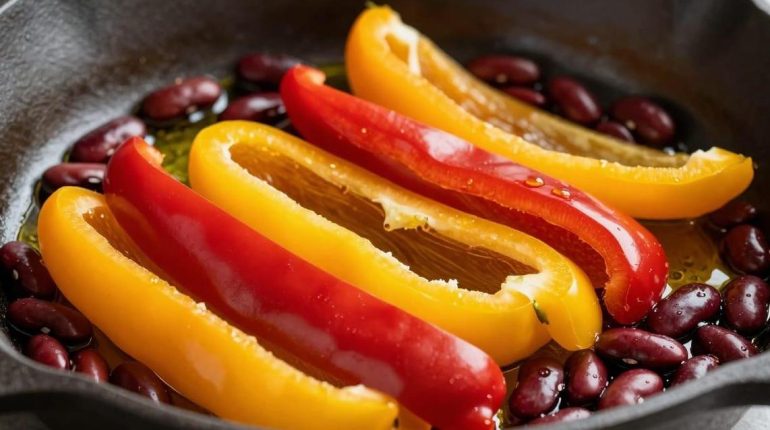
This quesadilla begins with an aromatic base that determines its entire taste personality. Sliced onion and peppers cut into fine strips form the essential vegetable duo, sautéed for 8 to 10 minutes in olive oil until the flavors concentrate and the textures soften without falling apart.
Seasoning happens at a strategic moment: salt, pepper, and paprika reveal the natural sweet notes of the peppers while the kidney beans bring their creamy consistency and protein richness. This pepper-legume combination creates a fundamental contrast of textures: the crunch of the colored strips responds to the softness of the beans.
This vegetable base is not just a simple filling. It constitutes the identity heart of the quesadilla, the one that dialogues with the Swiss Emmentaler AOP and transforms this dish into a balanced experience rather than a simple cheese sandwich. Timed cooking ensures that each ingredient retains its character while harmonizing with the others, thus preparing the ideal base to welcome the cheese that will bind everything together.
Strategic Assembly: The Double Cheese Technique
Once the filling is ready, the decisive step begins that distinguishes a successful quesadilla from a simple filled tortilla. The first tortilla joins a already hot pan, a neutral surface on which a methodical stratification will take place.
Swiss Emmentaler AOP appears first, sprinkled directly onto the tortilla. This initial layer is not trivial: it creates a melting base that will trap the pepper and kidney bean filling. Then comes the second layer of cheese, placed on the vegetables, which guarantees a homogeneous fusion and keeps each ingredient in its place during the flip.
This double cheese envelope transforms the assembly into a coherent structure. When the second tortilla comes to top it all off, it doesn’t just close it: it seals an ecosystem where heat and pressure will allow the Emmentaler to migrate between the layers, physically and tastefully binding each component. The cheese becomes the cohesive agent, the one that transforms distinct elements into an inseparable whole.
This closed sandwich technique requires no sophisticated utensils, just an understanding of the structural role of cheese in the final architecture of the dish.
Mastered Cooking: The Secret To Perfectly Melted Cheese
Thermal control now becomes the only variable between success and disappointment. The pan, already hot, welcomes the assembly over medium heat, that intermediate zone where the tortilla browns without charring and where the Swiss Emmentaler AOP has the necessary time to melt homogeneously.
Three to four minutes per side: this precise timer is not arbitrary. It is the exact threshold where the heat passes through the layers, progressively liquefies the cheese and transforms the surface into a slightly crispy crust. Too short, and the Emmentaler remains frozen between the tortillas. Too long, and the bottom burns while the heart refuses to give in.
Visual monitoring is essential: observe the edges starting to brown, detect the slight lateral expansion of the cheese shyly escaping, smell the characteristic nutty scent of heated Emmentaler. The flip, executed with firmness, reveals a first golden side. Four additional minutes are enough to complete the transformation.
Once removed from the heat, the quesadilla is cut into regular triangles. This simple geometry facilitates handling and exposes, at each slice, the inner layers where the melted cheese still traps the steaming filling.
Complete Service: The Art Of Accompaniment
The cut triangles are not an end in themselves, but the starting point of a plate composition where each element dialogues with the others. The quesadilla, still warm, releases its milky and smoky aromas while the green salad brings freshness and crunch, counterbalancing the richness of the melted cheese.
The duo of sauces radically transforms the experience. The tomato salsa, slightly spicy, wakes up the palate with its lively acidity and its touch of controlled heat. It contrasts with the creaminess of the Swiss Emmentaler AOP, creating a game of contrasts where the spice stimulates without dominating. In addition, the yogurt-lemon sauce introduces a cold and tangy dimension that refreshes between two bites and cleanses the palate.
This orchestration of accompaniments is not superfluous: it structures the meal, avoids taste saturation and prolongs the pleasure. Each triangle can be dipped alternately in one or the other sauce, or consumed plain between two salad leaves. The balance of hot-cold, creamy-crunchy, mild-spicy makes this quesadilla much more than a simple filled tortilla.
The final plate tells a complete story, where the melted cheese remains the star while accepting that other flavors enrich its narrative.