📌 Egg salad: why chopping by hand rather than mashing changes everything according to chefs
Posted 7 February 2026 by: Admin
The Errors That Ruin Classic Egg Salad
Most egg salads fail before they even reach the plate. Too much mayonnaise turns the mixture into a greasy mush. Not enough, and the texture becomes dry, almost grainy. In between? A balance that is almost impossible to achieve without a precise method.
The real drama unfolds in the pot. Those egg yolks marked with a gray-green ring betray excessive cooking. This discoloration is not just aesthetic: it is accompanied by a sulfurous smell and a bitterness that sabotage the whole dish. Yet, millions of cooks repeat this mistake daily, for lack of knowing the exact timing.
Texture poses another challenge. Mashing eggs with a fork produces a sticky paste, devoid of character. Conversely, pieces that are too large create an unsightly assembly where mayonnaise and eggs refuse to merge. This textural inconsistency turns every bite into a culinary lottery.
The lack of depth in flavors completes the massacre. Without acidity to cut through the fat, without aromatics to awaken the taste buds, without that little something unexpected, egg salad becomes a bland and one-dimensional experience. A waste of simple ingredients that deserved much better.
The secret? It lies not in exotic ingredients, but in an impeccable technique that corrects each of these systematic flaws.
The Foolproof Technique For Perfectly Cooked Eggs
That greenish ring that haunts so many preparations disappears thanks to a timed gentle cooking method. Place the eggs in a pot, cover them with an inch of cold water, then bring to a full boil. At the first signs of boiling, immediately remove from heat, cover, and let rest for exactly 9 to 10 minutes.
This controlled rest changes everything. The residual heat cooks the whites to perfection without turning the yolks into hardened rubber. After this precise time, plunge the eggs into an ice water bath for at least 5 minutes. This thermal shock instantly stops the internal cooking which, otherwise, would continue to attack the yolks even off the heat.
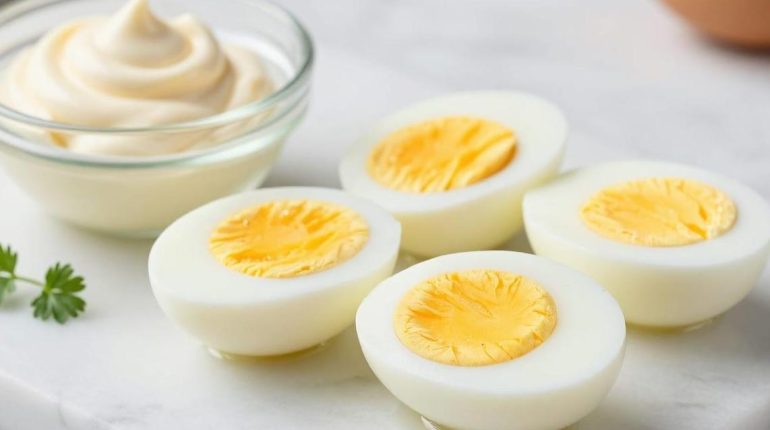
The result: bright yellow, creamy yolks, without the slightest grayish trace or that sulfur smell characteristic of mistreated eggs. This vibrant color not only indicates mastered cooking but also guarantees a pure flavor, free of any residual bitterness.
Peeling then becomes child’s play. Tap each egg on the counter, roll it gently to crack the shell uniformly, then peel under a stream of cool water. The membrane detaches without resistance, revealing smooth and intact whites.
This impeccable base constitutes the indispensable foundation. Without it, no seasoning will save your egg salad from the limbo of mediocrity.
The Strategic Assembly That Makes All The Difference
These perfectly cooked eggs will only reveal their potential if you follow one golden rule: chop them with a knife, never with a fork or a food processor. Mechanical mashing breaks cell membranes, releases excessive moisture, and turns your preparation into a sticky mush. Manual chopping preserves textured pieces that create that contrast between creaminess and structure.
Carefully dry the eggs after peeling, then cut them into irregular cubes of about half a centimeter. In a medium bowl, gently fold in 80 grams of full-fat mayonnaise, a teaspoon of Dijon mustard, and the juice of half a fresh lemon. This trinity creates the creamy emulsion that coats without drowning.
Then add 40 grams of finely chopped celery for crunch, two tablespoons of red onion or shallot for liveliness, one tablespoon of fresh dill or chives, and half a teaspoon of smoked paprika. This last ingredient brings that warm depth that distinguishes a mundane preparation from a thoughtful creation.
Fold the whole thing with a flexible spatula, in only three or four movements. Intentional under-mixing maintains pockets of varied texture that pleasantly surprise with every bite. Salt, pepper, taste. Adjust with caution: more lemon for freshness, more paprika for smoky heat, never more mayonnaise.
This methodical approach transforms ordinary ingredients into a balanced composition where each element plays its role without dominating the others.
The Resting Time That Reveals The True Flavor
This balanced composition still hides its potential. Cover the bowl tightly and refrigerate for at least thirty minutes before serving. This seemingly incidental lapse triggers an essential chemical transformation: the flavors fuse, the acidity of the lemon softens as it integrates with the lipids, the paprika diffuses its smoky heat into the emulsion, the onion loses its aggressiveness while retaining its character.
The cold also firms up the texture without hardening it, creating that creamy density that adheres to the bread without running. Many culinary preparations decline after cooling; egg salad does the opposite. Every hour spent in the refrigerator intensifies the gustatory cohesion, up to a maximum of forty-eight hours.
At the moment of serving, mix gently one last time and sprinkle with a pinch of fresh paprika or chopped herbs. Versatility then becomes your asset: spread on toasted rye bread for a substantial sandwich, slide a generous spoonful into a split croissant for an elegant brunch, or place in butter lettuce leaves for a low-carb version. It works just as well as a dip with sesame crackers or raw vegetable sticks.
This fifteen-minute preparation surpasses any takeout dish in freshness, ingredient control, and quality-to-time ratio. It keeps for three days in the refrigerator, making meal prep not only practical but strategic for anticipating rushed lunches and improvised picnics.