π Dried Fruit and Spice Cake
Posted 15 April 2026 by: Admin
Dried fruit cakes are one of the most polarizing recipes out there. It’s either a dense brick that sits heavy on the stomach, or something incredibly moist with aromas that intensify over the days. The difference between the two often comes down to a single poorly executed step.
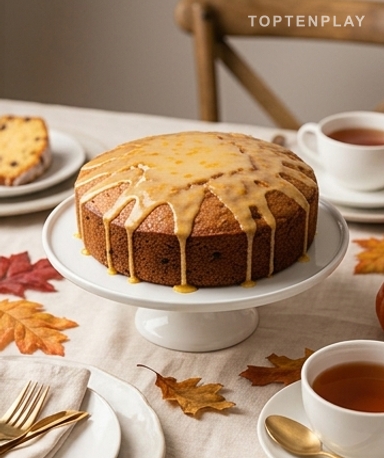
Take it out of the oven and wait two minutes. The scent hits first — warm cinnamon, a hint of nutmeg, that slightly caramelized undertone rising from the pan. The crust takes on a golden brown hue, like light gingerbread, with a few fruits peeking through the surface, already glistening. When you cut the first slice, the crumb reveals itself as dense but not heavy, punctuated by pieces of melting fruit and nuts that crunch slightly under the knife. And the icing drips into the cracks, just liquid enough to seep everywhere.
Why you’ll love this recipe
Ingredient Notes
All ingredients gathered: dried fruits, pecans, warm spices, and unsalted butter for a cake full of character.
- Buttermilk : This is what gives it that characteristic moisture. It reacts with the baking soda to create small bubbles in the batter — the result: a slightly airy texture, never compact. Don’t have any? Pour a splash of lemon juice into regular milk and wait five minutes. It works exactly the same way.
- Mixed dried fruits : Raisins, apricots, cranberries, dates — use what you have. The essential trick: coat them in two tablespoons of flour before incorporating them. Without this, they all sink to the bottom and you’re left with a plain cake topped with a layer of stuck fruit. The flour suspends them in the batter throughout the baking process.
- Softened butter — not melted : The nuance is important. Softened means out of the fridge for at least an hour, soft enough that a finger leaves an imprint without effort. Melted is too liquid and you lose the creamy texture that aerates the batter. If you forgot to take it out, cut it into cubes and microwave for 10 seconds — just to soften, not to melt.
- The spice blend : Cinnamon in the lead, nutmeg as support, cloves in the background. Don’t rebalance according to your mood without thinking. If you double the cloves, the cake will have a rather unpleasant medicinal taste. Stick to the given proportions — they are calibrated to stay warm without being aggressive.
The part everyone rushes: creaming the butter
This is the step that gets skipped too quickly. Beating the softened butter with the sugar really takes three to four minutes with an electric mixer — not thirty seconds. The mixture should go from a dense yellow paste to something almost white and light, falling back in ribbons when you lift the whisk. This change in texture is air being incorporated. That air is what makes the difference between a moist cake and a compact brick. Take the time.
Alternating dry ingredients and milk — without getting worked up
Once the eggs are incorporated one by one, add the dry ingredients and buttermilk alternately. Not all at once. Start with a third of the powders, then half of the milk, another third of the powders, the rest of the milk, and finish with the powders. This back-and-forth prevents overloading the batter and limits gluten development — less gluten means less density. Mix with a spatula, stop as soon as it’s homogeneous. Still see a few streaks? No big deal. They disappear on their own during baking.
Seventy minutes in the oven, but keep an eye out
Place the pan in the center of the oven, not too high. Every oven is different, and this truth applies particularly to dense cakes like this one. Around 50 minutes, take a look: if the top is browning too fast, cover it loosely with a piece of aluminum foil. When the spices slightly caramelize on the surface and the smell changes notes — less raw, deeper — you’re close. But don’t rely on smell alone. The toothpick remains your best ally: it should come out dry, maybe with a crumb, never with raw batter.
The icing: quick, but not haphazardly
Wait until the cake is completely cold before icing. Completely. Not lukewarm. On a lukewarm cake, the icing disappears into the batter and you’re left with a sticky surface and no visual finish. The right icing drips slowly from the spoon in a continuous, shiny ribbon — if too thick, add milk by the teaspoon; if too liquid, add powdered sugar. Orange juice instead of milk gives a slightly acidic result that contrasts well with the warmth of the spices. It’s my favorite version.
Tips & Tricks
- Take the butter and eggs out of the fridge an hour before — not out of habit, but because cold butter won’t cream and cold eggs will curdle the butter-sugar mixture when incorporated.
- Flour your dried fruits in a separate bowl, not directly in the batter — you control the amount better and ensure every piece is well coated before adding.
- If you have time, wrap the cooled cake in plastic wrap and wait 24 hours before serving. The flavors concentrate, the spices meld better into the crumb, and the texture becomes more velvety.
Why do my dried fruits all fall to the bottom of the cake?
It’s the classic problem. Before incorporating them into the batter, coat them in two tablespoons of flour in a separate bowl — this layer creates a slight grip that keeps them suspended during baking. Also make sure your batter isn’t too liquid, otherwise even the flour won’t be enough.
Can I replace buttermilk if I can’t find any?
Yes, no problem. Pour a tablespoon of lemon juice or white vinegar into 120 ml of whole milk, stir and wait 5 minutes — the milk will slightly curdle and mimic the acidity of buttermilk. The result is identical in the batter.
How to store the cake and for how long?
At room temperature, wrapped in plastic wrap, it keeps for 3 to 4 days. In the refrigerator, a week without issue. The cake is better the day after it’s made: the spices meld more into the crumb and the texture becomes more velvety.
Can I freeze this cake?
Absolutely. Slice it before freezing and wrap each slice individually in plastic wrap, then in a freezer bag. It keeps for up to 2 months. To thaw, take the slices out into the fridge overnight or at room temperature for 1 to 2 hours.
My cake is raw in the center but golden on the surface — what should I do?
Cover the top with aluminum foil and extend the baking time in 10-minute increments, testing with a toothpick each time. This often happens when the oven heats too strongly on the surface: the foil protects the crust and allows the heat to penetrate the heart of the cake.
Can I adapt the dried fruits and nuts to my taste?
Yes, the recipe is very flexible. Dried apricots, cranberries, sultanas, chopped dates, figs — everything works. For nuts, classic walnuts, pecans, or hazelnuts are all good. Avoid fruits that are too wet, like whole prunes, which risk weighing down the batter.
Dried Fruit and Spice Cake
French
Dessert
A moist and deeply aromatic cake, filled with dried fruits and nuts, topped with a delicate orange glaze. A comforting classic that improves with time.
Ingredients
- 225g (1 cup) softened unsalted butter
- 200g (1 cup) sugar
- 4 room temperature eggs
- 1 tsp vanilla extract
- 310g (2 ½ cups) flour (+ 2 tbsp for the fruit)
- 1 tsp baking powder
- ½ tsp baking soda
- ½ tsp salt
- 1 tsp ground cinnamon
- ½ tsp ground nutmeg
- ¼ tsp ground cloves
- 120ml (½ cup) buttermilk (or milk + 1 tbsp lemon juice)
- 180g (1 ½ cups) mixed dried fruits (raisins, apricots, cranberries)
- 90g (¾ cup) walnuts or pecans, coarsely chopped
- 180g (1 ½ cups) powdered sugar
- 2 to 3 tbsp milk or orange juice
- ½ tsp vanilla extract (optional, for the icing)
Instructions
- 1Preheat the oven to 160°C. Grease and flour a 22 cm round pan or a loaf pan, then line the bottom with parchment paper.
- 2In a bowl, mix the flour, baking powder, baking soda, salt, cinnamon, nutmeg, and cloves. Set aside.
- 3In a large bowl, beat the softened butter with the sugar using an electric mixer for 3 to 4 minutes until the mixture is pale, light, and fluffy.
- 4Incorporate the eggs one by one, mixing well between each addition, then add the vanilla.
- 5In a separate bowl, coat the dried fruits and nuts with 2 tablespoons of flour taken from the total amount.
- 6Alternate adding the dry ingredients (in 3 parts) and the buttermilk (in 2 parts) into the butter-egg mixture. Mix with a spatula without overworking the batter.
- 7Gently fold in the floured fruits and nuts.
- 8Pour the batter into the pan and bake for 60 to 75 minutes (round pan) or 70 to 85 minutes (loaf pan). Cover with foil if the top browns too quickly.
- 9Check for doneness with a toothpick — it should come out dry. Let cool for 15 to 20 minutes in the pan, then unmold onto a wire rack.
- 10Mix the powdered sugar with the milk or orange juice until you get a fluid icing. Pour over the completely cooled cake and let rest for 15 minutes before serving.
Notes
• The cake is better the next day: wrap it in plastic wrap as soon as it’s cooled and let it rest overnight at room temperature — the flavors concentrate and the texture improves.
• Storage: 3 to 4 days at room temperature, up to 1 week in the refrigerator well-wrapped, or 2 months in the freezer in individual slices.
• Variation: add the zest of an orange to the batter and use orange juice for the icing — it brings a tangy note that balances the richness of the spices.
Nutrition Facts (per serving, estimated)
| 520 kcalCalories | 7gProtein | 75gCarbs | 22gFat |