📌 Dirty oven window: the baking soda-white vinegar duo is enough to make it shine without chemicals
Posted 3 March 2026 by: Admin
The Problem We All Know: An Impossible-to-Clean Oven Window
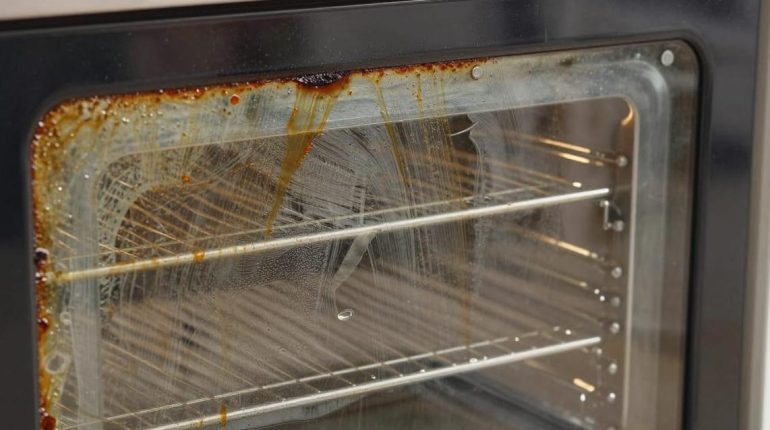
You scrub, you spray, you start over. Yet, your oven window remains desperately opaque, streaked with brownish marks that seem permanently encrusted. This frustrating observation affects millions of households: despite all efforts, the glass never regains its original transparency.
The culprits are multiple and act in synergy. An overflowing gratin, a splashing sauce, a juicy roast that crackles: every cooking session leaves its signature on the glass wall. Under the effect of intense heat, these splatters dry instantly, calcify, and adhere to the glass with formidable tenacity. The more you cook, the more the layers stack up, progressively transforming the window into an almost translucent surface.
But the real trap lies elsewhere. Your oven door hides an architectural secret: it generally consists of two glass panes separated by a narrow space. This insulating structure traps dirt between the walls, where no sponge can reach it. Result: even after a meticulous cleaning of the external surface, streaks persist on the inside, visible but inaccessible.
This progressive accumulation is not a fatality linked to your housekeeping habits. It is simply the mechanical consequence of normal use, amplified by a design that naturally complicates maintenance.
Chemical Products vs. Natural Solutions: The Real Match
Faced with this stubbornly dirty window, the reflex is tempting: grab a super-powerful industrial cleaner, the one that promises wonders on its packaging. Supermarkets are full of these bottles with “revolutionary” formulas supposed to instantly dissolve the most stubborn grease. However, raw power is not synonymous with lasting effectiveness.
These commercial products have major disadvantages that are often underestimated. Their aggressive composition releases chemical vapors that persist long after application, requiring long ventilation of the room. Their extreme pH requires meticulous rinsing to avoid potentially harmful residues in contact with food. Not to mention their substantial cost and environmental impact.
The natural alternative disrupts this equation. Baking soda and white vinegar, those basic ingredients stored in your cupboards forever, deploy comparable effectiveness without the inconveniences. Their action is based on a simple but formidable chemical reaction: baking soda (alkaline) combined with vinegar (acid) creates an effervescence that mechanically lifts dirt while dissolving cooked-on grease.
This natural approach simply requires mastering the application technique. Unlike commercial sprays that rely on immediate ease, it requires a few minutes of preparation. But this slight constraint becomes negligible compared to the savings made, the total absence of toxicity, and the spectacular results obtained with products already present in your home.
The Magic Formula: Baking Soda and White Vinegar
Let’s get practical with this proven recipe that will transform your oven window into a mirror. In a container, pour 4 to 5 tablespoons of baking soda. Gradually add white vinegar while stirring until you obtain a creamy consistency comparable to pastry cream. This dense texture guarantees optimal adhesion on the vertical surface.
Ensure your oven is completely cold before any intervention. Spread the paste generously over the entire window, insisting particularly on carbonized or greasy areas. Do not be afraid to apply a thick layer: it is precisely this generosity that will allow the chemical reaction to operate in depth.
Leave to act for 10 to 15 minutes. During this time, the effervescence works silently, lifting encrusted residues without excessive mechanical effort. Then equip yourself with a non-abrasive sponge or a slightly dampened microfiber cloth. Rub in circular movements without excessive pressure: the dirt detaches almost by itself.
Rinse thoroughly with clear water to eliminate any product residue. Dry immediately with a clean, dry cloth to avoid streaks. The result appears spectacular: the window regains its original transparency, revealing the interior of your oven again as if it were the first day. This method works even on windows neglected for months, provided the stains are not exceptionally stubborn.
Stubborn Stains: Complementary Techniques
Some dirt resists even this proven formula, particularly residues carbonized by months of intensive cooking. In these extreme cases, intensify the treatment without resorting to chemicals. Increase the resting time to 30 minutes for the most affected areas, covering the paste with plastic wrap to prevent it from drying prematurely.
For truly encrusted stains, make a more abrasive version of the paste by reducing the amount of vinegar, thus creating a grainy texture. Apply it locally on the black spots and rub gently with an old toothbrush, whose soft bristles reach the micro-roughness of the glass without scratching it.
If dirt has seeped between the two glass panes, partial disassembly of the door becomes necessary. Consult your appliance manual: some models allow you to easily unclip the inner frame to access this confined space. Then clean each face separately with the same baking soda preparation.
A complementary tip often ignored: after complete cleaning, wipe a cloth soaked in a few drops of pure white vinegar over the dry window. This invisible protective layer repels future grease splatters and considerably facilitates future maintenance. A simple preventive gesture that durably prolongs the restored brilliance of your oven window.