Vegetable juices are either done halfway or done really well — and you can taste the difference from the very first sip. This cucumber-carrot juice is one of those drinks you whip up on a tired morning and end up making twice a week because it picks you up so well. Simple, fast, and frankly a joy to drink.
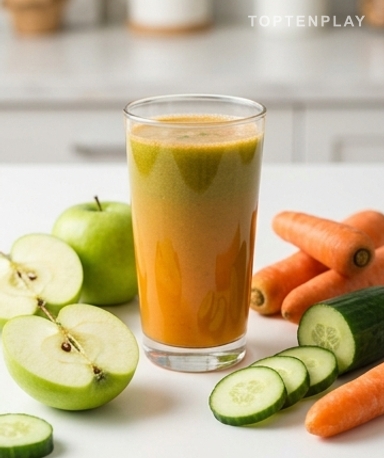
In the glass, the color is bold: a deep orange leaning slightly towards green, depending on the proportion of cucumber. The scent is fresh, almost botanical, with that little zing of lemon that tickles your nose even before you take a sip. The texture is smooth if you strain it, a bit thicker and more rustic if you keep it as is. And the taste? It’s mild, slightly sweet thanks to the apple, and never aggressive.
Why you’ll love this recipe
Ingredient Notes
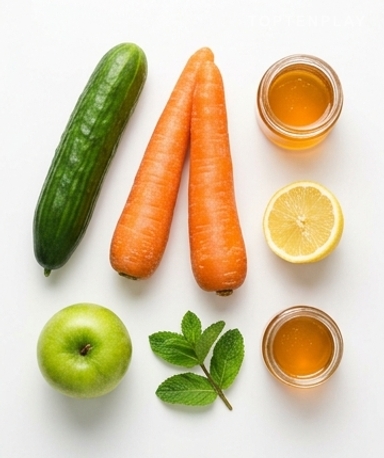
All the ingredients gathered: cucumber, carrots, green apple, lemon, and fresh mint.
- Cucumber : Pick one that feels firm — if it’s soft at the ends, it’s too old and the juice will be bland. A classic long cucumber works perfectly. You can keep the skin if it’s organic; it adds a slight bitterness that is quite pleasant.
- Carrots : Two large, bright orange carrots provide the color and sweetness. Baby carrots are less concentrated and therefore less interesting here. Avoid carrots with many fine roots around them: they are often hollow and tasteless.
- Green apple : Granny Smith is the best option here. Its acidity cuts through the sweetness of the carrot and creates an immediate balance. A red apple will make a sweeter juice — not bad, just different. Up to you.
- Lemon : Half a lemon, no more. The role of the lemon here is to provide zing and prevent the juice from oxidizing too quickly if you prepare it in advance. Squeeze it by hand directly into the blender, no special equipment needed.
- Honey : Optional, and really to be used at the last minute according to your taste. If your carrots are sweet and your apple isn’t too tart, you won’t need it. A teaspoon is enough if you want it slightly smoother.
Why I never make this juice without straining it at least once
Everyone starts by making the juice and drinking it straight from the blender. That’s a mistake — not a catastrophic one, but a mistake nonetheless. The suspended fibers give it a texture close to a thick smoothie, sometimes a bit grainy. By passing it through a fine sieve or a clean cloth, the liquid becomes perfectly smooth and the color intensifies, like a professional cold-pressed juice. The taste changes too: cleaner, less earthy. If you like thick juices, keep it as is. But if you want the truly pleasant version, ten seconds of straining is all it takes.
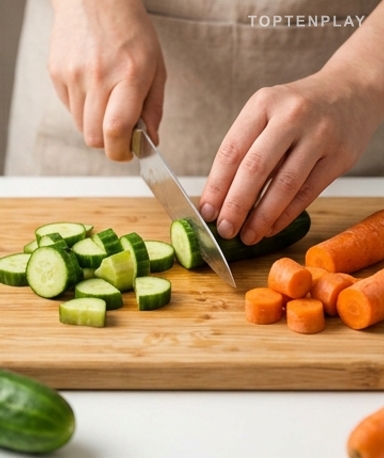
The part everyone gets wrong: the cucumber-carrot ratio
The default ratio — one cucumber for two carrots — is the right balance. But many people put in three carrots thinking that more carrot equals more flavor. Result: a juice that’s too sweet, almost heavy, closer to bottled carrot juice. The cucumber is there to lighten, dilute, and provide that freshness that makes you want a second sip. For example, if you’re making it on a hot summer morning, you can even go up to one and a half cucumbers for one and a half carrots — you’ll get something truly thirst-quenching, like a concentrated version of infused water.
Blend, strain, drink — in that order and without stress
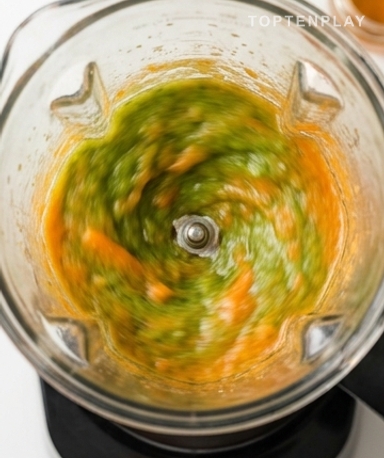
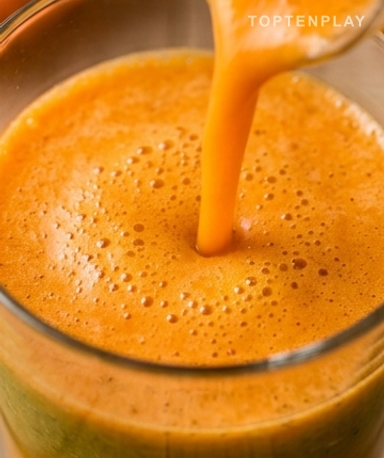
Start by putting the carrots in the blender; they are the hardest. Add the diced cucumber, the apple, then pour the water and lemon juice over them. The liquid helps the blender catch everything without jamming. Blend at full power — for a good minute — until you don’t hear any pieces hitting the blades. That steady, smooth whirring sound is the signal it’s ready. Pass it all through a sieve, pressing with the back of a spoon to extract the maximum juice. The remaining pulp is bright green-orange, almost like a puree — some keep it for soups or veggie patties. Pour into a tall glass over ice cubes.
Mint: not just decorative, actually useful
A few fresh mint leaves in the blender transform the juice. The aroma immediately becomes more complex, with a slightly mentholated finish that refreshes the back of the throat with every sip. It’s not just to look pretty in the glass — although it helps. If you don’t have fresh mint, a drop of food-grade mint extract does the job, but with much less subtlety. Fresh mint smells like real cooking; the other smells like candy. You know the difference!
Tips & Tricks
- Drink it within twenty minutes of preparation — after that, the juice oxidizes and the beautiful color turns a dull brown. If you want to make it ahead of time, add an extra splash of lemon and store it in an airtight jar in the fridge for no more than twelve hours.
- If the juice seems too thick even after straining, it’s often because the cucumber was too old and had lost some of its water. Add a small splash of cold water, stir, and it’s fixed in five seconds.
- For mornings when you don’t have a green apple, half a ripe pear works very well. The pear provides a different, more floral sweetness — the juice is less sharp but remains very pleasant.
Can I prepare this juice in advance?
Yes, but for no more than 12 hours. Store it in an airtight jar in the fridge with an extra squeeze of lemon to slow down oxidation. The color will be slightly less vibrant, but the taste remains fine. Beyond 12 hours, the juice loses its flavor and nutritional qualities.
Do I need a blender, or does a juicer work better?
A juicer yields a purer result and preserves nutrients better — but a good blender + fine sieve works very well and is much cheaper. The taste difference is real but subtle. If you already have a blender, there’s no need to invest in a juicer.
Can I replace the green apple with something else?
A half ripe pear or a red apple works well. The pear brings a more floral sweetness, while the red apple makes the juice sweeter. If you want to remove added sugar entirely, simply omit the apple — the juice will be more vegetal and less accessible, but just as good.
Should I peel the cucumber and carrots?
For carrots, yes — the skin can add an unpleasant bitterness. For cucumber, it depends: if it’s organic, you can keep the skin for a more vegetal taste and more fiber. If it’s conventional, peel it, as the skin can concentrate pesticide residues.
Is honey essential?
No, not at all. If your carrots are sweet and your apple isn’t too acidic, the juice doesn’t need any added sweetener. Taste before adding anything. Honey is mostly useful if you find the juice too tart or if you are using a very acidic Granny Smith.
How long can I keep the pulp after straining?
Carrot-cucumber pulp can be kept for 48 hours in the fridge in an airtight container. You can stir it into a vegetable soup, veggie patties, or a savory cake. Don’t throw it away — it still contains plenty of fiber and flavor.
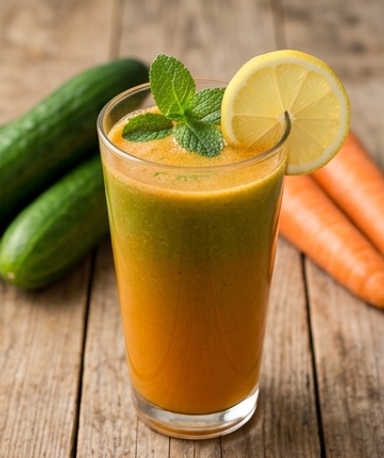
Cucumber-Carrot Vision Juice
International
Beverage
A fresh, vitamin-packed juice ready in ten minutes, featuring cucumber, carrot, green apple, and lemon. Light, balanced, and truly pleasant to drink.
Ingredients
- 1 medium (about 300g) cucumber
- 2 large (about 250g) carrots
- 1 (about 150g) green apple (Granny Smith type)
- 120ml (½ cup) cold water
- ½ lemon (freshly squeezed juice)
- 1 teaspoon honey (optional)
- a few leaves fresh mint (optional)
Instructions
- 1Peel the carrots and cucumber, then cut all ingredients into rough chunks.
- 2Place the carrots first in the blender, then add the cucumber, the apple cut into quarters (cored), and the mint if using.
- 3Pour the water and lemon juice over the top, then blend at full power for 1 minute until a perfectly smooth mixture is obtained.
- 4Pass the juice through a fine sieve, pressing with the back of a spoon to extract as much liquid as possible.
- 5Taste and add honey if necessary. Serve immediately in two tall glasses over ice.
Notes
• Storage: ideally drink the juice within 20 minutes. If making ahead, add an extra squeeze of lemon and store in an airtight jar in the fridge for at most 12 hours.
• No-strain variant: if you prefer a thicker smoothie-style juice, drink it straight from the blender — the texture will be more rustic but the fibers remain intact.
• The pulp recovered after straining keeps for 48h in the fridge and can be incorporated into a soup or vegetable patties.
Nutrition Facts (per serving, estimated)
| 95 kcalCalories | 2gProtein | 22gCarbs | 0.4gFat |