📌 Crème brûlée-style Yule log: the 5-step recipe with caramel insert and vanilla mousse
Posted 22 December 2025 by: Admin
The Creamy Caramel And Vanilla Praline Insert: The Gourmet Heart Of The Log
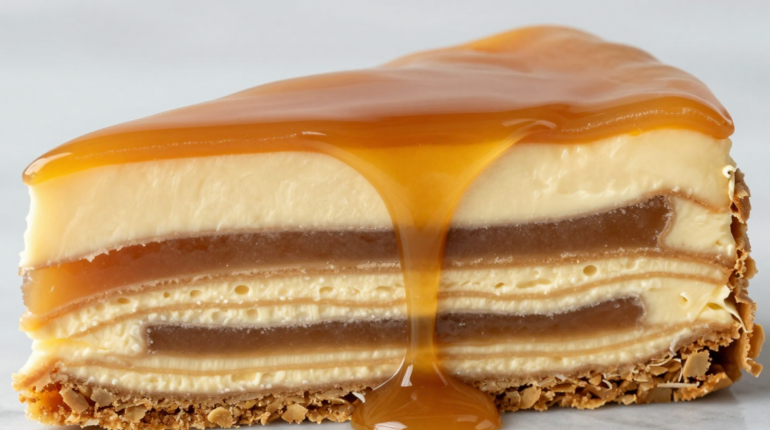
At the center of this crème brûlée-style log lies a two-layer insert that concentrates all the intensity of the dessert. The first layer, a caramel crémeux, requires precise technical mastery: after creating an amber caramel deglazed with warmed cream, the egg-cream mixture must reach exactly 82°C to obtain that characteristic velvety texture. The rehydrated gelatin, incorporated off the heat, guarantees the perfect hold of this melting layer which occupies half the height of the insert mold.
The second layer reveals a homemade vanilla praline whose production requires patience and precision. Sugar heated to 110°C with water coats the almonds before crystallizing and then transforming into caramel under continuous stirring. Once cooled on parchment paper with salt and vanilla, this almond caramel is blended until it becomes a smooth praline that tops the crémeux.
Assembling these two opposing textures – the fluid crémeux and the dense praline – requires freezing for at least 10 hours. This duration is non-negotiable: it alone allows the insert to maintain its layered structure during unmolding and final assembly, creating that taste surprise that makes the recipe so unique.
Madeleine Biscuit And Praline Crunch: The Textured Base
This now-solidified two-layer structure requires a base capable of supporting its density while providing softness. The madeleine biscuit with brown sugar fulfills this role with unexpected lightness. The batter, whipped until it forms a ribbon before integrating sifted flour, baking powder, and melted butter, must rest for 30 minutes in the refrigerator. This rest guarantees even baking across the entire surface of the 20×40 cm tray, spread in a thin layer for only 10 minutes at 180°C.
The soaking syrup is applied immediately after baking. Brought to a boil until the sugar is completely dissolved, it penetrates the still-warm biscuit and preserves its softness during prolonged freezing. Without this generous soaking, the biscuit would harden and compromise the balance of textures upon unmolding.
The real boldness lies in the crunchy layer: the previously prepared vanilla praline is mixed with crumbled gavottes to create a striking contrast. Spread directly onto the soaked biscuit, this gourmet layer must go into the freezer before final assembly. The professional tip that transforms this log? The biscuit is positioned at the top of the mold, crunchy side facing inward, creating an unexpected texture surprise at the first bite.
Vanilla Mousse: The Airy And Technical Coating
This architecture of textures now requires an element capable of unifying the whole while providing lightness and creaminess. The vanilla mousse fulfills this delicate role thanks to a custard base prepared according to professional pastry rules. Milk, cream, and vanilla heat together while the egg yolks are whisked with sugar until pale. The hot cream poured over the eggs while whisking constantly avoids any sudden coagulation.
Returning to low heat requires rigorous thermometric monitoring: cooking stops precisely at 82°C, the temperature at which the cream coats the spoon without forming lumps. Rehydrated gelatin is incorporated off the heat before blending to homogenize the texture. This custard must then cool to between 22 and 25°C before any whipped cream is incorporated. This temperature range is the critical point: too hot, the cream would melt the whipped cream and destroy the aeration; too cold, it would set and create lumps impossible to smooth out.
The whipped cream is delicately folded into the tempered custard with enveloping movements to preserve every air bubble. This airy mousse lines the bottom of the log mold, coats the caramel-praline insert on all sides, and then covers the whole before the crunchy biscuit seals the structure. A full night in the freezer will allow all these elements to merge into a perfectly unmoldable dessert, ready for its final transformation.
Assembly And Caramel Decor: The Spectacular Finish
This overnight fusion in the freezer marks the prelude to the final revelation: the unmolding and decoration that will transform this frozen architecture into a true reimagined crème brûlée. The assembly in successive layers – mousse at the bottom, two-layer insert in the center, a new layer of mousse, then crunchy biscuit with the textured side facing inward – guarantees a clean cut revealing each element distinctly. This prolonged freezing solidifies the whole without altering the individual textures which will regain their creaminess after a few minutes at room temperature.
The signature decor requires a bold preparation: an amber caramel poured onto parchment paper cools until completely hardened. Once set, this caramel is broken into pieces before being blended into a fine powder, creating that emblematic caramelized crust without a flame or blowtorch. At the moment of serving, the unmolded log is generously coated with this golden powder which adheres to the frozen mousse, forming a crackling film instantly evoking the crunchy surface of a traditional crème brûlée.
The whipped cream, piped with a nozzle, provides the final touch, visually contrasting with the gold of the caramel while recalling the milky sweetness of the original dessert. This double finish – mineral caramel coating and airy whipped cream swirls – signs a log that reinvents festive codes by capturing the essence of a great French classic, proving that innovation and tradition can merge into a spectacular dessert worthy of the most demanding tables.