📌 Creamy parmesan polenta: the gluten-free Corsican side dish that replaces pasta and rice in 20 minutes
Posted 28 February 2026 by: Admin
The Italian Heritage Of A Corsican Mountain Dish
Corsica is French today, but its culinary soul remains deeply Italian. For centuries, Pisa and then Genoa ruled the island, indelibly shaping its mountain gastronomy. This transalpine influence persists particularly in the inland villages near Corte, where polenta still graces family tables.
When people mention Corsican polenta, the collective imagination immediately conjures up chestnut flour. Chestnut trees indeed fed entire communities, earning the island the nickname “land of wood and bread.” However, this vision obscures an equally anchored culinary reality: corn polenta remains firmly rooted in Corsican family kitchens.
In Christiane Schapira’s La Bonne Cuisine Corse, a reference work on the island’s gastronomic heritage, the only documented polenta recipe is Corn flour polenta (Pulenta de farin’ di granonu) – prepared in the oven, topped with tomato sauce and gratinéed with cheese.
On the Colonna family side, the approach differs slightly: corn polenta is prepared creamy, served as an accompaniment to generous winter stews. Recently, a wise mother-in-law brought back a bag of pre-cooked cornmeal from Savoy. Prepared smooth rather than oven-baked, this polenta accompanied a veal stew with olives. The natural sweetness of the corn perfectly balanced the salty sauce, enhanced with freshly chopped parsley.
It is simple mountain cooking. From the land.
The Secrets To A Smooth Polenta Every Time
Polenta is ground cornmeal, sometimes labeled as cornmeal, maize semolina, or semoule de maïs. Choose a product explicitly labeled “polenta” to avoid confusion with fine corn flour or starch.
The choice of grind determines the final texture: fine grinds produce an unflattering pasty consistency, while coarse grains give a rustic result. A medium grind offers the ideal balance between creaminess and character.
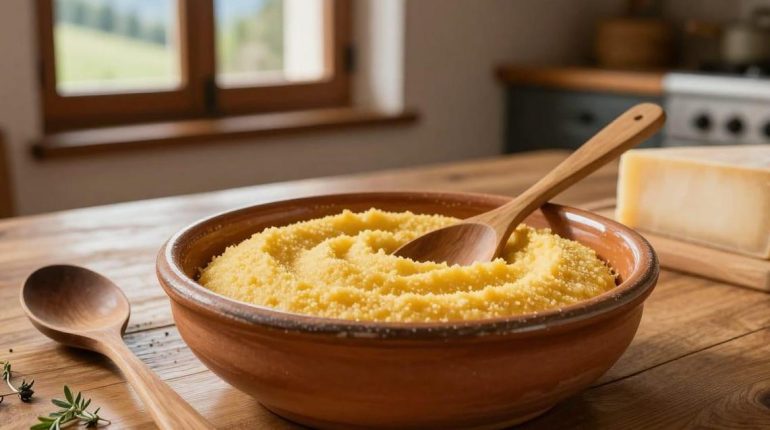
For a creamy polenta, three rules are enough: respect a ratio of 1 volume of polenta to 5 volumes of liquid (200g of semolina for 1 liter of water), stir constantly during cooking, then stir in butter and cheese off the heat. This last step transforms a correct preparation into a velvety taste experience.
If your polenta lacks creaminess, the diagnosis is simple: it lacks liquid and stirring. A little extra water and a few more minutes of stirring systematically correct the problem. The polenta is ready when it pulls away slightly from the sides of the pan, shiny and creamy.
This technical simplicity contrasts with its richness of taste. Served immediately, it retains that silky texture that perfectly absorbs generous sauces – an essential characteristic for accompanying the traditional dishes with which it is historically inseparable.
Culinary Geography: From Lombardy To The Corsican Mountains
This silky texture and absorption capacity find their origin in northern Italy, where polenta has structured meals in Lombardy, Veneto, and the Alpine regions for centuries. It was in these mountain lands that it established itself as an economic alternative to bread, feeding rural families during long winters.
The historical link between Genoa and Corsica explains the implantation of this dish in the island’s villages. During centuries of Genoese domination, Italian culinary traditions crossed the Mediterranean to take root in the Corsican mountains, particularly around Corte where families still perpetuate these recipes passed down from generation to generation.
In Corsican family kitchens, corn polenta remains common – a living testimony to this transalpine lineage where Italian heritage and French influence meet without opposing each other. The family anecdote illustrates it perfectly: this Savoy semolina brought back by the mother-in-law, served creamy with a veal stew with olives, embodies this Mediterranean culinary circulation that ignores administrative borders.
Rural Corsican villages preserve this tradition, proof that certain dishes transcend national affiliations to simply become of the land – a local expression designating this simple, generous mountain food deeply rooted in the daily lives of island families.
Perfect Pairings: When Corn’s Sweetness Meets Generous Sauces
This creamy parmesan polenta reveals its full culinary relevance when it accompanies dishes generous in sauce. The natural sweetness of corn remarkably balances salty preparations, creating a contrast that justifies its omnipresence in Mediterranean kitchens.
Slow-cooked dishes are its preferred partners: Corsican veal stew with olives and peppers, beef bourguignon, or coq au vin find in this creamy base the ideal setting for their concentrated juices. Family experience confirms it – this Savoy semolina served with the veal stew demonstrated how the richness of butter and cheese absorbs savory sauces while creating a taste harmony.
Braised meats and sausages also benefit from this accompaniment which captures their juices without diluting them. For vegetarian options, simple tomato sauce, roasted vegetables, or a French-style vegetable tian offer alternatives where polenta maintains its structuring role.
This versatility is explained by its texture: consistent enough to carry sauces, creamy enough to never dry out the palate. In Corsican and Italian dishes particularly, where slow-cooked preparations dominate, this absorption capacity becomes essential – transforming a simple side dish into an indispensable component of the dish’s balance.