This dish smells wonderful from the moment the leeks hit the hot pan — that sweet, slightly caramelized aroma rising before they even start to melt. On a Saturday when you want to eat well without spending the afternoon in the kitchen, this is exactly what you make. Thirty-five minutes, one pan, and a result far exceeding the effort.
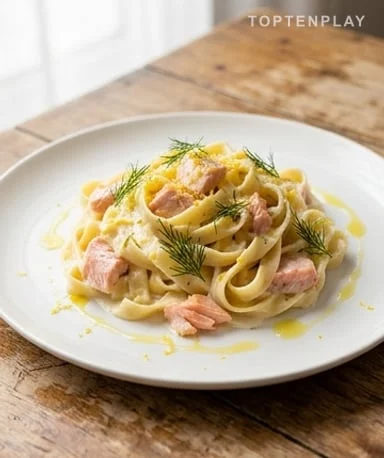
The sauce takes on a lightly creamy pink hue when the salmon juice blends into the fat — neither white nor orange, something in between that’s truly appetizing. The tagliatelle naturally curl into it, each ribbon coated in a fine, silky layer. You smell the dill before you even see it on the plate. And there’s always a bit of sauce left in the pan that you finish with a spoon, because it’s too good to leave.
Why you’ll love this recipe
Ingredient Notes

Tender leeks, soft salmon, heavy cream and a squeeze of lemon: four elements that perfectly understand each other.
- Tagliatelle (300 g) : The ribbon shape has a real role: it catches the creamy sauce across its entire surface, whereas short pasta would let the sauce pool at the bottom of the plate. Good quality dried ones are perfectly fine, but fresh ones give a much silkier texture if you can find them in the chilled section.
- Leeks (2 pieces) : The leek brings a sweet tenderness and a melting texture that onion doesn’t have. It needs to cook slowly over low heat — on high heat, it toughens and develops a slight bitterness that then carries through the sauce. Use only the white and light green part; the dark green is too fibrous to melt properly in under ten minutes.
- Salmon (200 g) : Fresh or smoked, it’s not the same experience at all. Fresh cooks in the pan, releases its juices into the sauce, and gives a tender texture and a milder flavor. Smoked remains assertive and is felt in every bite. The combination of both — 150 g fresh and 50 g smoked — is excellent if you want both registers at once.
- Heavy cream (20 cl) : Thick cream holds up better to heat than light cream and gives a sauce that coats the pasta without pooling in the plate. The light version works but the sauce will be less enveloping. Avoid: plain yogurt, which can curdle over heat if you’re not careful with the flame.
- Lemon juice (half a lemon) : It’s not there for its taste per se, but to cut the richness of the cream. Without it, the sauce becomes heavy after a few bites and ends up weighing you down. A splash during cooking is enough; a few zest strips grated at the end further boost the aromas without adding extra acidity.
- Dill or flat-leaf parsley : Dill and salmon have a natural affinity — the herb brings a lightly anise-like freshness that balances the fish’s fat without overwhelming it. Flat-leaf parsley is a good alternative if dill is too strong for the household. In any case, add it off the heat so its aromas don’t dissipate.
The leeks, and we really take the time
It all starts here, and this is where many people go wrong: leeks need at least ten minutes over low heat to become truly tender. Not five minutes by cranking up the heat — at too high a temperature, they stay firm and develop a slight bitterness that then lingers in the entire sauce. Start by cleaning them properly: split them lengthwise, rinse under cold water to remove sand trapped between the layers, then slice thinly. The more uniform the slices, the more even the final texture. In a spoonful of olive oil heated gently, the leeks begin to sweat almost immediately — they lose their rigidity, soften, and that sweet, slightly herbal smell rises in the kitchen. Stir occasionally so they cook evenly without sticking to the bottom. When they are translucent and have lost about two-thirds of their original volume, add the finely chopped garlic and cook for another one to two minutes, just to release the aromas without browning the garlic.

The salmon enters the pan
From here, the dish comes together quickly. If using fresh salmon, cut it into cubes about two centimeters — not too small, or they crumble completely into the sauce and disappear; not too large, or the center remains pink while the outside is already overcooked. Add them to the leeks and cook over medium heat for five to seven minutes, stirring gently. Fresh salmon changes color as it cooks: it goes from translucent pink to matte opaque pink, and its texture firms slightly under the spatula — that’s the moment to stop; one extra minute is enough to dry it out. If using smoked salmon, the logic is reversed: it doesn’t need to cook, only to warm through. Add it only once the cream is already in the pan, so it retains its smoky character without breaking into small pieces.
The cream, the lemon, and nothing else
Pour the heavy cream directly over the leeks and salmon. It deglazes the pan slightly and immediately starts to take on color — lightly pink from the salmon juice, with a smell that becomes much richer and more enveloping. Let it simmer over low heat for five minutes, stirring occasionally. The sauce should not boil vigorously: it thickens naturally at low temperature and stays emulsified, whereas a strong boil would reduce it too quickly or, worst case, cause it to separate. Add the lemon juice halfway through — the sauce changes imperceptibly, becomes brighter, less heavy. Taste and adjust salt and pepper. If it seems too thick at this point, a ladle of pasta cooking water will do the trick exactly, much better than adding more cream.
The pasta and assembly
While the sauce simmers, cook the tagliatelle in a large pot of well-salted boiling water — it should taste like the sea, not like a lake. Follow the time on the package minus one minute: the pasta will finish cooking in the sauce and must not arrive too soft at this stage. Before draining, reserve a large ladle of cooking water and keep it handy. Drain the pasta without rinsing — the starch remaining on the surface is precisely what makes the sauce adhere. Pour the tagliatelle directly into the pan over low heat and toss by lifting rather than pressing. If the sauce thickens too quickly upon contact with the hot pasta, add the reserved cooking water spoon by spoon until the desired texture is reached. Thirty seconds over low heat and everything comes together.
The finishing touch that changes everything
Off the heat, sprinkle fresh herbs over the pasta. Dill releases its aroma as soon as it’s snipped — that slightly anise-like, fresh scent that contrasts with the warmth of the sauce and instantly signals the dish is ready. If you have a lemon on hand, a few zest strips grated directly over the plates change the level from one bite to the next: brighter, more aromatic, without extra acidity. Serve in warm shallow bowls if possible — the sauce cools quickly in a cold plate and loses its creaminess. A good turn of the pepper mill just before bringing to the table, and it’s ready.

Tips & Tricks
- Do not rinse the pasta after draining: the starch remaining on the surface is exactly what helps the creamy sauce adhere to the ribbons. Rinsing water removes it completely, and the sauce slides to the bottom of the plate instead of coating the pasta.
- Reserve a ladle of cooking water before draining: it’s the only liquid that can adjust the sauce’s texture without diluting its flavors. The dissolved starch in it binds the sauce differently than tap water or extra cream.
- Cook fresh salmon over medium heat, never high: at too high heat, it quickly loses its juices and becomes dry in less than two minutes. Moderate heat lets it cook evenly and gently release its aromas into the leeks and cream.
- Add smoked salmon off the heat or at the very end: it has no need to cook, and prolonged heat erases its characteristic smoky notes. Stir it into the warm sauce just before the pasta so it retains its full character.

Can I use smoked salmon instead of fresh?
Yes, and it’s even a great option if you want to save time. Smoked salmon doesn’t need to cook — simply fold it into the hot cream off the heat to preserve its smoky flavor. The result is bolder than fresh, and combining both (150 g fresh + 50 g smoked) gives the best of both textures.
How do I avoid the sauce being too thick or too thin?
The pasta cooking water is key: be sure to reserve a ladle before draining. If the sauce thickens too much when mixing with the tagliatelle, a tablespoon of cooking water is enough to loosen it without diluting flavors. Conversely, if it seems too thin, two to three extra minutes over low heat will naturally concentrate it.
Can I make this dish ahead of time?
The sauce — leeks, salmon, and cream — can be prepared up to a day in advance and stored in the refrigerator. However, the pasta should be cooked at the last minute and tossed with the gently reheated sauce (with a splash of water). Pasta already mixed and cooled will absorb liquid and become compact upon reheating.
What alternative to heavy cream can lighten the recipe?
Light cream (15% fat) works well and reduces fat content, though the sauce will be slightly less rich. Soy cream is a dairy-free alternative that holds up decently to heat. Plain yogurt should be avoided: it can curdle if the heat is too high.
What type of pasta can replace tagliatelle?
Linguine or fettuccine work very well — these are also long pasta shapes that catch the sauce similarly. Pappardelle, wider, gives an even more generous version. Short pasta like penne are less suitable: the creamy sauce slides into the plate instead of coating the pasta.
How to reheat leftovers without drying them out?
Over very low heat in a pan with a tablespoon of water or cream, stirring regularly — this method best preserves the texture. The microwave also works at medium power with a lid, but the pasta will be slightly softer. In any case, avoid high heat, which can separate the sauce and toughen the salmon pieces.
Creamy Leek and Salmon Tagliatelle
French
Pasta / Main Course
Tagliatelle coated in a creamy sauce with tender leeks and soft salmon. A simple yet elegant dish ready in 35 minutes, perfect for a weekday dinner or entertaining.
Ingredients
- 300 g tagliatelle (dried or fresh)
- 200 g salmon (fresh or smoked, or a mix)
- 2 leeks (white and light green only)
- 1 garlic clove
- 20 cl heavy cream
- 1 tbsp olive oil
- ½ lemon (juice, and zest optional)
- a few sprigs fresh dill or flat-leaf parsley
- salt and black pepper from the mill
Instructions
- 1Clean the leeks: split lengthwise, rinse under cold water to remove sand, then thinly slice the white and light green parts.
- 2Heat olive oil in a large pan over low heat. Add the leeks and cook for 10 minutes, stirring occasionally, until tender and translucent without browning.
- 3Add the minced garlic and cook for 1-2 minutes without browning.
- 4If using fresh salmon: cut into 2 cm cubes, add to the pan, and cook over medium heat for 5-7 minutes until opaque and firm. If using smoked salmon: set aside and add after the next step.
- 5Pour in the heavy cream, stir, and let simmer over low heat for 5 minutes. Add lemon juice, salt, and pepper. If using smoked salmon, fold it in now off the heat.
- 6Meanwhile, cook the tagliatelle in a large pot of well-salted boiling water, removing 1 minute from the package time. Before draining, reserve a ladle of cooking water.
- 7Add the drained pasta (do not rinse) directly to the pan. Gently toss over low heat for 30 seconds. Adjust the texture with cooking water if the sauce is too thick.
- 8Sprinkle with fresh herbs off the heat. Serve immediately in warm shallow bowls with a grind of black pepper.
Notes
• Do not rinse the pasta after draining: the starch on the surface helps the creamy sauce adhere.
• For the best texture, combine 150 g fresh salmon (cooked in the pan) and 50 g smoked salmon (folded in off the heat) — each brings something different.
• Store leftovers in the refrigerator for up to 2 days. Reheat over low heat with a tablespoon of water or cream, stirring regularly.
Nutrition Facts (per serving, estimated)
| 550 kcalCalories | 25 gProtein | 60 gCarbs | 22 gFat |