📌 Creamy Homemade Hummus
Posted 30 March 2026 by: Admin
Hummus: everyone thinks it comes from a plastic tub. It’s one of those rare recipes where the homemade version is so much better that it doesn’t even make sense to compare. Four ingredients, a blender, ten minutes — and your guests will be asking for the recipe.
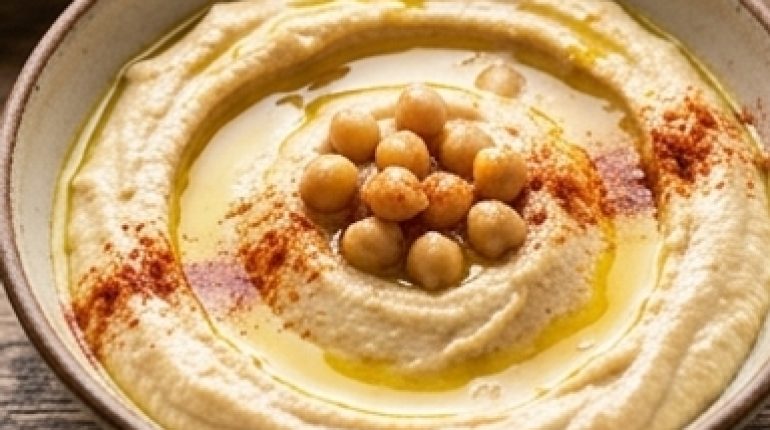
What you see in the bowl is a pearly beige cream, almost ivory, with that smooth surface you never get with an industrial version. The drizzle of olive oil forms a small golden pool in the center. You can smell the toasted sesame even before bringing the spoon close — a warm, slightly bitter scent that balances with the lemon. And when you dip a piece of bread in, the texture gives way without resistance, like a very dense mousse.
Why you’ll love this recipe
Ingredient Notes
Four ingredients are enough for a hummus that makes you forget all commercial versions.
- Canned chickpeas : No need to soak them overnight — canned ones do a great job here. Rinse them well under cold water to remove the canning liquid that gives a metallic aftertaste. A 400 g drained can gives about 250 g, which corresponds to the 450 g indicated in the recipe when including well-drained chickpeas.
- Tahini : This is what makes the difference between a flat hummus and a hummus with character. Tahini is sesame paste — not sweetened sesame butter. Get it from a Middle Eastern grocery store if you can; brands like Al Yaman or Baroody are much better than what you find in supermarkets. It should smell like toasted sesame, not rancid. If yours has been at the back of the cupboard for six months, check that it’s not too bitter.
- Lemon : A fresh lemon, not bottled juice. You can taste the difference. And take the opportunity to grate the zest before squeezing it — two or three passes on a fine grater are enough; it brings a floral note that the juice alone doesn’t have.
- Garlic : One clove is enough. Hummus shouldn’t explode with garlic — it should just have that slightly pungent background that disappears behind the tahini. If you want something milder, you can lightly sauté it in a pan for 30 seconds before adding it.
- Ice water : This is the secret no one tells you. Cold water — really cold, with ice cubes if possible — emulsifies the ingredients differently than room-temperature water. The result is lighter, almost airy. Do not skip this step.
Don’t skimp on the tahini — it’s everything
We tend to think the chickpeas are the star of the recipe. In reality, it’s the tahini. Without it, hummus is bland, grainy, and lacks binding. With a good tahini — thick, oily, with that roasted sesame scent that hits you as soon as you open the jar — the result changes completely. 120 g might seem like a lot, but it is precisely this generous amount that gives the creaminess we’re looking for. Do not reduce the dose.
Add the ice water at the beginning of blending
Everything goes into the blender at the same time: drained chickpeas, tahini, pressed garlic, lemon zest and juice, salt, pepper, and the 10 cl of ice water. No ice water at the end to adjust — right from the start, so the emulsion forms correctly. You’ll hear the blender struggle for the first few seconds on the chickpeas, then everything homogenizes and the sound changes — smoother, more regular. That’s when you know it’s working. Let it run for at least a minute and a half at full power.
Blend without stopping for two full minutes
This is where most people stop too soon. The hummus looks smooth after thirty seconds, but there are still micro-bits that give it a slightly grainy texture. Two continuous minutes of blending at full power is what makes the difference between a decent hummus and a truly silky one. If your blender heats up, take a twenty-second break. After blending, taste and adjust: salt, lemon, or a tiny bit of water if it’s too thick.
Plating is five seconds that changes everything
Pour the hummus into a wide bowl and swirl a spiral with the back of a spoon. This little well in the center will hold the drizzle of olive oil — use a fruity oil, not too peppery. A few whole chickpeas on top, a pinch of paprika or sumac if you have some, and it’s ready. Put it on the table with warm pita bread and watch people dive in. It’s a simple presentation that makes an impact with zero effort.
Tips & Tricks
- If your tahini has separated in the jar — oily part on top, compact paste at the bottom — mix it well before measuring. Poorly mixed paste results in hummus that’s too dense on one side and too oily on the other.
- To store it, always add a small drizzle of olive oil on the surface before sealing the airtight container. This prevents the surface from drying out and forming a crust.
- If you want to serve it warm — yes, that’s an option — warm it gently in a double boiler while stirring. Don’t use the microwave; the texture changes and it becomes grainy.
How long does homemade hummus last?
3 to 4 days in the refrigerator in an airtight container. Add a drizzle of olive oil on the surface before closing to prevent the crust from drying. Vacuum-sealed, it lasts up to 10 days.
Can you freeze homemade hummus?
Yes, up to 3 months in the freezer. The texture will be slightly different after thawing — grainier. A quick whirl in the blender after thawing can help fix it.
What can I substitute for tahini if I don’t have any?
Tahini is hard to replace without changing the flavor of the dish. As a backup, a spoonful of unsweetened peanut butter works but gives a very different result. Ideally, find tahini at a Middle Eastern grocery store — it really changes everything.
My hummus is too thick, how do I fix it?
Add ice water, one tablespoon at a time, blending between each addition. Never use lukewarm or hot water — the texture would become heavy and sticky.
Do I absolutely need a powerful blender?
A standard blender does the job just fine. An immersion blender also works, but the result will be slightly less smooth. What really changes the texture is the blending time — not the power of the machine.
Can I use dry chickpeas instead of canned?
Yes, and the result is even better. Soak them overnight, then cook for 1h30 in boiling water until they can be easily crushed between your fingers. Use about 200 g dry to get 450 g of cooked chickpeas.
Creamy Homemade Hummus
Mediterranean
Appetizer / Starter
A smooth and creamy hummus, ready in 10 minutes with four ingredients. The homemade version that makes supermarket tubs obsolete.
Ingredients
- 450g cooked chickpeas (1 large can, drained and rinsed)
- 120g tahini (sesame paste)
- 1 garlic clove
- 1 lemon (zest + 2 tbsp juice)
- 10 cl ice water
- 1 tsp salt
- ½ tsp ground black pepper
- 2 tbsp olive oil (for serving)
Instructions
- 1Drain and rinse the chickpeas thoroughly under cold water.
- 2Place the chickpeas in the blender with the tahini, pressed garlic, lemon zest, and 2 tablespoons of lemon juice.
- 3Add the ice water, salt, and pepper.
- 4Blend at full power for 2 continuous minutes, without stopping, until perfectly smooth.
- 5Taste and adjust: salt, lemon juice, or a tablespoon of ice water if the hummus is too thick.
- 6Pour into a bowl, swirl a spiral with the back of a spoon, and drizzle with olive oil before serving.
Notes
• Storage: 3 to 4 days in the refrigerator in an airtight container, with a drizzle of olive oil on the surface to prevent drying.
• Make ahead: hummus is better after a few hours in the fridge — feel free to prepare it the day before.
• Variations: add a spoonful of smoked paprika, ground cumin, or a bit of sweet chili in the blender to vary flavors without changing the technique.
Nutrition Facts (per serving, estimated)
| 246 kcalCalories | 10gProtein | 26gCarbs | 13gFat |