📌 Cooked rice: why letting it cool at room temperature promotes food poisoning
Posted 9 February 2026 by: Admin
The Unknown Danger Of Cooked Rice: When A Common Food Becomes A Threat
Cooked rice seems to be one of the most harmless foods to store. Simple, neutral, easy to reheat, it is the ideal backup meal. However, food safety experts are sounding the alarm: if poorly stored, this starch quickly transforms into a real health hazard. This food poisoning is so common that it has a specific medical name: “Fried Rice Syndrome.”
Unlike other foods that we refrigerate without concern, cooked rice has characteristics that make it a fertile ground for bacterial development. Many households cook large quantities of rice and save the leftovers for later, convinced that refrigeration alone is enough to guarantee their safety. This blind trust is precisely the trap.
Rice behaves differently from other starches. Without proper handling, it becomes an ideal environment for the proliferation of dangerous bacteria, and this phenomenon can occur in just a few hours. The delay between cooking and correct storage is critical. This narrow time window, often ignored, explains why so many people fall ill after consuming apparently normal leftover rice. The threat is real, documented, and affects thousands of kitchens worldwide every day.
The Daily Mistake That Turns Your Kitchen Into A Breeding Ground For Bacteria
The scene repeats in millions of homes: a large quantity of rice is prepared for dinner, some is consumed, and the rest is placed in the refrigerator. This gesture, apparently logical and responsible, actually hides a major flaw in our understanding of food safety.
Refrigeration is not enough. This is the information that most cooks ignore. Unlike pasta, potatoes, or other starches that tolerate gradual cooling, rice requires a specific storage protocol. The problem lies not in the refrigerator itself, but in the delay and method used to place the rice there.
When cooked rice stays at room temperature, even briefly, it creates perfect conditions for bacterial multiplication. Trapped steam, residual moisture, and heat form an ideal trio for pathogenic microorganisms. These bacteria do not just develop slowly: they proliferate exponentially, transforming a healthy dish into a vector for poisoning.
The danger is all the more insidious because it remains invisible. Contaminated rice often shows no apparent signs: no suspicious smell, no color change, nor altered texture. This deceptive appearance leads to the confident consumption of food that has become dangerous. The time elapsed between cooking and refrigeration directly determines the level of risk incurred.
Why Rice Reacts Differently: The Science Behind The Risk
This particular vulnerability of rice is explained by a precise biological mechanism. At the heart of the problem is Bacillus cereus, a spore-forming bacterium naturally present in raw rice. These spores resist cooking, even at high temperatures, and survive quietly in the cooked grains.
The danger activates during cooling. Between 5°C and 60°C, dormant spores transform into active bacteria that multiply rapidly. At room temperature, this proliferation reaches its peak: a single bacterium can generate millions of descendants in just a few hours. Cooked rice offers exactly what they need: moisture, nutrients, and residual heat.
Bacillus cereus produces particularly formidable heat-stable toxins. Even subsequent reheating at high temperatures destroys the bacteria, but not their toxins. These substances resist heat and remain active, causing nausea, vomiting, and severe diarrhea within hours of ingestion.
The critical window is between two and four hours after cooking. Past this time at room temperature, the rice gradually becomes unfit for consumption, without any visible indicator betraying its contamination. This combination of speed, invisibility, and thermal resistance makes poorly stored rice one of the sneakiest vectors of food poisoning.
Essential Prevention Steps For Storing Rice Safely
Faced with this invisible threat, prevention relies on a golden rule: speed. Rice must be refrigerated within an hour of cooking, ideally as soon as it stops steaming. This immediate reaction prevents Bacillus cereus spores from entering the active multiplication phase.
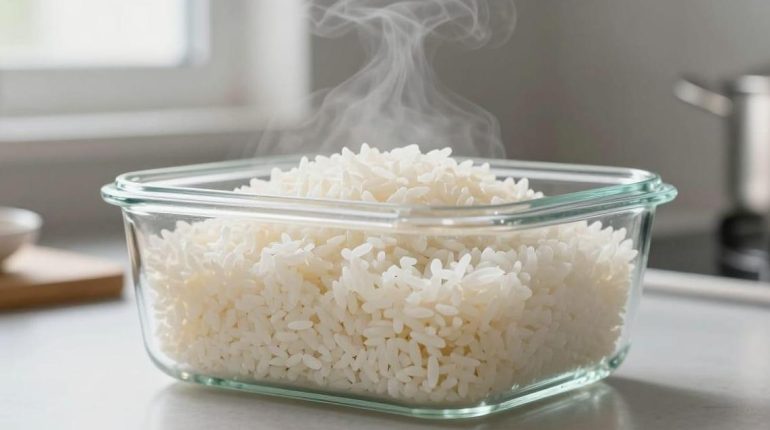
Packaging plays a decisive role. Dividing rice into individual portions in shallow containers speeds up cooling and quickly passes through the critical temperature zone. A deep container maintains residual heat in the center for hours, creating precisely the conditions bacteria seek.
Storage should never exceed three days in the refrigerator. Beyond that, even if correctly stored, rice loses its sanitary reliability. Reheating must be thorough and uniform, reaching at least 75°C at the core, even if this precaution destroys bacteria without neutralizing already formed toxins.
Certain signs require immediate disposal: sour smell, slimy texture, or altered appearance. But the absence of these indicators guarantees nothing. Contaminated rice often remains normal in appearance, hence the importance of scrupulously following the storage protocol as soon as it leaves the heat.
This vigilance transforms a common culinary habit into a safety reflex. Every minute gained between cooking and refrigeration drastically reduces the risk of poisoning.