📌 Coconut cake: the refrigerator trick that completely transforms texture and flavors
Posted 4 February 2026 by: Admin
A Dessert That Reconciles Indulgence And Lightness
This coconut cake breaks the codes of traditional desserts. Neither cloying nor bland, it finds that rare balance between airy texture and gourmet richness. The secret lies in the subtle combination of a soft coconut-flavored sponge and a smooth mascarpone cream, which brings freshness and melt-in-the-mouth quality without weighing the whole thing down.
This recipe stands out for its remarkable versatility. Whether for an improvised family snack, a birthday to celebrate, or a dinner where you want to impress without stress, this cake delivers. Its major asset: simple and accessible ingredients found in any well-equipped kitchen. No need to chase after hard-to-find exotic products.
Coconut breathes in that warm and sunny touch that immediately evokes escape, while the mascarpone cream tempers this sweetness with its delicate freshness. The taste balance is all the more successful as the cake is neither too sweet nor too heavy, a feat in the world of coconut desserts, which are often overwhelming.
A crucial detail that many recipes neglect: the resting time of at least one hour in the refrigerator. This step allows the flavors to develop fully and the cake to firm up slightly. Result: a taste experience that reaches its peak at the moment of tasting, when each component reveals its character.
The Secrets Of A Perfect Texture: Technique And Timing
The success of this cake rests on an often neglected step: the energetic whisking of the eggs with the sugar. This operation transforms the mixture into a light and thickened foam, capturing the air necessary for this soft and airy texture so sought after. Without this preliminary work, the sponge falls flat and loses its melting character.
The incorporation of ingredients follows a precise order. The melted butter, lukewarm but not hot, is added gently to avoid cooking the eggs. The flour and baking powder, sifted together, eliminate lumps that would compromise homogeneity. The shredded coconut is integrated last, without ever overmixing the batter at the risk of developing gluten and obtaining a rubbery texture.
Baking at 180°C for 35 minutes requires monitoring. The cake should have a slightly golden surface, while a knife blade inserted in the center comes out dry. This simple check avoids bad surprises: a heart that is too wet or a crust that is too dry.
Then comes the decisive moment that many rush: complete cooling before assembly. Filling a still-warm cake melts the cream and turns the dessert into mush. Even more crucial, this resting time of at least one hour in the refrigerator after assembly firms up the whole and allows the flavors to marry fully. This patience pays off: the cake reaches its maximum taste potential, each bite revealing the perfect balance between sponge and cream.
The Mascarpone Cream: The Signature Element That Changes Everything
This cream radically transforms the nature of the dessert. Without it, the cake remains a simple coconut sponge. With it, it attains the status of refined pastry. Its preparation requires rigor and precision to achieve that light and airy texture that characterizes great creations.
Whipping the cream is the first technical challenge. The liquid cream must be ice-cold, ideally accompanied by a bowl and whisks previously placed in the freezer for a few minutes. This low temperature accelerates the emulsion and guarantees a firm whipped cream, an essential condition for supporting the mascarpone without falling flat.
The mascarpone itself requires a different approach. Its 250 grams are loosened with icing sugar and vanilla extract until a creamy and homogeneous consistency is obtained. This step eliminates lumps and prepares the cheese to receive the whipped cream. The incorporation is done in several stages, with a spatula, using delicate bottom-to-top movements. Any brutal whisking would destroy the air bubbles so laboriously created.
The 20 centiliters of whipped cream combined with the mascarpone produce a smooth mousse that perfectly balances the density of the sponge. For those looking for a slightly more tangy version, Philadelphia-type cream cheese offers an interesting alternative, although less rich on the palate. This cream, the true backbone of the dessert, alone justifies the exceptional status of this cake.
Assembly And Finishing: When Simplicity Becomes Elegance
The complete cooling of the cake conditions the success of the assembly. Any premature attempt condemns the cream to melt and the dessert to collapse. Once the sponge has returned to room temperature, the horizontal cut is the most delicate step. A long, thin-bladed knife, passed in a steady motion, separates the cake into two discs of equal thickness.
Spreading the mascarpone cream requires generosity and method. It is distributed to the edges, forming a uniform layer that guarantees a consistent taste experience with every bite. The second disc is placed delicately, without excessive pressure that would risk pushing the filling out the sides.
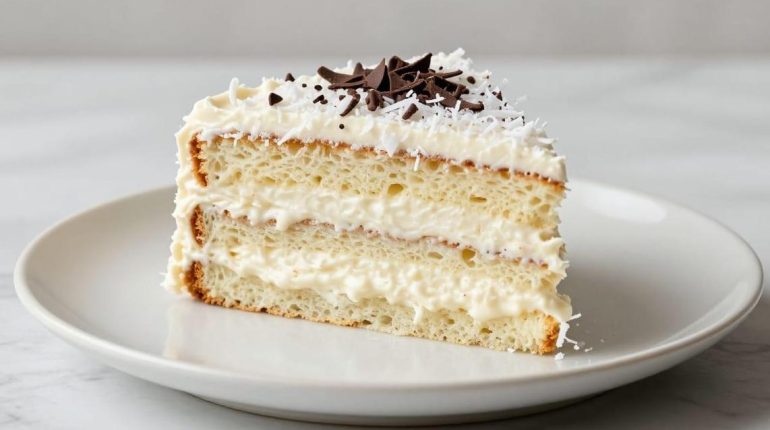
The finish reveals all the sophistication of the dessert. The 50 grams of grated chocolate sit alongside 40 grams of coconut to create a striking visual contrast: the deep black of the cocoa against the pearly white of the dried pulp. This association goes beyond simple decoration. It announces the flavors to come and adds a crunchy textural dimension that breaks with the softness of the sponge and the cream.
The stay in the refrigerator for at least one hour completes the process. This period allows the cream to firm up slightly, the flavors to fuse, and the textures to find their definitive balance. Served chilled, this cake transcends its simple ingredients to reach the refinement of a true pastry creation, accessible to all but worthy of the most demanding tables.