📌 Churros without frying: how the Airfryer reproduces crispness in 10 minutes
Posted 8 January 2026 by: Admin
The Express Non-Fried Recipe
Seven ingredients are enough to transform your kitchen into a homemade churro shop. 250 ml of water, 30 g of butter, 150 g of flour: this trio forms the backbone of a churro dough that radically eliminates frying oil. The Airfryer disrupts a centuries-old Spanish classic here by offering hot air cooking without compromising on crispness.
The complete list fits on one line: water, butter, salt, flour, an optional but highly recommended egg, optional sugar in the dough, plus the final coating. This disconcerting simplicity produces 15 to 20 churros, the ideal quantity for a family snack or an improvised dessert. Adding a tablespoon of sugar directly into the preparation remains a freedom left to the cook, depending on whether they prefer a neutral or slightly sweet dough.
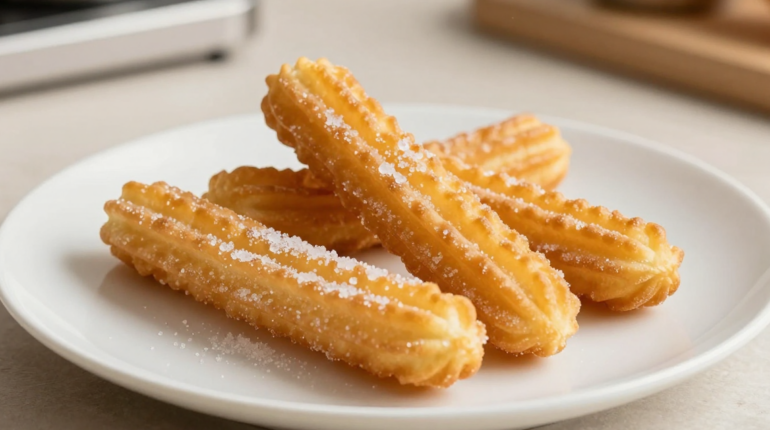
This light version preserves the essentials: the characteristic texture of the churro, its golden exterior, and its tender heart. The Airfryer replaces the boiling oil bath without sacrificing the result. Preparation time is counted in minutes, cooking is done in successive batches, and cleaning avoids greasy splashes. A healthy alternative without sacrificing taste: the promise lies in this precise ratio between three basic ingredients and modern cooking technology.
Each component plays a defined role in the final architecture of these golden sticks.
The Secrets of the Perfect Dough
Behind this apparent simplicity lies a precise molecular architecture. The butter, limited to 30 grams, ensures smoothness without weighing down the structure. This fat melted in boiling water creates an emulsion that coats each flour particle, guaranteeing a texture that is neither brittle nor rubbery. The ratio of 250 ml of water to 150 g of flour is non-negotiable: too liquid, and the dough collapses in the appliance; too compact, and it refuses to pass through the nozzle.
The egg radically changes the game. Officially optional, it remains the true secret of the soft interior that characterizes a successful churro. Its proteins coagulate in the heat, creating that airy crumb that contrasts with the crust. Without it, the result remains decent but lacks that signature tenderness. The salt, a simple pinch, reveals the flavors; the tablespoon of sugar in the dough, optional, anticipates the final coating for those who prefer a progressive sweetness.
This alchemy of mundane ingredients produces a simplified choux pastry, a technical cousin of eclairs and profiteroles. The difference lies in the cooking: where traditional frying brutally seizes the surface, the Airfryer operates a gradual transformation by air circulation at 180°C. The final result depends less on the ingredients than on their methodical assembly.
The cooking technique now deserves full attention.
The Airfryer Technique Decoded
Abandoning traditional frying constitutes a radical technical break. Where Spanish churrerías plunge their dough into liters of oil at 180°C, the Airfryer substitutes a superheated air flow circulating at high velocity. This forced convection dehydrates the surface of the dough while cooking the interior, reproducing the Maillard effect without the lipid bath. The result: a golden crust obtained by water evaporation rather than oil absorption.
Purists will cry heresy. However, the appliance meets a concrete demand: enjoying a gourmet dessert without ingesting 30 grams of fat per serving. Traditional churros absorb up to 15% of their weight in oil during frying. The Airfryer version eliminates this component while maintaining the characteristic fluted structure obtained by extrusion through a star nozzle. The texture differs slightly – less greasy, drier in the mouth – but the fundamental architecture remains intact.
This adaptation illustrates how modern culinary technology revisits classics without denaturing them. The Airfryer does not replace the deep fryer: it offers an alternative for those who prioritize lightness over the authentic taste of hot oil. A conscious compromise, not an imposture.
It remains to perfect the experience with the final step: the coating that sublimates every bite.
The Signature Coating
Leaving the basket marks the critical moment. The burning hot churros, still steaming from their forced-air cooking, demand an immediate coating. The granulated sugar adheres by partial melting upon contact with the hot surface – a physical phenomenon impossible to reproduce on cooled dough. This window of a few seconds determines the quality of the finish: too early, the sugar melts excessively; too late, it slides off without sticking.
The sugar-cinnamon duo stands as the historical standard. Ceylon cinnamon, with its lemony notes, stands out from the Cassia variety, which is bolder and more bitter. But its addition remains optional – a personal choice that divides enthusiasts. Some prefer sugary purity, others demand that characteristic spicy note of Madrid churros. The classic ratio: 100 grams of sugar for two teaspoons of ground cinnamon.
Coating is done by rolling in a wide container or by manual sprinkling. The first method guarantees uniform coverage, the second allows for progressive dosing. No absolute rule – simply two approaches for an identical result: transforming a neutral dough into an addictive dessert.
This final personalization reveals the adaptability of the recipe. The churro becomes what everyone decides to make of it.