📌 Choripan with Chimichurri
Posted 5 April 2026 by: Admin
The best street sandwich in the world doesn’t come from the United States. It comes from Argentina, it’s called choripan, and it relies on two things: a grilled sausage with character and a handmade chimichurri. Nothing else.
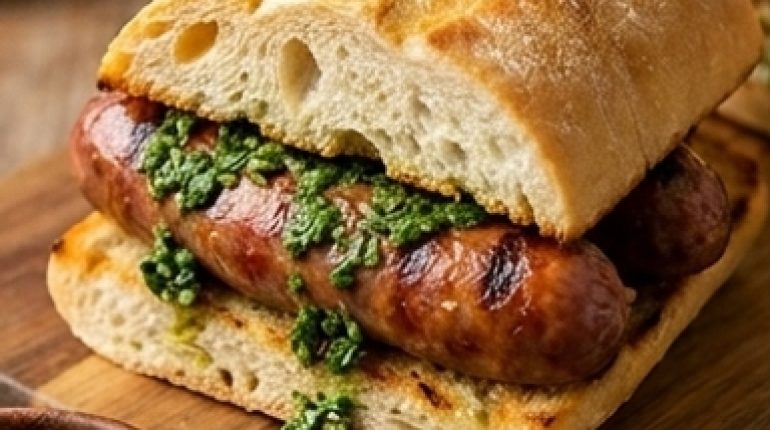
Imagine the bread — a firm ciabatta, lightly toasted, that crackles under your fingers before giving way. Inside, a lamb merguez whose skin has blistered on the barbecue, with those little almost-black spots that smell of smoked cumin and embers. On top, a generous spoonful of bright green, shiny chimichurri, with small pieces of parsley and garlic melting on the heat of the sausage. It drips a little. That’s normal. In fact, that’s the point.
Why you’ll love this recipe
Ingredient Notes
A few simple ingredients — that’s all it takes to make the best sandwich of your life.
- Lamb merguez : Look for artisanal merguez at a butcher — supermarket ones tend to be too thin and dry out quickly during cooking. A good merguez should be firm to the touch, with a natural casing that resists before snapping on the grill.
- Ciabatta or baguettine bread : The bread must be firm. Not a soft brioche-style baguette — the bread is going to soak up the sausage juices and chimichurri, and if it’s too soft, it collapses at the second bite. A well-aerated ciabatta or a half-baguette does the job perfectly.
- Flat-leaf parsley : Strictly flat-leaf parsley, never curly. Curly is more bitter, less fragrant, and chops poorly. For chimichurri, you want broad-leaf parsley that releases its essential oils under the knife — a peppery, herbaceous, almost anise-like smell.
- Garlic : Three cloves for four people is the baseline. Some use five. Raw garlic in chimichurri remains powerful even after infusing — if you’re not a big fan, stick to three cloves and avoid chopping it too finely.
- Red wine vinegar : This is the acidity of the chimichurri. One tablespoon is enough — the idea isn’t to make a vinaigrette, but to provide a touch of acidity that wakes up the herbs and counterbalances the sausage fat. Apple cider vinegar also works if that’s what you have on hand.
Why chimichurri is always prepared in advance
Raw chimichurri — what we call chimichurri fresco — needs time. Not two hours, not all night. Thirty minutes minimum, one hour is better. During this time, the olive oil infuses with the parsley, the garlic loses its aggressive edge, and the vinegar binds everyone together. Hand-chopped, not in a blender — you want pieces, not a green puree. The aroma rising from the bowl as you mix is already a promise: parsley, raw garlic, a slight vinegary acidity. If you taste it immediately after mixing, it’s sharp and unbalanced. Let it sit. That’s where the magic happens.
The part everyone misses: cooking the sausage
Merguez is cooked slowly. This is where everyone fails — a barbecue that’s too hot, sausage burnt on the outside and cold on the inside. You need two cooking zones: a high-heat zone to sear the skin, a gentler zone to finish. Two to three minutes over direct embers so the skin blisters and turns that deep mahogany color, then ten minutes in indirect heat so the meat cooks without drying out. When you prick it with a fork and the juice that comes out is clear — not pink — it’s ready. Resist the urge to poke it too early.
The bread needs to be toasted too
Not optional. Toasted bread is the boundary between a good choripan and an ordinary sandwich. Thirty seconds crumb-side down on the hot grill, just long enough for the surface to turn golden like light caramel and for the ciabatta holes to crunch slightly under your fingers. This toasted layer absorbs the sausage juices without getting soggy — it holds. And it adds that slightly smoky background that harmonizes perfectly with the chimichurri herbs.
Assembly: two seconds, no more
Don’t overthink it. Sausage in the bread, two spoonfuls of chimichurri on top. That’s it. Eat immediately, standing up if possible, because the choripan is a street sandwich before it’s a sit-down meal. The chimichurri will drip down the sides, the sausage juice will slightly soak the bottom bread — that’s exactly what’s supposed to happen. Have napkins ready.
Tips & Tricks
- Don’t cut the sausage in half lengthwise to speed up cooking — you’ll lose all the juices inside, and the merguez will end up dry. Leave it whole on the grill for even cooking.
- If you make the chimichurri the day before and put it in the fridge, take it out 20 minutes before serving: olive oil slightly solidifies in the cold and the sauce loses its vibrancy. At room temperature, it regains its fluid texture and aromas.
- Adjust the amount of red chili flakes to your tolerance — a pinch just gives depth, a full teaspoon and you’ll start feeling the heat rise. Start light, taste, and adjust.
Can I prepare the chimichurri in advance?
Yes, it’s even recommended. One hour of infusion is enough for the flavors to blend, but you can make it the day before and keep it in a closed jar in the refrigerator. Take it out 20 minutes before serving so it regains its fluid texture — olive oil solidifies slightly in the cold.
Can I cook the merguez without a barbecue?
Absolutely. A dry-heated cast iron skillet works very well: sear the merguez for 2-3 minutes on high heat to color them, then lower to medium heat, cover, and continue cooking for 8-10 minutes. The oven grill at 220°C also works, turning halfway through.
What can I substitute for lamb merguez?
Spicy beef sausage or poultry sausage with fennel are excellent alternatives. To stay in the Argentine spirit, look for a smoked beef sausage at a butcher. Smoked plant-based sausages also work surprisingly well with the herbaceous chimichurri.
Is choripan eaten with anything other than chimichurri?
In Argentina, some people add a salsa criolla — a brunoise of tomatoes, onions, and peppers seasoned with vinegar. But traditionally, choripan is eaten only with chimichurri. Resist the urge to add mustard or ketchup.
How to store leftovers?
Chimichurri keeps for up to 5 days in the refrigerator in an airtight jar. Cooked merguez keeps for 2 days in the cold, but is truly best freshly grilled. Reheat them in a pan rather than the microwave, and always keep the bread separate.
How to dose the chili in the chimichurri?
Start with a small pinch and taste before adding more — the chili is felt more after infusing than right after mixing. For a group with mixed tastes, serve the chili on the side so everyone can adjust in their own bowl.
Choripan with Chimichurri
Argentine
Main course
The quintessential Argentine street sandwich: a grilled lamb merguez in a crispy bread, topped with a fresh parsley and garlic chimichurri. Two ingredients, zero compromises.
Ingredients
- 4 lamb merguez (approx. 120g each)
- 4 firm bread rolls like ciabatta or baguettine
- 40g fresh flat-leaf parsley (1 bunch)
- 3 garlic cloves
- 1 c. à café dried oregano
- ½ c. à café red chili flakes
- 60 ml olive oil
- 1 c. à soupe red wine vinegar
- 1 c. à soupe fresh lemon juice
- 1 c. à café salt
- ½ c. à café ground black pepper
Instructions
- 1Finely chop the parsley and garlic. Mix in a bowl with oregano, chili flakes, olive oil, vinegar, and lemon juice. Season with salt and pepper. Let infuse for at least 30 minutes at room temperature.
- 2Prepare the barbecue with two zones: a direct-heat zone for searing and an indirect zone for finishing the cooking.
- 3Sear the merguez for 2-3 minutes on the hot zone until the skin blisters and turns a deep mahogany color.
- 4Move the merguez to the indirect zone and continue for 8-10 minutes, turning halfway through. They are ready when the juice that runs out is clear.
- 5Toast the bread crumb-side down on the grill for 30 seconds, until golden like light caramel.
- 6Slide a merguez into each bread and top generously with chimichurri. Serve immediately.
Notes
• The chimichurri can be prepared up to 24h in advance and stored in the refrigerator in an airtight jar. Take it out 20 minutes before serving.
• Do not prick the sausages during cooking — you would lose the juices that keep them moist.
• For a milder version, replace the merguez with slightly spiced beef sausages or poultry sausages with fennel.
Nutrition Facts (per serving, estimated)
| 580 kcalCalories | 25gProtein | 44gCarbs | 33gFat |