📌 Chocolate and shiitake: Charles Coulombeau’s bold recipe that reinvents pastry
Posted 9 February 2026 by: Admin
Chocolate Bases: Two Complementary Textures
The construction of this dessert is based on a precise technical principle: opposing two expressions of chocolate to create a dialogue of textures. On one side, a chocolate mousse made from 200g of milk, 140g of liquid cream, and 50g of honey, enriched with 36g of Guanaja-type dark chocolate and 7g of milk chocolate. This creamy base incorporates 30g of egg yolks whipped with 50g of sugar, guaranteeing an airy consistency.
On the other, an intense chocolate sorbet concentrates bitterness on a minimalist base: 60g of water, 10g of sugar, a touch of honey and glucose, 3g of cocoa powder, and 20g of dark chocolate. The contrast is asserted in the proportions: where the mousse dilutes the chocolate in fats to soften it, the sorbet concentrates it in ice water to exacerbate its character.
This duality is not just a matter of temperature. It establishes the foundations of a dessert where each bite alternates between milky roundness and icy vivacity, preparing the palate for more surprising associations. Charles Coulombeau thus orchestrates a progression: first the chocolate evidence, then the unexpected.
The Bold Association: Buckwheat And Mushroom Serving Chocolate
The unexpected arises with the buckwheat-shiitake sauce, a sharp break in the sweet universe. Charles Coulombeau combines 8g of roasted buckwheat and 2g of dried shiitake in 30g of water, adding 7g of liquid cream, 3g of butter, and a spoonful of maple syrup. The addition of soy sauce and a pinch of salt transforms this preparation into a vector of umami, that fifth flavor that amplifies the depth of chocolate without sweetening it.
This sauce does not play the card of gratuitous exoticism. It exploits the gustatory kinship between roasted cocoa and grilled buckwheat, while the shiitake brings woody notes that resonate with the bitterness of dark chocolate. The maple syrup softens without sweetening, the soy sauce enhances without being overtly salty.
Buckwheat returns in a second form: a crunchy element where 20g of grains are coated in maple syrup and dusted with cocoa powder. This dry preparation contrasts with the fluid sauce, creating a play of crunchy textures that anchors the dessert in an almost savory dimension.
This audacity reveals Coulombeau’s signature: repurposing Japanese cuisine ingredients to enrich French pastry, without pastiche. The mushroom and buckwheat do not decorate, they structure. The walnut will complete this balance between sweetness and character.
The Walnut Dimension: From Parfait To Caramelization
The walnut extends this gustatory architecture in four technical variations. The walnut parfait combines 60g of egg yolks with 30g of sugar, 200g of liquid cream, and three gelatin leaves, all enriched with a spoonful of praline. This creamy base offers a semi-frozen texture that contrasts with the chocolate sorbet, while creating an aromatic bridge to the brownie.
The walnut sauce amplifies this presence: a handful of roasted kernels mixed with two spoons of liquid cream, a spoon of brown sugar, a knob of butter, and a spoon of honey. A few drops of soy sauce and a pinch of fleur de sel reproduce the salty-sweet balance already explored with the shiitake. This sauce coats without weighing down, strengthens without masking.
Caramelized walnuts provide the crunch: 9g of whole kernels glazed in a syrup of 9g of sugar and 18g of water, then seasoned with fleur de sel. This classic confectionery technique creates golden shards that punctuate the plating.
Finally, 80g of crushed walnuts are integrated into the melting brownie, where 90g of dark chocolate merges with 110g of butter, six eggs, and 270g of flour. The addition of 50g of bread powder lightens the crumb without sacrificing moistness. This quadruple presence of the walnut weaves an aromatic coherence that unifies mousse, parfait, sauce, and cake. The finishes will seal this composition.
Chef’s Finishes: Sauces And Decorative Elements
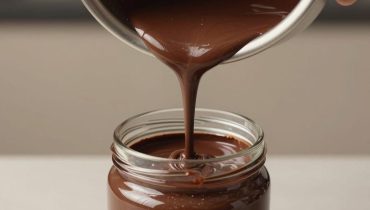
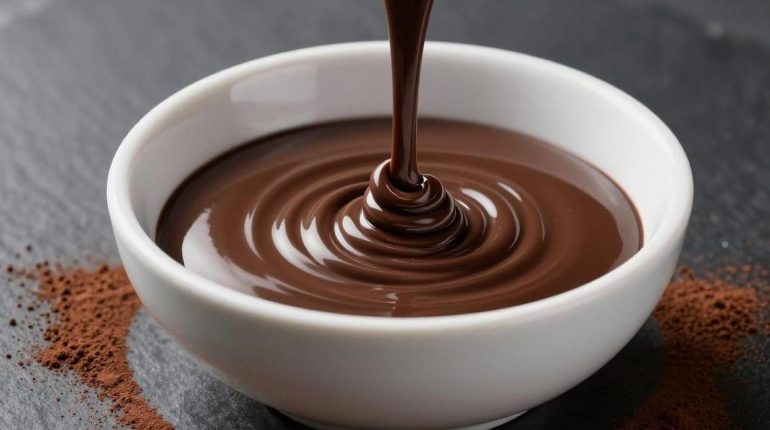
The finishing elements transform this technical composition into a spectacular dessert. The shiny chocolate sauce balances 20g of liquid cream and 20g of milk with 30g of dark chocolate and 10g of milk chocolate, all enhanced by a pinch of fleur de sel. This lacquered emulsion coats without freezing, providing a visual brilliance that contrasts with the matte cocoa powder of the brownie.
The chocolate paper pushes technicality to its peak: 10g of sifted icing sugar, 5g of flour, and a spoonful of cocoa powder form an ultra-fine paste with a spoonful of milk and a spoonful of melted butter. Spread to the nearest micron then dried, this crunchy lace stands as an airy veil. Its extreme fragility requires delicate handling but rewards with a striking architectural effect.
The assembly of the melting brownie concludes the preparation: six eggs beaten with 110g of sugar, 110g of melted butter, and 90g of dark chocolate, then bound by 270g of flour and 50g of bread powder. The 80g of crushed walnuts are dispersed within to create crunchy pockets in a flowing crumb. Baked to a soft heart, this cake forms the terrestrial base of the dessert.
These finishes require 2h30 of active handling and 12h of rest for the frozen textures. For ten guests, Charles Coulombeau orchestrates mousse, sorbet, parfait, sauces, crunchies, and brownie in a score where each element dialogues without ever merging. The final plating will reveal this gustatory architecture where chocolate, walnut, buckwheat, and shiitake compose a gastronomic experience that defies traditional dessert conventions.