📌 Chocolate and praline rolled log: the professional recipe in 4 steps for 8 to 10 servings
Posted 21 December 2025 by: Admin
Preparation Of The Cocoa Sponge Cake
The success of a rolled log relies on a precise technical foundation. The cocoa biscuit requires four medium-sized eggs, 120 grams of powdered sugar, 80 grams of sifted flour, and 20 grams of unsweetened cocoa. These proportions are not random: they guarantee the elasticity necessary for rolling without breaking.
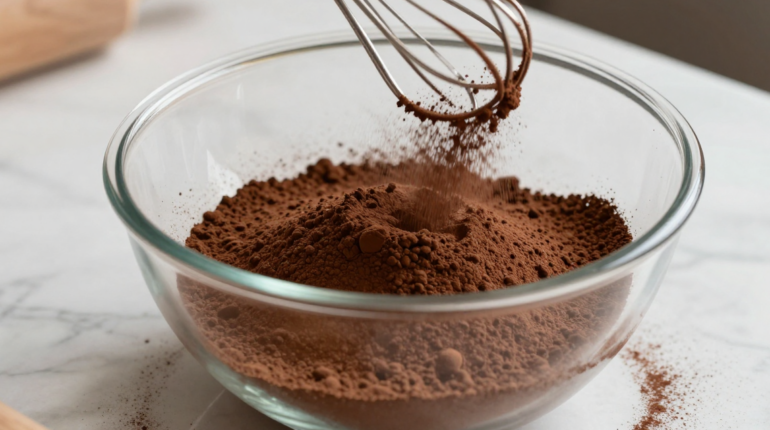
Sifting the flour and cocoa is a non-negotiable step. This operation eliminates lumps and incorporates air into the powders, thus promoting an airy texture. The pinch of salt, often neglected, plays a subtle but decisive role: it reveals the chocolate notes by creating a contrast that amplifies the aromatic depth.
The ratio between eggs and sugar defines the very structure of the biscuit. Too much flour would make it dry and brittle when rolling. Too little, and the batter would collapse without holding its shape. This alchemy of proportions, inherited from French pastry techniques, transforms simple ingredients into a perfectly flexible base.
Mastering these fundamentals separates an approximate attempt from a professional realization. But even the most successful biscuit needs a complement to reach its full taste potential and maintain its softness over time.
Soaking Syrup And Strategic Hydration
This discreet complement separates amateur achievements from professional creations. The soaking syrup combines 80 milliliters of water with 40 grams of sugar, brought to a boil and then cooled. This simple formula radically transforms the texture and lifespan of the log.
Professional pastry chefs systematically flavor this syrup. A teaspoon of vanilla extract brings a gourmet roundness, while a tablespoon of strong coffee intensifies the cocoa notes of the biscuit. This personalization creates a distinctive taste signature.
The “optional but recommended” label deserves clarification: technically optional, this syrup guarantees lasting softness. Without it, the biscuit dries out quickly, particularly in the refrigerator where the cream absorbs residual moisture. Soaking creates a protective barrier that maintains flexibility for several days.
Application is done with a brush on the still-warm biscuit, just before filling. The residual heat promotes the penetration of the syrup into the cells of the biscuit. This strategic hydration perfectly prepares the base to receive the creamy filling that will define the character of the log.
Triple Texture Praline Cream
The filling constitutes the gustatory soul of this log. The praline cream requires 250 milliliters of liquid cream with 30% fat content, imperatively refrigerated for several hours before use. This cold temperature guarantees optimal whipping during assembly.
The association of 120 grams of praline paste with 40 grams of mascarpone creates a remarkable alchemy. The praline brings its assertive character of caramelized hazelnuts, while the mascarpone softens the whole and provides that characteristic creaminess of high-end creations. This combination avoids the pitfall of a cream that is too sweet or too dense.
The assembly technique determines the final success. The cream is first whipped alone to a firm consistency, then the praline and mascarpone are delicately incorporated. This method preserves the airy volume while uniformly distributing the flavors. A tablespoon of icing sugar can adjust the sweetness according to preference.
This triple texture cream is spread generously on the soaked biscuit, reserving a thin layer to mask the outside of the rolled log. The regular thickness ensures a harmonious spiral when cut, revealing the visual contrast between the chocolate biscuit and the light filling. The exterior finish ideally prepares the surface to receive the shiny glaze that will crown the whole.
Shiny Glaze And Decorative Finalization
The glaze transforms this achievement into a spectacular piece of pastry. The recipe requires 150 grams of dark pastry chocolate between 50 and 60% cocoa, a crucial proportion to obtain that signature shine of professional creations. A chocolate that is too bitter or too sweet would compromise the taste balance against the praline cream.
The preparation technique dictates the final result. The liquid cream (120 milliliters) is heated until the first simmer before being poured over the crushed chocolate. After thirty seconds of rest allowing for homogeneous melting, the addition of 20 grams of unsalted butter brings that characteristic fluidity. The mixture is emulsified until perfectly homogeneous, without excessive manipulation that could incorporate air and dull the surface.
Application is carried out on a log refrigerated for at least two hours. The cooled glaze is coated in a fluid gesture, from the center to the ends, then delicately smoothed with a spatula. This controlled temperature guarantees a progressive setting without brutal hardening.
The final decoration personalizes the creation. Melted chocolate lines trace graphic patterns, while sugar pearls or hazelnut chips add relief and texture. These elements are placed quickly, before the glaze completely sets. Crushed praline subtly recalls the internal filling, creating visual and gustatory coherence.
A final refrigeration of one hour stabilizes the whole before serving, the moment when this log fully reveals its architecture in successive layers.