When the saffron touches the hot broth, something shifts in the kitchen — a scent between earth and sea, slightly bitter, deeply fragrant, that clearly announces what’s coming. Catalan paella is that kind of dish that turns an ordinary meal into a memorable gathering without keeping you stuck in the kitchen for three hours. A big pan, fresh seafood, a bit of technique — and you impress without making life complicated.
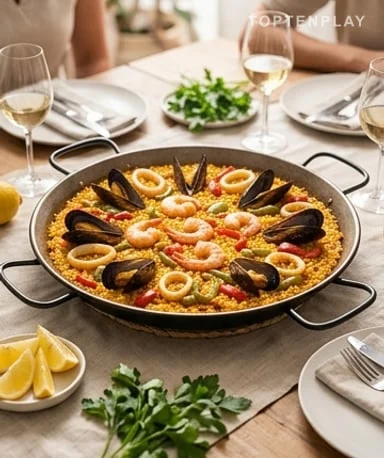
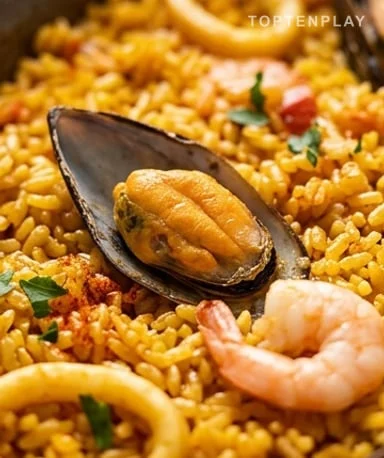
In the still-steaming pan, the mussels have opened their shells to reveal pearly orange flesh. The rice has absorbed all the saffron broth and taken on that characteristic golden hue — not completely uniform, with variations depending on the heat zones, which is exactly how it should be. Beneath the rice layer, if you’ve managed the heat well, a light crust begins to form: that’s the socarrat, the hallmark of a true paella. The pink shrimp and calamari rings stand out against this amber background.
Why you’ll love this recipe
Ingredient Notes
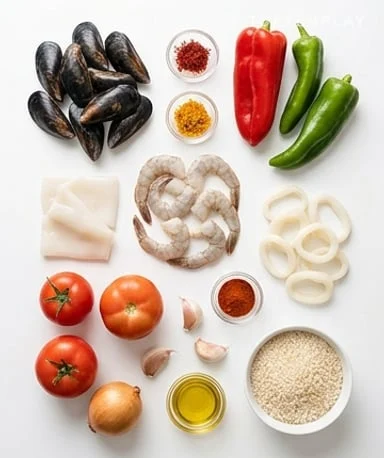
Fresh seafood, paella rice, colorful bell peppers, and saffron: simple ingredients for a spectacular result.
- Paella rice : Paella rice — Bomba or Calasparra varieties if you can find them — absorbs two to three times its volume in liquid without becoming mushy. This absorption capacity allows the grains to capture the saffron broth’s flavors. Avoid basmati rice, which doesn’t hold up to prolonged cooking, and especially risotto rice, which releases too much starch and would turn your paella into creamy porridge.
- Fresh mussels : Mussels do two things in this dish: they bring a pronounced briny flavor and release their natural juice during cooking, enriching the broth from within. Buy them on the day, closed and heavy. Discard any that refuse to close when you tap the shell before cooking, and those that remain closed after — these are reliable signs of freshness.
- Saffron threads : Saffron gives paella its golden color and floral-earthy taste that can’t be replicated otherwise. To get the most out of it, steep the threads in a few spoonfuls of hot broth for ten minutes before adding them to the pan — hot water extracts pigments and aromas far better than direct contact with oil.
- Peeled shrimp : Shrimp balance the intense brininess of mussels with a slightly sweet mildness. They cook very quickly — two to three minutes is enough — and should be added at the very end to stay tender. For presentation, a few whole shrimp with shells placed on top add more visual character and a stronger flavor.
- Fish broth : The broth is the foundation of all rice flavor: the grains will absorb it completely, so its quality really matters. Homemade or high-quality broth makes a real difference compared to commercial cubes, which are often too salty and flat. If you don’t have any, a robust vegetable broth works as a backup. Keep an extra ladle handy — some rices absorb faster than expected.
- Sweet paprika : Paprika adds color and a slight smoky-sweet note that complements the saffron. Add it to the hot fat, over the garlic and onion, rather than directly into the broth: a quick sauté in oil releases its aromas much better. Be careful not to let it burn — it quickly turns from fragrant to bitter.
The sofrito: don’t rush this start
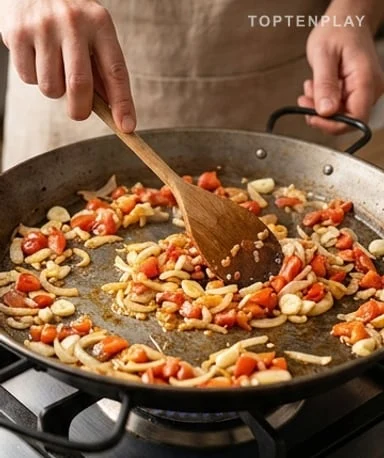
Everything begins here, and this is where most paellas fail before the rice even hits the pan. The sofrito — onion, garlic, peppers, and tomatoes melted in olive oil — is the aromatic base that conditions everything that follows. Start with the sliced onion in hot oil over medium heat. It needs to become translucent and lightly golden, which easily takes ten minutes — the smell should go from pungent to sweet, almost sugary. Then add the minced garlic and red and green pepper strips. They will soften gradually, their juices concentrating in the pan bottom. When the peppers have lost their crunch and begin to take on color, incorporate the crushed tomatoes. Let them cook until almost all the liquid has evaporated and the mixture has a thick, almost confit consistency. That’s when the paprika goes in — thirty seconds in the hot fat, then the broth arrives.
The saffron broth builds flavor depth
Pour the hot fish broth over the sofrito — the thermal shock triggers an immediate boil and a fragrant steam cloud rises from the pan. Add the saffron infusion made separately: the pan instantly takes on that characteristic golden amber color. Taste the broth before adding the rice — this is your last chance to adjust salt, because once the grains are in, they will absorb the liquid and concentrate flavors. The broth should taste slightly too salty at this stage, that’s normal. Bring to a boil, then add the calamari rings: they need about fifteen minutes of cooking over medium heat to become tender, and now is the time for them to cook without risking drying out.
The rice: pour and don’t touch
Add the rice in a steady rain over the entire surface of the pan and spread it quickly to get an even layer. From this moment on, one absolute rule: you do not stir. Ever. Unlike a risotto, paella requires leaving the rice alone so that the socarrat — the caramelized crust on the bottom — can form. The rice will cook by absorbing broth from below, and the top grains will finish steaming. Maintain medium-high heat for the first ten minutes; the broth should bubble steadily around the rice, then reduce slightly as the liquid level drops. Around the fifteenth minute, pinch a grain of rice between your fingers — it should be cooked but still slightly firm in the center, and the broth almost entirely absorbed.
The seafood arrives last — on purpose
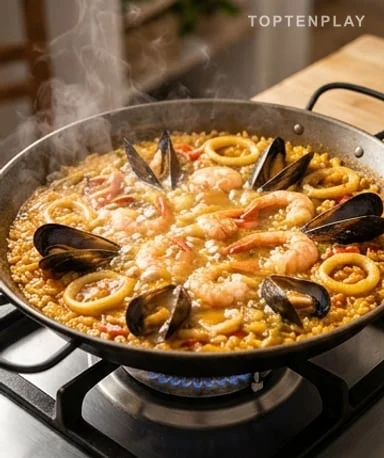
When about five minutes of cooking remain, distribute the mussels and shrimp over the rice. Place the mussels flat, hinge side down, so they open properly under the heat. Tuck the shrimp between the mussels. Cover the pan with a lid or aluminum foil — the trapped steam will cook the seafood from above while the bottom continues to sear. After four to five minutes, the mussels are open and the shrimp have turned pink. The sound has changed too: the active bubbling of the beginning has given way to a gentle crackling from the bottom — that’s the socarrat forming, not a warning signal.
Put the pan in the center and let people serve themselves
Remove from heat, sprinkle with fresh chopped parsley, and let rest uncovered for two minutes — the rice finishes homogenizing and the flavors stabilize. Place the pan in the center of the table on a sturdy trivet, with lemon wedges all around. The lemon is not decoration: a few drops squeezed over the mussel meat or shrimp cut through the olive oil and awaken all the marine flavors. Everyone serves themselves directly from the pan — it’s both simpler and more convivial than plating. And if the socarrat has formed well, people will be scraping the bottom at the end.
Tips & Tricks
- Steep the saffron in hot broth for ten minutes before adding it — the threads release their pigment and flavor much better in hot liquid than directly in cold oil or broth during cooking.
- Never stir the rice after pouring it into the pan — this allows the socarrat to form on the bottom and keeps the grains separate rather than sticky and starchy.
- Keep a ladle of hot broth in reserve during cooking — if the rice absorbs too quickly and starts to stick before it’s cooked, add a splash of hot liquid around the edges without stirring.
- Add the shrimp and mussels only at the very end of cooking — five minutes under cover is plenty, and you avoid rubbery shrimp and shrunken mussels that have released all their water into the rice.
Can you prepare the paella in advance?
The sofrito (onion, garlic, peppers, tomatoes) can be made the day before and stored in the fridge. However, the rice and seafood must be done at the last minute — reheated rice loses its texture and reheated seafood becomes rubbery.
How to avoid the rice being too dry or too sticky?
The ratio to follow is about 2 volumes of broth to 1 volume of rice, but rice varieties vary. Always keep a ladle of hot broth in reserve: if the rice absorbs too quickly before it’s cooked, add a splash around the edges without stirring. Conversely, if the broth is slow to absorb, raise the heat slightly.
Do you absolutely need paella rice?
Ideally, yes. Paella rice (Bomba, Calasparra) absorbs broth without disintegrating, giving distinct, well-flavored grains. Long-grain basmati doesn’t hold up to prolonged cooking, and risotto rice releases too much starch — you’d get a creamy texture far from a paella.
What is socarrat and how to achieve it?
Socarrat is the light caramelized crust that forms on the bottom of the pan at the end of cooking. To get it, never stir the rice after pouring it and maintain medium-high heat until the broth is absorbed. A gentle crackling from the pan bottom, accompanied by a slightly toasted smell, signals it’s forming.
Can you use frozen mussels?
Frozen (pre-cooked) mussels work as a backup, but they have a major drawback: they don’t release their natural juice during cooking, which deprives the broth of much of its briny depth. If you use them, add them at the very end just to warm through — they are already cooked, and overcooking a pre-cooked mussel makes it tough and tasteless.
What pan size for 6 people?
A paella pan 40-45 cm in diameter is suitable for 6 people with 500g of rice. The practical rule: the rice should form a layer about 1.5 cm thick before adding the broth. Too thick a layer doesn’t cook through; too thin a layer dries out too fast.
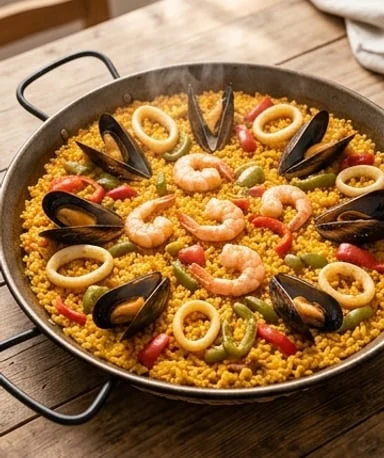
Catalan Paella with Mussels and Shrimp
Spanish
Main dish
A generous seafood paella fragrant with saffron, with fresh mussels, shrimp, and calamari on golden rice that has absorbed all the fish broth. The great convivial dish that carries itself.
Ingredients
- 500g paella rice (Bomba or Calasparra)
- 1kg fresh mussels, cleaned and scrubbed
- 300g peeled shrimp
- 200g calamari rings
- 1 red bell pepper, cut into strips
- 1 green bell pepper, cut into strips
- 2 ripe tomatoes, crushed
- 1 onion, sliced
- 3 garlic cloves, minced
- 1 liter fish broth, hot (+ 1 ladle reserved)
- 1 generous pinch saffron threads
- 1 tsp sweet paprika
- 4 tbsp olive oil
- 1 bunch fresh parsley
- 2 lemons, cut into wedges
- salt and pepper
Instructions
- 1Steep the saffron threads in 4 tbsp of hot broth for 10 minutes.
- 2Heat the olive oil over medium heat in a large paella pan (40-45 cm). Sauté the sliced onion for 8-10 minutes until translucent and lightly golden.
- 3Add the minced garlic and red and green pepper strips. Cook for 8 minutes, stirring, until the peppers are tender.
- 4Stir in the crushed tomatoes and cook for 5-7 minutes until almost all liquid has evaporated. The mixture should be thick and concentrated.
- 5Add the sweet paprika, stir for 30 seconds in the fat, then pour in all the hot broth and the saffron infusion. Bring to a boil.
- 6Add the calamari rings. Simmer for 10 minutes over medium heat.
- 7Taste and adjust salt. Sprinkle the rice evenly over the entire surface and spread it uniformly. Do not stir from now on.
- 8Cook for 15-18 minutes over medium-high heat. The broth should bubble steadily around the rice for the first ten minutes, then decrease as the rice absorbs the liquid.
- 9When the broth is almost fully absorbed, distribute the mussels (hinge side down) and shrimp over the rice. Cover with a lid or aluminum foil.
- 10Cook for 5 minutes: the mussels should be open and the shrimp pink. A gentle crackling from the bottom indicates the socarrat forming.
- 11Remove from heat, let rest uncovered for 2 minutes, sprinkle with chopped parsley, and serve directly from the pan with lemon wedges.
Notes
• The sofrito can be made the day before and stored in the fridge — this reduces cooking time on the day to about 25 minutes.
• Always keep a ladle of hot broth in reserve: if the rice absorbs too quickly before it’s cooked, add a splash around the edges without ever stirring.
• Discard any mussels that remain closed after cooking — they are not safe to eat.
• A few whole shrimp with shells placed on top before covering gives a more dramatic presentation and a more pronounced flavor.
Nutrition Facts (per serving, estimated)
| 520 kcalCalories | 28gProtein | 62gCarbs | 12gFat |