📌 Carrot Juice with Lemon and Honey
Posted 20 April 2026 by: Admin
Carrot juice is the kind of thing you’d never order in a café. Too sensible, too healthy, too boring. And yet, since I started making it in the morning, I finally understand why some people are addicted to it.
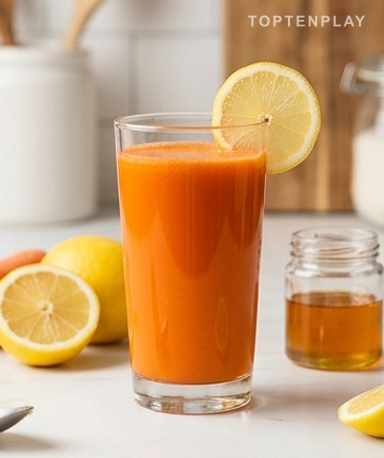
In the glass, it’s bright orange — not the dull orange of supermarket bottles, but a bold, almost luminous orange, like a freshly peeled carrot. The smell is light and vegetal at first, then the lemon gently takes over. A fresh sip, slightly sweetened by the honey, with that acidity that wakes up the palate without being aggressive. It’s simple. Surprisingly good.
Why you’ll love this recipe
Ingredient Notes
Three carrots, a lemon, raw honey, and water: the simple quartet of this morning drink.
- The carrots : Choose them firm and bright orange. Soft or too thin carrots yield little juice and a flat taste. Medium sizes are ideal — neither too big with a woody core, nor too small. No need to peel them if they are organic, otherwise yes.
- The lemon : A small, bright yellow lemon, not too big. The juice of half a lemon is enough if you don’t like bold acidity. Squeeze it just before blending to keep the aromas — lemon juice squeezed an hour ago quickly loses its brightness.
- Raw honey : Unpasteurized raw honey has a thick, almost crystallized texture and a stronger taste than standard honey. If you don’t have any, ordinary wildflower honey works just fine. Dose according to your sugar tolerance — one teaspoon is enough to balance without oversweetening.
Before blending
Peel your carrots and cut them into 3-4 cm chunks. No need to be precise. The important thing is that your blender can handle them without struggling. If your appliance is a bit low on power, put the water in first, then the carrots on top — it helps it get started. Squeeze your lemon at the last moment. The scent rising from the cut lemon is already promising, tangy, almost sharp.
The blender does the work
Everything into the blender: carrots, lemon juice, water, honey. Run at full power for a solid minute. The sound changes when the texture becomes consistent — no more hard thumps against the sides, just a steady, dull hum. The color in the blender turns a deep, opaque orange, almost terracotta. It’s done when you can no longer see any pieces.
To strain or not to strain
This is where you pick a side. If you leave the fibers, the juice is thick, almost like a light smoothie — filling. If you strain it through a fine sieve or a clean cloth, you get something more liquid, a translucent and shiny orange, pleasant to drink in one go. The fibers are useful. The strained juice is more visually appealing. Both have their merits.
Tips & Tricks
- Drink it within 20 minutes of preparation — carrots oxidize quickly and the color turns to a less attractive orange after this time.
- Add a 1 cm piece of fresh ginger to the blender if you want a version that slightly warms the throat — it completely changes the profile of the juice.
- If you find the taste too earthy, a slice of apple in the blender balances it very well without masking the carrot.
Can I prepare this juice the night before?
Technically yes, but it’s not ideal. Carrots oxidize and the juice loses its color and freshness after a few hours. If you must prepare it in advance, store it in an airtight jar in the fridge and drink it within 12 hours maximum.
Do I need a high-powered blender?
A standard blender does the job just fine, provided you cut the carrots into small chunks and put the water in first. If you are going to strain the juice anyway, even an entry-level blender is sufficient — the fibers caught by the sieve compensate for imperfect blending.
Can I replace honey with something else?
Yes, no problem. Agave syrup gives a very similar result, more neutral in taste. Coconut sugar also works but leaves a slight brown tint in the juice. If your carrot is naturally sweet, you can also omit it entirely.
Can I make this juice without a blender, using a juicer?
Yes, and it’s even better for strained juice — the juicer automatically separates the juice from the fibers and gives a clearer result. Simply add the lemon juice and honey to the glass after extraction.
What is the difference between strained and unstrained?
Unstrained is thicker, more filling, and you keep the carrot fibers. Strained is more liquid, lighter to drink in the morning, and visually more beautiful. Both provide the same essential nutrients, only the fiber content differs.
Carrot Juice with Lemon and Honey
International
Beverage
A very simple morning juice: three carrots, one lemon, a spoonful of honey. Ready in 10 minutes, surprisingly good.
Ingredients
- 3 medium (approx. 300g) carrots, peeled and cut into chunks
- 30 ml (juice from ½ to 1 lemon) fresh lemon juice
- 1 teaspoon (7g) raw honey (or wildflower honey)
- 250 ml (1 cup) water
Instructions
- 1Peel the carrots and cut them into 3-4 cm chunks.
- 2Squeeze the lemon and set the juice aside.
- 3Pour the water into the blender first, then add the carrots, lemon juice, and honey.
- 4Blend at full power for 1 minute until smooth.
- 5Strain through a fine sieve or a clean cloth for a smooth juice (optional).
- 6Pour into a large glass and drink immediately.
Notes
• Consume within 20 minutes after preparation to enjoy the vivid color and fresh aromas.
• Ginger variation: add 1 cm of peeled fresh ginger to the blender for a more tonic version.
• Storage: up to 12h in the fridge in a closed airtight jar, stirring before drinking.
Nutrition Facts (per serving, estimated)
| 145 kcalCalories | 3gProtein | 35gCarbs | 0.5gFat |