Have you ever looked at the clock at 5 PM wondering how to feed guests without looking like you’ve fought a war with your kitchen? Carne guisada solves that problem. Beef, spices, a little patience on the stove — and you arrive at the table with something that looks like a dish prepared with real intention.
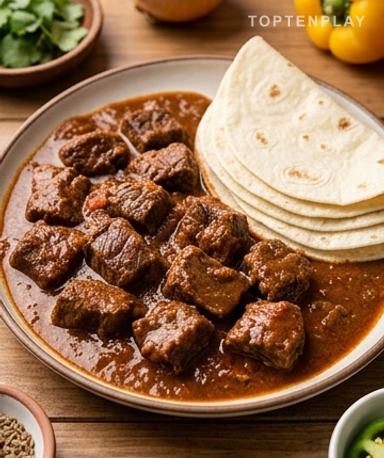
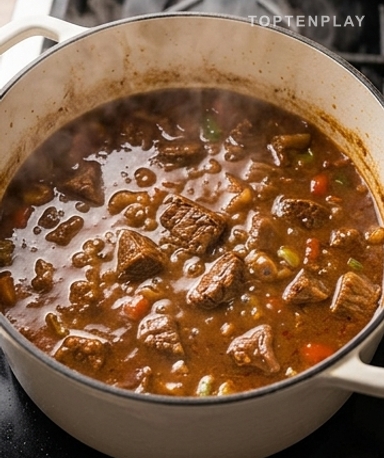
The beef is cut into large irregular cubes, drowned in a mahogany-brown sauce that catches the light. Not runny, not dry — just that balance point where every piece is coated in cumin, chili, and meat juices melted together. The smell wafting from the pot is warm, almost smoky, with that earthy note of cumin beginning to open up. Set aside, a stack of warm flour tortillas, as soft as clean fabric fresh out of the dryer.
Why you’ll love this recipe
Ingredient Notes
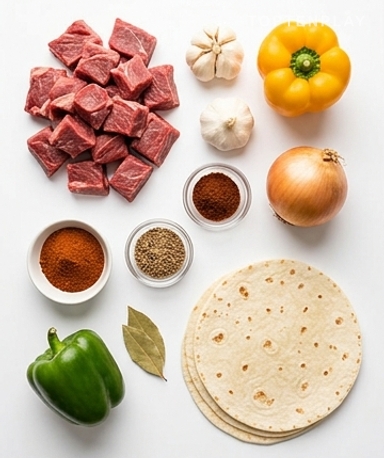
All ingredients gathered before starting: beef chunks, peppers, garlic, onion, and the spices that make all the difference.
- The beef — chuck roast or shoulder : This is the base, so choose well. Chuck roast is perfect here: it’s a hard-working muscle, rich in collagen, which will melt during cooking and naturally thicken the sauce. Avoid grilling cuts — they will become stringy. Cut into fairly large cubes (4-5 cm), they will shrink during cooking.
- Chili powder : Not pure Cayenne pepper — real Tex-Mex chili powder, which is a blend of dried chilies, cumin, oregano, and sometimes garlic powder. If you can’t find it easily, mix 2 parts mild paprika with 1 part cumin, half a part oregano, and a pinch of cayenne. It’s almost the same.
- Ground cumin : The spice that truly defines this dish. Freshly ground cumin is more fragrant — if you have whole seeds and a dedicated spice grinder, now is the time to use them. But store-bought ground cumin works just fine too.
- Bell peppers : Preferably green for the slight bitterness they bring to the base of the sauce, rather than red which is too sweet. Cut them into medium pieces — they will almost disappear into the sauce but contribute to the overall taste, discrete and indispensable.
- Flour tortillas : Get small ones, street taco size. Heat them directly in a dry pan for 30 seconds per side — they puff up slightly, brown like light caramel in spots, and become perfectly soft. A cold, rubbery tortilla ruins the dish.
Why searing the meat is not an optional step
Many stew recipes mention ‘searing the meat’ without explaining why — consequently, people do it halfway or not at all. This is a mistake. When beef cubes touch a very hot pan, they emit a loud sizzle that decreases in intensity after 30 seconds — that’s the sign that the Maillard reaction is happening. This browning creates a caramelized layer on each side, and that layer is pure flavor. Once dissolved in the sauce, it gives that depth you can’t get any other way. Work in small batches without crowding the pan, otherwise the meat boils in its own juices instead of searing. Two batches are better than one failed attempt.
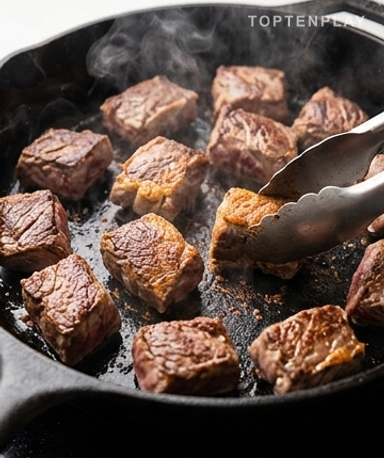
The bottom of the pan: the part everyone gives up on too fast
After removing the seared beef, brown bits remain stuck to the bottom, almost black in places. Do not clean it. This is where we sauté the onion, garlic, and peppers — the vegetables will release their water and naturally deglaze all that caramelized goodness. The smell at this moment is bold and direct: the garlic begins to golden, the peppers soften, and the whole pan smells like a neighborhood restaurant kitchen. When the vegetables are translucent, add the spices directly to the pan for one minute before the liquid. They will release their aromas into the fat, and the final sauce will be much more complex.
Simmering: how long is actually how long
One hour and thirty minutes over low heat, lid slightly ajar. Not 45 minutes because you are hungry. The difference between meat that resists the bite and meat that melts is entirely there, in that extra hour. The sauce starts thin, almost like a spicy broth. Around the 1-hour mark, it thickens and gains body — at this point you can add a tablespoon of cornstarch dissolved in a little cold water if you want to speed things up. At 1h30, dip a spoon and taste. The sauce should coat the back of the spoon without running too much. It’s ready when it’s ready.
Serving: don’t overcomplicate what is already good
Carne guisada doesn’t need an elaborate garnish. A bowl, a generous ladle, warm tortillas on the side. If you want, a few slices of fresh jalapeño for those who like heat, some chopped cilantro. A squeeze of lime juice just before serving — the acidity wakes up the spices and cuts through the richness of the sauce. Offer a second bowl before anyone even asks.
Tips & Tricks
- Prepare double the amount and freeze some. Carne guisada freezes very well, and having this in the freezer is insurance for lazy nights when you want to eat something real.
- If your sauce is too thin at the end of cooking, remove the lid and turn up the heat for 10-15 minutes. It will reduce quickly. Avoid adding flour if you can — a natural reduction gives a much more flavorful sauce.
- The quality of the broth changes the result. If you use bouillon cubes, dilute them with slightly less water than indicated — they are often too salty and too light compared to a high-quality store-bought or homemade stock.
Can I prepare carne guisada the day before?
It is actually recommended. Like all stews, carne guisada is better after a night in the fridge — the spices settle, the sauce thickens, and the flavors harmonize. Reheat over low heat with a splash of water or broth if necessary.
What meat should I use if I can’t find chuck roast?
Shoulder, shank, or bottom round roast work very well. The key is to choose a cut rich in collagen, designed for slow cooking. Avoid ribeye or sirloin — they become dry and stringy with prolonged heat.
My sauce is too thin, how can I fix it?
Remove the lid and let it reduce over medium heat for 10-15 minutes — this is the cleanest method. If you are in a hurry, dissolve a tablespoon of cornstarch in a little cold water and stir it in. Let it thicken for 5 minutes.
Can I freeze this dish?
Yes, without any problem. Freeze only the stew, without the tortillas. In individual portions in airtight bags or containers, it keeps for 3 months. Thaw in the fridge overnight and reheat gently.
Corn or flour tortillas — does it really make a difference?
Yes, quite a bit. Flour tortillas are softer, thicker, and absorb the sauce better — they are better suited for a stew. Corn tortillas have more character and flavor, but they are more fragile and can break during use.
How do I know if the meat has simmered enough?
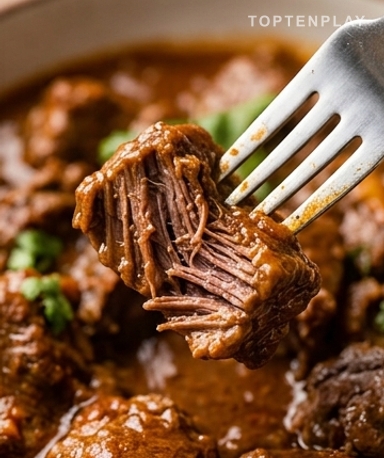
Poke a fork into a cube and twist slightly — the meat should fall apart without resistance. If it shreds easily without forcing, it’s perfect. If it bounces back a bit, cover and leave for another 15 to 20 minutes.
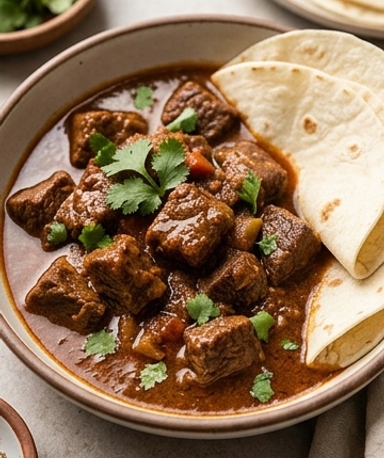
Carne Guisada with Flour Tortillas
Tex-Mex
Main Course
A Tex-Mex beef stew simmered in a thick cumin and chili sauce, served with warm flour tortillas. Simple to prepare, impossible to fail.
Ingredients
- 800g beef chuck roast (or shoulder), cut into 4-5 cm cubes
- 2 tbsp neutral vegetable oil
- 1 large yellow onion, sliced
- 4 cloves garlic, finely minced
- 2 green bell peppers, diced
- 2 tbsp chili powder (or 1 tbsp paprika + 1 tsp cumin + 1/2 tsp cayenne)
- 1.5 tsp ground cumin
- 1 tsp salt
- 1/2 tsp garlic powder
- 2 tbsp tomato paste
- 400ml beef broth
- 1 tbsp cornstarch (optional, for thickening)
- 8 small flour tortillas (street taco size)
Instructions
- 1Mix the chili powder, cumin, salt, and garlic powder in a bowl. Coat the beef cubes with this mixture and set aside.
- 2Heat oil in a large pot over high heat. Sear the beef cubes in 2 batches, 3 to 4 minutes per side, until a caramel-brown crust forms. Set the meat aside.
- 3In the same pot, sauté the onion, garlic, and bell peppers for 5 to 7 minutes over medium heat, scraping the bits from the bottom with a spatula.
- 4Add the tomato paste and let it sauté for 1 minute while stirring. Return the beef to the pot.
- 5Pour in the beef broth, mix well, and bring to a simmer. Partially cover and simmer for 1h30 over low heat.
- 6If the sauce is still too thin, dissolve the cornstarch in 2 tbsp of cold water, stir into the pot, and let thicken for 5 minutes over medium heat.
- 7Heat the tortillas in a dry pan for 30 seconds per side. Serve the stew in bowls with the warm tortillas.
Notes
• Make-ahead: Prepare the carne guisada the day before, it’s even better reheated. Keeps for 4 days in the fridge.
• Freezing: Freeze the stew alone (without tortillas) in individual portions for up to 3 months. Thaw in the fridge and reheat over low heat with a splash of broth.
• Spicier variation: Add 1 or 2 chopped chipotle peppers in adobo sauce with the vegetables for a smoky and spicier taste.
Nutrition Facts (per serving, estimated)
| 490 kcalCalories | 33gProtein | 34gCarbs | 24gFat |