Have you ever bitten into a pastry and felt the layers separate under your teeth, clean, like the pages of a book being flipped? The Caribbean Twist does exactly that. Except, it also has mango, coconut, and that tangy passion fruit undertone that wakes you right up.
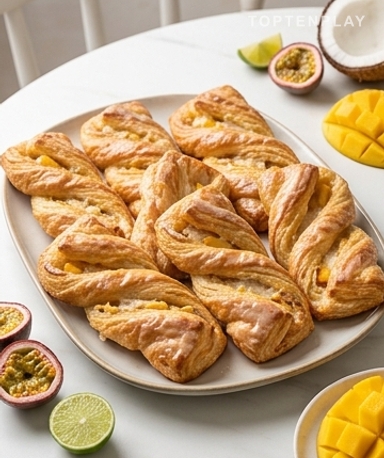
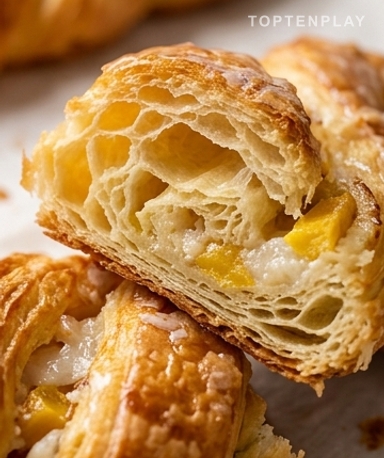
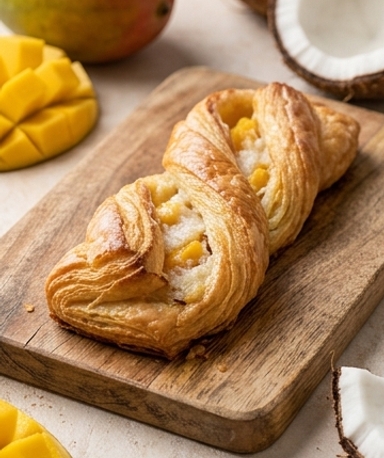
Place it on the table. It has this deep honey color, almost amber caramel on the ridges, with edges that have slightly crackled during baking. Touch it: the crust yields with a dry crunch, then the dough gives way in layers. Inside, the coconut-mango filling is melting, almost creamy, with bright orange dots revealing the diced mango. The aroma rising is warm butter mixed with vanilla and something fruitier, slightly sweet and sour.
Why you’ll love this recipe
Ingredient Notes
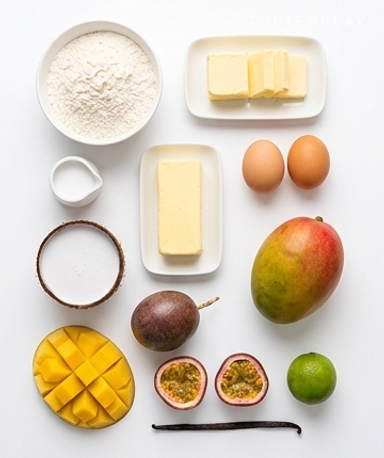
Everything needed for these tropical pastries: flour, butter, exotic fruits, and coconut milk.
- The laminating butter : The one place where you really shouldn’t skimp. A dry butter with at least 84% fat content—Charentes-Poitou AOP is perfect. Standard butter is too wet and will melt and stick instead of creating layers. You can physically feel the difference under the rolling pin: dry butter resists, almost snaps, while the other just slides.
- Coconut milk : Full-fat, not light. The light version is mostly water with a hint of flavor. For the filling to be creamy and not runny when baked, you need the full version. Shake the can before opening: if it sounds thick, that’s a good sign.
- Mango : Fresh if in season, frozen otherwise—it works very well and is even more practical. Important: very ripe, bright orange inside, cut into fine brunoise to integrate into the cream without creating moisture pockets that make the dough soggy.
- Passion fruit : Three fruits for ten pastries. Don’t filter out the seeds: they crunch under the teeth and remind you that it’s real fruit, not a flavoring. Choose fruits that are well-dimpled with wrinkled skin—it’s counter-intuitive, but the more wrinkled the skin, the riper and more concentrated the fruit.
- Vanilla : A real pod. Split, scrape, and infuse the whole pod in the hot coconut milk for 10 minutes, then remove it. Artificial flavoring smells like industrial candy. Real vanilla smells like a professional bakery.
The dough (détrempe): Cold, not fast
Water from the fridge—not the tap. Everything in laminated pastry aims to prevent the butter from melting before baking, so we start cold. Mix the flour, sugar, yeast, and salt without your hands heating the dough too much. It should be supple, slightly sticky, but not elastic. Form a flattened rectangle, wrap tightly, and leave in the fridge overnight. The next morning, it is firm, cold, and ready to handle the lamination without tearing.
Lamination: The part nobody does carefully enough
The butter is placed in the center of the dough, folded inside like an envelope. Roll gently at first—you should feel the butter softening under pressure without ever seeing it peek out from the edges. If it comes out, the dough is too warm. Back to the fridge for 30 minutes. We do three double turns with rest in between. The dough gradually becomes smoother and shinier. When you cut a scrap in half, you can already see the alternating strata in cross-section: white-butter-white-butter. That’s how you know it’s good.
The tropical filling: Ten minutes and you’re done
Reduce the coconut milk with the vanilla pod over medium heat until it thickens slightly—this takes about 8 minutes and the smell coming from the pot is worth the trip. Off the heat, add the diced mango and passion fruit seeds with their juice. Mix and let cool completely. A warm filling on cold dough is a guaranteed disaster: the butter melts immediately and the lamination disappears before even reaching the oven.
The twist: It looks scary in photos, but it’s simple in person
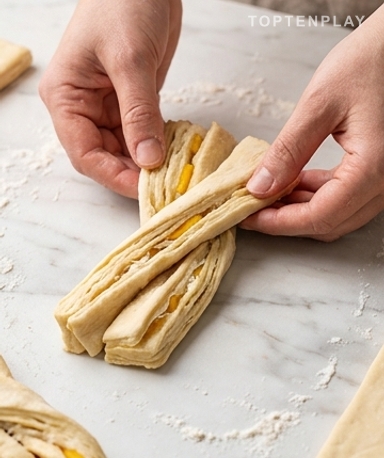
Roll the dough into a rectangle. Spread the filling over one half, fold the other half over. Cut strips 2 cm wide with a very sharp knife—clean slices, not sawn. Each strip is twisted two or three times on itself, then the two ends are joined to form a spiral. Place on a tray, cover with a cloth, and let proof at room temperature until the pastries have puffed up by one third. Expect 1.5 to 2 hours depending on your kitchen temperature.
Baking: 15 minutes, not one more
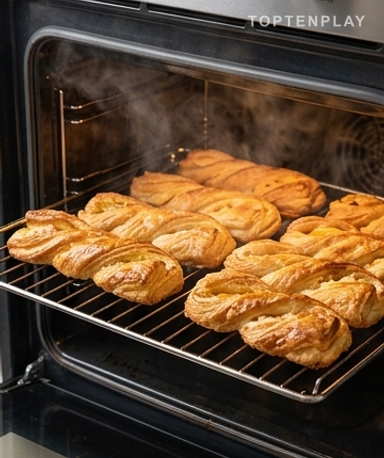
Preheat oven to 190°C fan. Glaze with beaten egg using a light touch—pressing too hard crushes the layers you spent hours building. Around 8 minutes, the edges start to brown first, like a light caramel appearing. At 12 minutes, the color should be uniform. At 15 minutes, take them out even if you’re in doubt—an overbaked pastry loses all its internal structure. Let cool for 10 minutes on a wire rack before touching: the filling is still liquid when it comes out of the oven.
Tips & Tricks
- If your kitchen is hot, work early in the morning or refrigerate the dough between each step. If butter becomes shiny under your hands, it’s melting—stop everything and put it back in the cold.
- The coconut-mango filling can be prepared two days in advance. It keeps well in the fridge and even concentrates slightly, which strengthens the flavors.
- These pastries can be frozen raw after shaping. Take them out the night before, let them proof in the fridge overnight, and bake in the morning directly without further thawing.
Can I prepare the Caribbean Twists the day before and bake them the next morning?
Yes, it’s actually the recommended method. After shaping, place the pastries on their tray in the fridge overnight. The slow cold proofing develops the flavors even better. In the morning, take them out for 20 minutes at room temperature, then bake immediately.
Can I use baking powder instead of baker’s yeast?
No. Baking powder does not create the same honeycomb structure and cannot withstand the 16-hour cold rest. For laminated pastry, you must use baker’s yeast, either fresh or dried. Active dry yeast should be rehydrated for 5 minutes in a little warm milk before use.
What should I do if the butter leaks out of the dough during lamination?
Stop immediately and put the dough back in the fridge for 30 minutes without touching it. Butter leaking out means the dough is too warm and the layers are merging. After resting, resume lamination with firmer movements and fewer rolling passes per turn.
Can I replace the mango with another tropical fruit?
Absolutely. Very finely diced pineapple works well, as does very ripe papaya. Avoid fruits that are too watery like watermelon or kiwi—they release too much juice during baking and will make the dough soggy. If using frozen fruit, drain thoroughly before incorporating.
How can I tell if the lamination is successful before baking?
Cut a small scrap of dough with a sharp knife and look at the edge. Distinct alternating lines indicate the butter-dough layers are in place. If the edge looks homogeneous and compact, the butter has melted into the dough—the lamination will be lost during baking.
Can I freeze cooked Caribbean Twists?
Yes, once completely cooled, wrap them individually in plastic wrap and freeze for up to 2 months. To reheat, place them in the oven for 8 minutes at 160°C without prior thawing. Avoid the microwave as it softens the crust and destroys the lamination.
Caribbean Twist
Tropical Fusion
Pastry
Twisted laminated pastries filled with coconut, mango, and passion fruit cream. Crunchy layers, melting filling, and scented with vanilla.
Ingredients
- 500g bread flour (T45)
- 10g fine salt
- 80g granulated sugar
- 10g dry baker’s yeast (or 20g fresh)
- 2 whole eggs
- 200ml whole milk
- 50g softened unsalted butter
- 250g dry laminating butter (84% fat minimum)
- 200ml full-fat coconut milk
- 1 vanilla bean
- 30g sugar (for the filling)
- 15g cornstarch
- 150g ripe mango, finely diced
- 3 passion fruits (pulp and seeds)
- 1 beaten egg (for glaze)
Instructions
- 1Mix the flour, salt, sugar, and yeast. Add the eggs and milk, knead for 8 minutes. Incorporate the softened butter and knead for another 3 minutes. Form into a rectangle, wrap, and refrigerate overnight.
- 2Prepare the filling: heat the coconut milk with the split vanilla bean and sugar. Dissolve the starch in 2 tablespoons of cold water and pour into the hot milk, stirring until thickened (2 minutes). Remove from heat.
- 3Off the heat, stir in the diced mango and passion fruit pulp. Remove the vanilla bean. Let cool completely in the fridge.
- 4Flatten the laminating butter between two sheets of parchment paper into a 20×20 cm square. Refrigerate 30 minutes until firm but malleable.
- 5Take out the dough, roll it into a rectangle twice as large as the butter square. Place the butter in the center and fold the dough over it like an envelope. Seal the edges by pressing down.
- 6Perform a first double turn: roll into a long rectangle, fold in 4. Wrap and refrigerate 30 minutes. Repeat twice for a total of 3 double turns with 30 minutes of rest between each.
- 7Roll the dough into a 30×50 cm rectangle. Spread the cold filling over the bottom half. Fold the top half over and press lightly to seal.
- 8Cut 10 strips 3 cm wide. Twist each strip 2 to 3 times, bring the two ends together to form a spiral. Place on trays lined with parchment paper.
- 9Cover with a cloth and let proof at room temperature for 1.5 to 2 hours, until the pastries have puffed up by one third.
- 10Preheat the oven to 190°C fan. Glaze gently with beaten egg. Bake for 15 minutes until a uniform amber caramel color. Let cool 10 minutes on a wire rack before serving.
Notes
• Storage: Caribbean Twists keep for 24h at room temperature in an airtight box. After that, they lose their crunch but remain good if reheated for 5 minutes at 160°C.
• Freezing raw recommended: shape, place on tray, freeze for 2h then transfer to a bag. Keeps for 2 months. Thaw in the fridge overnight, proof 1h at room temperature, then bake as normal.
• No fresh fruit variant: out of season, replace fresh mango with 150g frozen mango, well-drained and patted dry in a clean towel before incorporating.
Nutrition Facts (per serving, estimated)
| 520 kcalCalories | 8gProtein | 50gCarbs | 32gFat |