📌 Caramel Cornstarch Flan
Posted 23 April 2026 by: Admin
Stovetop flan is what people make when they’ve realized that pastry doesn’t need to be complicated to be good. Forget water baths, special molds, and candy thermometers. Five ingredients, ten minutes on the heat, and you get something that beats most desserts prepared the day before.
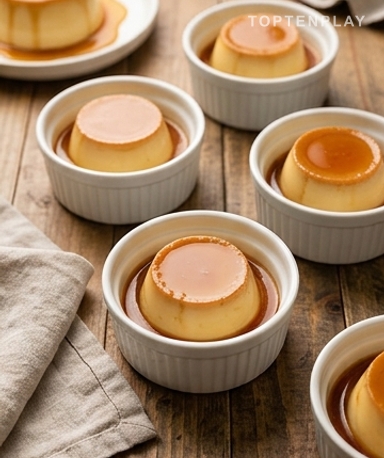
Imagine the surface of a perfectly unmolded flan. Smooth as satin. The ivory cream color, slightly translucent, topped with a light amber caramel — not the bitter dark brown, but the luminous amber of a caramel that has just set. When you dive a spoon into it, it yields with slight resistance, then immediately melts on the tongue without any heaviness. The smell of vanilla is there, discrete, just enough to remind you that this isn’t industrial.
Why you’ll love this recipe
Ingredient Notes
The short list: cornstarch, egg yolks, milk, sugar, vanilla, and liquid caramel. Nothing more.
- Cornstarch (Maizena) : This is the central ingredient, the one that provides the structure. Maizena is the most common brand and it works very well — but any white cornstarch will do. Be careful not to confuse it with yellow cornmeal, which will give a grainy texture and a completely different taste. It should be white, fine, and impalpable between your fingers.
- Egg yolks : Two yolks only. They bring richness and that slight cream tint to the flan. Save the whites for a meringue — here they serve no purpose. Standard eggs are perfectly fine, no need to make it complicated.
- Liquid caramel : Store-bought is just fine. Don’t start making a homemade caramel if you’re a beginner — it adds unnecessary difficulty to this dessert. Any supermarket brand works. The goal here is the layer that flows over the top when unmolded.
- Vanilla extract : Liquid, not artificial powder with its plastic notes. A capful is enough. If you have a real pod lying around in a cupboard, scrape it and throw the pod into the milk while you heat it — you’ll smell the difference as soon as the saucepan starts to simmer.
Why cornstarch is the most underrated gelling agent in the kitchen
We use it to thicken sauces and forget that it works wonders in desserts. It gels, it thickens, it gives a smooth and silky texture — and unlike gelatin, it doesn’t make the result elastic or sticky. Cornstarch flan has a texture that holds but melts as soon as it touches the tongue. The secret is cold dissolution. The starch must be perfectly integrated with the yolks and sugar before adding any hot liquid. If you throw it directly into burning milk, you’ll get lumps that even a blender won’t fix. Take two minutes to whisk the mixture until you get a pale, smooth paste that falls in a ribbon from the whisk. It seems like nothing. It makes all the difference.
The part everyone fails: the cooking
It’s simple, but it requires presence. You pour the preparation into the saucepan, medium heat, and you stir. Constantly. No breaks, no distractions. For the first five minutes, nothing happens — the preparation remains fluid and you start to doubt. Then suddenly, you feel resistance in the whisk. The texture changes in thirty seconds, going from liquid to creamy almost all at once. This is where many stop too early. Continue for another two minutes, until the cream really coats the back of a spoon — draw a line with your finger; it should stay clean without closing. A slight smell of warm vanilla begins to escape from the pan. That’s when you remove it from the heat.
Caramel at the bottom: don’t neglect it
A thin layer of liquid caramel at the bottom of the ramekin before pouring the hot cream. It seems anecdotal. It is not. During the cold set, the caramel will slightly mix with the first layers of cream, creating a light amber gradient around the edges. When unmolded, it flows slowly over the ivory surface of the flan. Visually, this is what transforms an ordinary cream into a real dessert. And taste-wise, the slight bitterness of the caramel against the vanilla sweetness of the cream — it’s the only balance this dessert needs.
Two hours in the cold: patience does the work
The flan comes out of the pan hot and already thick. As it’s poured into the ramekins, it begins to set. But while hot, it still lacks hold — in the mouth, it’s a cream, not a flan. The cold does the real magic. After a minimum of two hours in the refrigerator, the texture is firm but creamy, slightly wobbling when you move the mold. The surface is smooth, without a single bubble. If you can prepare it the night before, do so. A full night in the fridge and it will be in a state of grace.
Tips & Tricks
- Never heat on high to go faster — it burns the bottom in 30 seconds and gives a burnt taste to the whole preparation. Medium heat is medium heat. Really.
- To unmold cleanly, run the blade of a thin knife all around the edge before turning the ramekin over. A little nudge is enough — if it still resists, it’s not cold enough.
- Individual ramekins are more practical than a large mold: each portion unmolds easily, the plate presentation is clean, and you can serve on demand without slicing.
How long does cornstarch flan keep?
Three days in the refrigerator, well wrapped with plastic film touching the surface (the film directly touches the flan’s surface to prevent a skin from forming). Beyond that, the texture starts to release a bit of water and loses its creaminess.
Why is my flan lumpy?
The almost certain cause: the starch was not perfectly dissolved before cooking. It must be fully mixed with the yolks and sugar while cold, then the milk must be added gradually while whisking. If lumps appear during cooking, you can use an immersion blender before it sets completely.
Can vegetable milk be used instead of whole milk?
Yes. Soy milk gives the closest result, with a comparable firm texture. Oat milk also works well but brings a slightly sweet taste. Avoid rice milk, which is too liquid — the flan will have trouble setting correctly.
Can you freeze this flan?
No, not really. Cornstarch-based flans handle freezing poorly: when thawing, the texture becomes grainy and releases a lot of water. Prepare it the day before and keep it in the refrigerator — that’s more than enough.
How to unmold without breaking everything?
Run a thin knife blade all around the edge of the ramekin, pressing slightly against the rim (not against the flan). Place an inverted plate over the ramekin, flip the whole thing quickly, and wait a few seconds for the flan to release naturally. If it resists, the flan isn’t cold enough — put it back in the fridge for 30 minutes.
Can I vary the flavors?
Easily. Replace the vanilla with grated lemon zest, a teaspoon of instant coffee dissolved in the hot milk, or a few drops of orange blossom water. The caramel can also be replaced by liquid honey or fine jam at the bottom of the ramekins.
Caramel Cornstarch Flan
French
Dessert
A creamy and melting flan prepared in a saucepan, without an oven. Five simple ingredients, ten minutes of cooking, and a result that keeps all its promises.
Ingredients
- 40g (5 level tablespoons) cornstarch (Maizena type)
- 2 egg yolks
- 500ml whole milk
- 100g granulated sugar
- 1 teaspoon liquid vanilla extract
- 4 tablespoons liquid caramel (for the molds)
Instructions
- 1In a bowl, whisk the egg yolks, sugar, and starch until you get a pale and smooth paste, without any lumps.
- 2Gradually pour in the milk in a thin stream while whisking continuously to perfectly dissolve the starch.
- 3Add the vanilla extract and mix.
- 4Pour the preparation into a heavy-bottomed saucepan and place over medium heat.
- 5Stir without ever stopping with a whisk for 8 to 10 minutes, until the cream thickens and coats the back of a spoon.
- 6Pour a tablespoon of liquid caramel into the bottom of each ramekin.
- 7Immediately distribute the hot cream into the ramekins and smooth the surface with a spatula.
- 8Allow to cool to room temperature, then cover with plastic wrap touching the surface and refrigerate for at least 2 hours.
- 9When ready to serve, run a thin knife around the edges and unmold onto a plate.
Notes
• Prepare it the day before: the texture is even better after a full night in the fridge, firmer and better set.
• Storage: 3 days in the refrigerator, plastic wrap touching the surface to avoid skin formation.
• Variation: replace the vanilla with the grated zest of half a lemon or a teaspoon of instant coffee for a coffee version.
Nutrition Facts (per serving, estimated)
| 260 kcalCalories | 5gProtein | 48gCarbs | 6gFat |