📌 Cacio e Pepe: pasta cooking water, the secret ingredient for a lump-free cream
Posted 22 February 2026 by: Admin
The Essential Preparation: Water And Cheese
The Roman recipe for Cacio e Pepe pasta begins with a counter-intuitive decision that escapes most cooks: drastically reducing the amount of salt in the cooking water. This technical modification is necessary once you understand the very nature of pecorino romano, a sheep’s milk cheese that is already heavily salted and constitutes the soul of the dish. Boiling a large pot of lightly salted water thus becomes the first step in a preparation that breaks with usual habits.
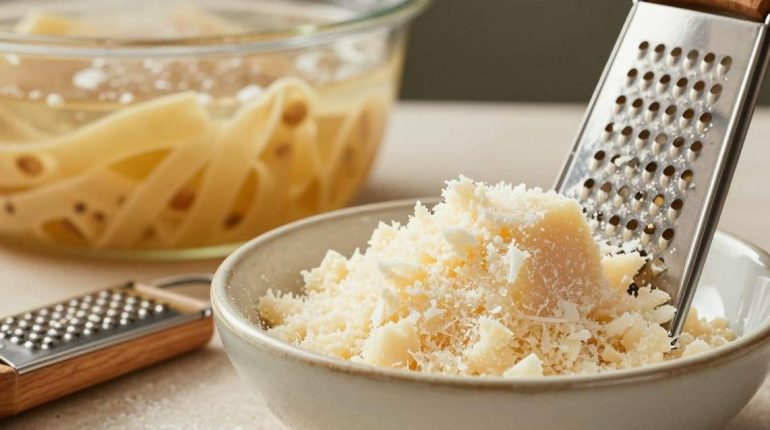
While the water temperature rises, the meticulous grating of the sheep’s cheese is done with precise timing. This preparatory step, far from being trivial, directly conditions the success of the cream that follows. The pasta is then plunged into the boiling water, gradually releasing the starch that will become the invisible but determining technical element of the recipe.
This initial phase already reveals the sophistication hidden behind the apparent simplicity of the dish. Only three ingredients, certainly, but an orchestration where each gesture anticipates the next. Adjusting the salt is the first technical key to a millimeter-precise taste balance, where nothing is left to chance. This cooking water, lightly salted and soon loaded with starch, will become the indispensable binder for a precise chemical transformation.
The Secret To Lump-Free Cream
The cooking water, now loaded with starch, reveals its true function in a technical operation that Roman tradition has codified with precision. After a few minutes of boiling the pasta, a ladle of boiling water taken directly from the pot is added to the grated cheese. This encounter causes a gradual melting where the starch released by the pasta plays a determining chemical role: it prevents the cheese proteins from binding together, thus avoiding the dreaded formation of lumps.
The operation is repeated methodically, ladle after ladle, until a homogeneous creamy consistency is obtained. This ancestral technique is based on an empirical understanding of food chemistry that Roman cooks have mastered for generations. Adding fresh water or milk would inevitably produce a grainy texture: only the cooking water, enriched with starch, guarantees the sought-after creaminess.
Freshly ground black pepper is then incorporated directly into this cream, infusing its aromas into the still-warm preparation. This precise moment marks the transformation of raw ingredients into a sauce whose perfect fluidity will determine the final result. The resulting cream now waits for the pasta in a state of fragile balance, ready to merge with it in a final decisive step.
Finalizing In The Pan: Two-Stage Cooking
This waiting cream now calls for the pasta, but according to a timing that amateurs systematically neglect. Draining occurs several minutes before the time indicated on the package, when the pasta still retains a perceptible firmness to the bite. This deliberate anticipation constitutes the technical signature of professional cooks: it reserves for the pan, and not the boiling water, the privilege of finishing the cooking.
The pasta then joins the cheese and pepper cream in the hot pan, where a gradual fusion begins. During these final minutes, the residual starch on the surface of the pasta mixes with the sauce while the pasta absorbs the creamy liquid, swelling slightly under the effect of this impregnation. The maintained heat allows the flavors to bind intimately, creating a gustatory harmony impossible to obtain by simple mixing after complete cooking.
This double-stage cooking technique radically transforms the final texture. The pasta no longer appears as a base coated in sauce, but as an element fused with it, each bite revealing the characteristic creaminess of the dish. The pan becomes the stage for an alchemy where the cheese, pepper, and pasta form a single homogeneous preparation, ready to reach the plate in a state of precarious balance that only immediate service will preserve.
Immediate Service: The Final Decisive Gesture
This precarious balance tolerates no delay. As soon as it leaves the pan, the dish requires immediate service, because every second erodes the creamy texture that the two-stage cooking has just established. The cheese, held in suspension by the starch and heat, begins to cool and threatens to freeze into a compact mass if the pasta stagnates in its container. This temporal urgency, which Roman cooks have known for generations, separates masterful preparations from the lukewarm and frozen versions that dishonor tradition.
The plate receives the steaming pasta, the final step before a generous sprinkling of freshly ground black pepper crowns the preparation. This final gesture does not just provide a visual touch: the peppercorns, releasing their essential oils upon contact with the residual heat, deliver a final aromatic wave that awakens the whole. The high temperature activates these volatile compounds, creating an olfactory contrast with the milky sweetness of the sheep’s cheese.
Tasting then begins in optimal conditions, when the sauce still coats each pasta with a creamy veil and the pepper diffuses its characteristic pungency. Any waiting irremediably compromises this moment of technical perfection, transforming a Roman classic into a bland approximation. Immediate service is not a recommendation, but the ultimate requirement of a recipe that forgives no negligence.