📌 Cà phê trứng — Vietnamese Egg Coffee
Posted 13 April 2026 by: Admin
A gray Tuesday morning, the usual coffee in its stoneware mug, and suddenly a craving for something different. Not a long coffee, not a 6-euro latte. Just this recipe that the Vietnamese invented in the 40s, when milk was scarce and they had to improvise with what was at hand.
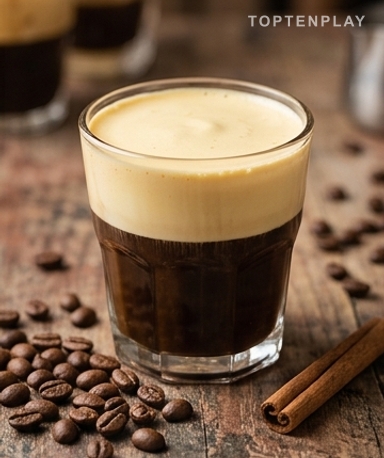
Look at this glass. Two distinct layers: below, a dark espresso, almost black, and above, a thick ivory foam, lightly golden like a flan freshly out of the oven. As you bring the glass to your lips, you first feel the full-bodied coffee, then the foam—warm, slightly sweet, with that scent of beaten egg that recalls raw sponge cake batter. The texture under the tongue is silky, dense without being heavy. Two flavors in a single sip.
Why you’ll love this recipe
Ingredient Notes
Everything you need for a creamy dairy-free coffee: fresh egg, honey, strong coffee, and a touch of optional condensed milk.
- The egg yolk : This is what does all the work. Choose a very fresh farm egg, with a bright orange yolk—not the pale yellow of battery eggs. The more colored it is, the more beautiful and flavorful the foam will be. One is enough per cup.
- The coffee : Here, no question of filtered coffee that is too light. You need a short espresso, or a strong coffee brewed in a moka pot. The coffee must stand up to the sweetness of the foam. An Arabica that is too light would be overwhelmed—opt for a blend with Robusta if you can.
- Honey or sugar : Vietnamese people use classic sugar. But acacia honey brings an additional roundness that pairs well with coffee. A level teaspoon, no more—the foam is already naturally sweet once emulsified.
- Sweetened condensed milk (optional) : In the original Hanoi version, this is a key element. It further thickens the foam and softens the whole. If you want to stay in the authentic cà phê trứng spirit, add a tablespoon. Otherwise, skip it—it’s not essential.
Choose a coffee that doesn’t back down
The coffee is the foundation. A short espresso, a moka brewed with almost boiling water. The goal is for it to be hot—really hot—when pouring. It’s this heat that will slightly cook the surface of the foam and create that thin semi-firm film, similar to the skin on milk in a saucepan. Prepare it last, just before serving. It should not wait.
Beat until the mixture is almost white
Crack the egg, keep only the yolk. Add your sugar or honey directly on top, in a small bowl. Now, beat. Not thirty seconds—two minutes minimum, by hand or with an electric whisk. The mixture must turn from bright yellow to pale cream, almost white, and triple in volume. You feel the resistance change under the whisk: first liquid, then increasingly airy, almost elastic. This is the exact moment the foam is ready.
Pour slowly—the first centimeter is crucial
Place your glass on the table. Pour the hot coffee slowly, in a stream, over the beaten foam. Not all at once—you would crush everything. The foam rises to the edges, the coffee seeps in from underneath, and you get those two distinct layers that make all the charm of the drink. Some mix immediately. Don’t do that. The first sip should be foam, then coffee—two different moments in a single cup.
Taste before adding anything
Resist the urge to sprinkle cinnamon or add vanilla before you’ve tasted it. The egg-coffee-honey combination already has its own flavors—sweet, slightly smoky, with that subtle umami background that only egg yolk can give. Adjust afterward if you want. A pinch of cinnamon on top works very well. But don’t drown the egg’s work under too many aromas.
Tips & Tricks
- Take your egg out of the fridge 15 minutes before—a room temperature yolk emulsifies much more easily and gives a more stable foam than a yolk straight from the cold.
- If the foam seems too sweet, reduce the honey to half a spoon and add a tiny pinch of fine salt on top—it wakes everything up and balances the sweetness effortlessly.
- The iced version exists and is worth the detour: let the coffee cool to room temperature, pour it over ice cubes, and spoon the foam on top. In contact with the cold, the texture changes—denser, almost creamy, like a light whipped cream that slowly melts into the coffee.
Is it risky to drink raw egg yolk in coffee?
The risk exists but remains very low—about 1 in 20,000 eggs is estimated to be contaminated with salmonella. The hot coffee poured directly onto the foam reaches a temperature sufficient to significantly reduce this risk without completely cooking the yolk. If you have a weakened immune system, simply opt for pasteurized eggs available in stores.
Can I prepare this coffee without an espresso machine?
Absolutely. A moka pot gives excellent results, provided you don’t let the coffee burn on the stove. The important thing is to get a strong and concentrated coffee—an ordinary drip coffee will be too light and get overwhelmed by the sweetness of the foam.
Why does my foam collapse so quickly?
It is almost always a matter of insufficient beating time. It takes at least two minutes for the yolk to triple in volume and form a stable foam. A yolk straight from the fridge is also harder to emulsify—let it come to room temperature for about fifteen minutes before starting.
Can I use a whole egg instead of just the yolk?
No, raw egg white brings a watery texture and an unpleasant taste that ruins the whole thing. It’s really the yolk—and only the yolk—that contains the lecithins necessary for the emulsion. Keep the white for another use (meringues, omelet, etc.).
How to adapt the recipe for an iced version?
Prepare the foam in exactly the same way. Let your coffee cool to room temperature then pour it over ice cubes in a tall glass. Then spoon the foam on top. In contact with the cold, it becomes even denser and creamier—some prefer this version to the hot one.
Can I prepare the foam in advance?
It can be kept in the refrigerator for up to 4 hours in a covered bowl. Give it a quick whisk before using if it has slightly collapsed. Beyond 4 hours, the raw yolk starts to lose quality—better to prepare it fresh in the morning.
Cà phê trứng — Vietnamese Egg Coffee
Vietnamese
Hot drink
The traditional Hanoi recipe: a strong espresso topped with a thick foam of egg yolk beaten with honey. Velvety, sweet, and dairy-free.
Ingredients
- 1 (about 18g) fresh egg yolk (farm egg preferred)
- 1 teaspoon (7g) acacia honey (or powdered sugar)
- 60-80 ml short espresso (or very strong moka coffee)
- 1 tablespoon (15ml) sweetened condensed milk (optional, for traditional version)
- 1 pinch ground cinnamon (optional, for serving)
Instructions
- 1Separate the yolk from the white. Pour the yolk into a bowl and add the honey (and condensed milk if using).
- 2Beat vigorously with a manual or electric whisk for 2 minutes, until the mixture is pale, thick and almost white, with tripled volume.
- 3Prepare your short espresso and pour it hot into a heat-resistant glass.
- 4Spoon the foam gently onto the hot coffee—do not mix.
- 5Sprinkle with a pinch of cinnamon if desired. Serve immediately and drink letting the two layers pass through.
Notes
• Take the egg out of the refrigerator 15 minutes before starting: a room temperature yolk emulsifies more easily and gives a more stable foam.
• The foam can be prepared up to 4 hours in advance and stored in the refrigerator. Give it a quick whisk before use.
• For an iced version, pour the cooled coffee over ice cubes and spoon the foam on top.
Nutrition Facts (per serving, estimated)
| 110 kcalCalories | 3gProtein | 10gCarbs | 6gFat |