📌 Button-down shirts: the real function of this loop on the back from American campuses
Posted 13 February 2026 by: Admin
The Enigma Of The Small Detail That Intrigues
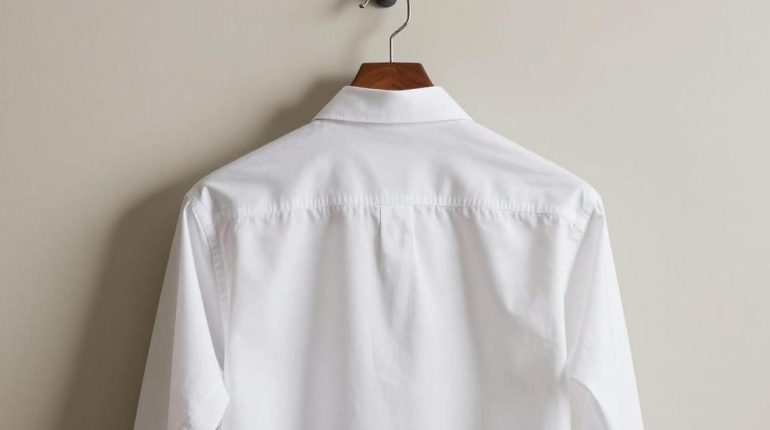
Some mysteries hide in plain sight. On button-down Oxford shirts—those timeless classics of the male wardrobe—a discreet detail escapes the eye until the day it jumps out at you: a small loop of fabric, sewn in the center of the back, just below the collar.
At first glance, nothing spectacular. A simple rectangular tab, a few centimeters of fabric carefully fixed to the seam. Yet, once spotted, this discreet presence becomes obsessive. Impossible to ignore. The question then naturally arises: what could this loop possibly be for?
Is it a purely decorative ornament, added to enhance the line of the back? A historical vestige, a relic of a bygone era that manufacturers perpetuate out of tradition? Or does it hide an unsuspected practical function, a precise use fallen into oblivion?
The answer combines these three dimensions. This modest fabric loop carries within it a fascinating history that crosses the campuses of the Ivy League, the university locker rooms of the American East Coast, and the subtle evolutions of contemporary masculinity. An apparently harmless clothing detail that reveals, to whoever takes the time to examine it, the cultural and practical layers of traditional menswear.
The Historical Origin: The “Locker Loop”
This loop has a name: the “locker loop”. A name that immediately reveals its primary function and the context of its appearance.
The story begins in the 1960s, in the heart of the prestigious Ivy League campuses—Yale, Princeton, Harvard. At that time, male students wore button-down Oxford shirts daily, the true unofficial uniform of the American university elite. In the cramped locker rooms of dormitories and sports clubs, storage space remained limited. Hangers were not always available, let alone spacious individual wardrobes.
East Coast haberdasheries—shops specializing in men’s clothing items—then integrated this small loop into shirts. An ingenious solution that allowed the shirt to be hung on a simple hook without wrinkling it, preserving its collar and structured shoulders. A simple gesture that became a ritual: remove your shirt, pass it through the loop on the locker hook, and find it ready to wear.
This functional detail quickly established itself as a marker of authenticity. Traditional manufacturers—Brooks Brothers in the lead—made it a distinctive signature, transforming a practical necessity into an identity element of the preppy wardrobe. The “locker loop” now embodied the casual elegance of the American establishment.
The Practical Function In Locker Rooms
This loop allowed shirts to be hung in locker rooms without wrinkling them. A simple wall hook, a peg in the gym, a nail in the dormitory was enough. The student passed the loop over the hanging point and his shirt remained suspended vertically, the collar preserved, the shoulders maintained in their natural shape.
In the world of university campuses of the 1960s, this solution responded to a concrete constraint. Collective spaces—sports locker rooms, common bathrooms, student clubs—cruelly lacked individual storage. Hangers remained rare, personal wardrobes non-existent or tiny. The “locker loop” transformed any vertical surface into an improvised closet.
The gesture was part of a precise daily ritual. After sports class or the morning shower, the Oxford shirt returned to its place on its assigned hook. The Oxford fabric, thick and resistant, perfectly supported this mode of suspension. The weight of the shirt naturally distributed the folds, avoiding systematic ironing.
This pragmatic ingenuity reflected the practical spirit of traditional masculine clothing culture. No superfluity, only functional solutions discreetly integrated into the garment. The loop disappeared under a jacket or sweater, invisible in normal use, but always available when the need arose. A perfect balance between utility and discretion that already foreshadowed its future transformation into a simple stylistic marker.
The Contemporary Survival Of A Stylistic Heritage
Today, no one hangs their shirt in a university locker room by this loop anymore. Hangers abound, individual lockers equip modern gyms, and collective dormitories have given way to student residences with personal storage. Yet, the “locker loop” persists on authentic Oxford shirts, visible on models from Brooks Brothers, J.Press, or Ralph Lauren.
This functional detail that has become superfluous has metamorphosed into a signature of authenticity. Its presence now signals adherence to a precise clothing heritage, that of the classic Ivy League style. Manufacturers maintain it consciously, not out of practical necessity, but as a marker of historical legitimacy. An Oxford shirt without its back loop seems incomplete to purists, deprived of a constitutive element of its identity.
This permanence illustrates how dress codes survive their primary utility. The loop tells a story—that of East Coast campuses, collective locker rooms, a time when masculine style combined casual elegance and discreet pragmatism. It embodies the transformation of a practical solution into a cultural symbol, tangible proof that certain details transcend their initial function to become carriers of meaning.
The evolution of the “locker loop” thus reflects the profound mutations of masculinity and style. What used to hang a wet shirt after sport becomes the badge of belonging to a bygone, but still admired, clothing tradition.