📌 Bread storage: why temperatures above 24°C accelerate the appearance of mold
Posted 31 January 2026 by: Admin
Warning Signs: Distinguishing Mold From Stale Bread
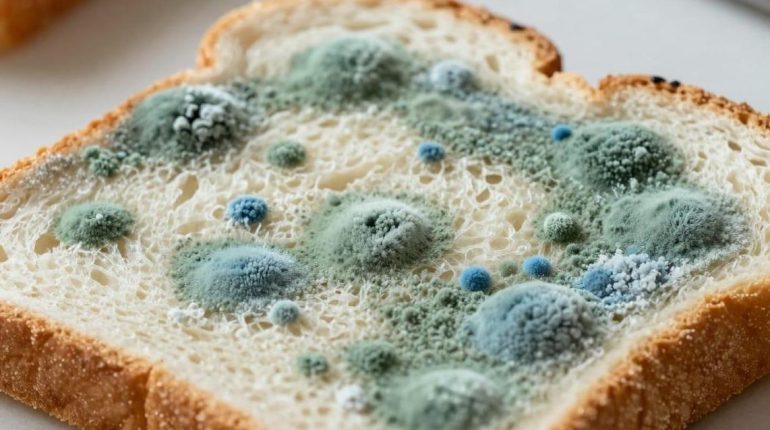
Before changing your storage habits, a check is necessary: is it actually mold? Fungal colonies manifest as fuzzy green, blue, or black spots on the surface of the bread. These organisms actively feed on the crumb, forming characteristic growths that are impossible to confuse with simple dryness.
Stale bread has a firm and dehydrated texture, but its surface remains free of these colored and cottony areas. The difference is crucial: while a dried slice can be toasted safely, consuming moldy bread exposes you to proven health risks. The mycotoxins produced by certain fungi can cause digestive disorders or even allergic reactions in sensitive individuals.
When in doubt, the rule remains uncompromising: throw away the suspicious bread without hesitation. The apparent saving is never worth the risk to your health. Spores invisible to the naked eye may have colonized the entire loaf long before the appearance of the first visible spots, making any attempt at “salvage” by removing only the affected part illusory.
This correct identification is the first step towards better management of your bread. Because understanding the problem allows for the identification of environmental causes.
Temperature: Your Bread’s Invisible Enemy
Your kitchen might well be the primary culprit. Molds thrive in heat, and the critical threshold of 24°C (75°F) transforms your counter into an involuntary incubator. Beyond this temperature, fungal spores accelerate their development exponentially, drastically reducing the shelf life of your bread.
Most households are unaware of the actual temperature of their storage space. An ambient thermometer often reveals surprises: proximity to the oven, exposure to afternoon sun, or simply a room that is naturally warmer than the rest of the house. These seemingly minimal variations are enough to create ideal conditions for microbial proliferation.
The solution lies in environmental control. Identify the coolest areas of your kitchen using a basic thermometer. A closed pantry, away from heat sources, generally maintains a more stable temperature than an exposed counter. If your kitchen regularly exceeds 24°C, consider moving your bread supply to a more temperate adjacent room.
This thermal vigilance also explains why some breads keep better in winter than in summer. Ambient heat acts as an invisible catalyst, accelerating a natural process that you can nevertheless control with simple adjustments.
But temperature is only part of the equation. Air humidity plays an equally decisive role.
Humidity: The Secret Fuel For Mold
Ambient air contains a sneaky enemy that few people measure: humidity. Beyond the critical threshold of 60%, your kitchen’s atmosphere transforms into an ideal playground for fungal colonies. This seemingly abstract percentage determines the difference between bread kept for a week and bread that goes moldy in three days.
Risk zones often hide in plain sight. The sink diffuses constant steam during dishwashing, the stove releases moisture with every boil, and these micro-environments create pockets of saturated air. Storing your bread near these sources is equivalent to exposing it directly to mold spores waiting for these conditions to proliferate.
A compact dehumidifier in the pantry solves this problem radically. The investment remains modest compared to recurring food waste. Certain non-electric, silica-based models are sufficient for small spaces and keep the air below the fatal threshold.
Cooking steam deserves special attention. Opening a window during and after meal preparation evacuates excess humidity before it accumulates. This simple habit reduces the overall humidity rate of the room and protects not only your bread but all your dry foods.
Even with controlled temperature and humidity, the precise storage location can sabotage all your efforts.
Storage Traps: Keeping Bread Away From Danger Zones
The refrigerator and dishwasher are the worst possible neighbors for your bread. Their appearance as cold and clean appliances masks a problematic thermal reality. The refrigerator motor generates continuous heat that accumulates on its top surface, transforming this popular storage spot into a mold incubator. This area regularly reaches 27°C (80°F), well beyond the critical threshold of 24°C.
The dishwasher, for its part, releases massive volumes of steam during each cycle. This moisture disperses into the surrounding air and permeates everything nearby. Bread stored near this appliance absorbs this invisible condensation, creating the perfect humid environment for fungal spores.
The solution lies in a dedicated location, far from these sources of disturbance. An airtight bread box in a dry cupboard offers the necessary insulation against variations in humidity and temperature. This simple container maintains a stable microclimate while allowing minimal air circulation that prevents condensation buildup.
Cupboards far from appliances are the ideal alternative. Prioritize the interior spaces of cabinets rather than exposed surfaces. This physical distance creates a protective barrier that naturally extends shelf life.
But even the best location requires other adjustments in your daily practices to maximize freshness.