📌 Bleach stains on your clothes: two simple methods to eliminate them without throwing them away
Posted 10 February 2026 by: Admin
Domestic Drama: When Bleach Attacks Your Clothes
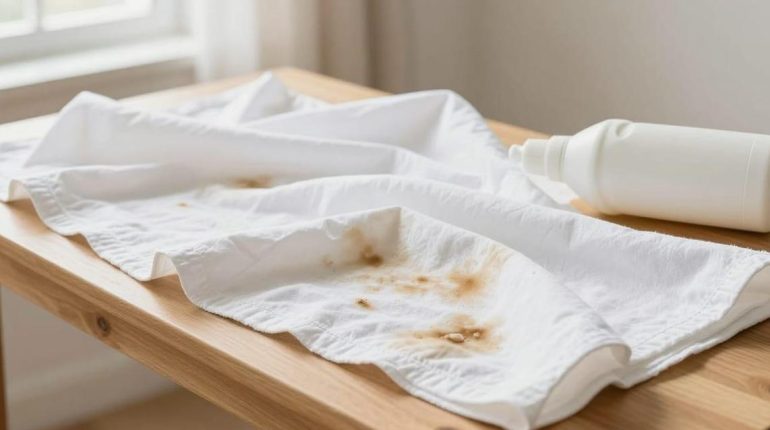
We’ve all experienced it: that moment of distraction when a few drops of bleach splash onto our favorite garment. In seconds, a discolored stain appears, and the immediate reflex is to consider the textile permanently lost. This rapid resignation stems from a deeply rooted belief: that damage caused by bleach is irreversible.
However, this conviction is more myth than reality. Domestic accidents involving this cleaning product occur with surprising frequency, precisely because bleach is among the essential allies of household chores. Its disinfecting power justifies its regular use, but mechanically multiplies the risks of accidental splashes.
The good news? Concrete solutions exist to recover those clothes you were about to relegate to the back of a closet or throw away. Two specific techniques allow you to eliminate these stubborn stains in record time, without professional equipment or special skills. The effectiveness of these methods lies in their simplicity of application and immediate accessibility.
Before condemning your stained shirt or pants, it is worth understanding why bleach causes such damage and how to reverse this apparently irremediable process.
Understanding the Phenomenon: Why Is Bleach So Formidable?
The ubiquity of bleach in our cupboards is explained by its exceptional disinfecting properties. This chemical product remains the preferred choice for eliminating bacteria and mold, cleaning sanitary surfaces, and whitening laundry. This unmatched effectiveness justifies why it is practically impossible to do without it in daily maintenance.
This frequent use inevitably multiplies the opportunities for accidental contact with our clothes. Unlike classic stains that deposit a substance on the fabric, bleach acts by direct chemical reaction with the textile fibers. It literally destroys the colored pigments by oxidizing the molecules responsible for the tint, thus creating an apparently irreversible discoloration.
The speed of this alteration accentuates the dramatic nature of the accident: a few seconds are enough for the whitish stain to set permanently. This immediacy explains why so many people immediately give up on saving their garment.
Yet, understanding this mechanism also reveals the path to countering its effects. If bleach destroys color, specific techniques allow for restoring the uniformity of the textile through processes that are as accessible as they are fast.
Express Intervention: Quick Solutions at Hand
Faced with this chemical alteration, two specific methods offer a concrete and accessible response. Unlike classic stain removers which prove ineffective on this type of discoloration, these techniques aim to restore the chromatic uniformity of the fabric rather than removing a substance.
The first approach consists of visually neutralizing the stain by harmonizing the surrounding color. This solution is particularly suited to dark textiles where the discoloration creates a marked contrast. The process requires common products available in any home, without requiring professional equipment or special technical skills.
The second method exploits the opposite principle by uniforming the entire garment through controlled dilution. More radical, it is suitable for situations where the stain occupies a visible or extensive area. This technique transforms the initial accident into an opportunity to create an intentional faded effect, thus giving a second life to the damaged textile.
The effectiveness of these interventions relies on their speed of execution. The earlier the treatment occurs after the incident, the better the results obtained. This reactivity limits the progressive oxidation of the fibers and optimizes the chances of recovering the garment.
These solutions demonstrate that a simple domestic accident does not irremediably condemn your favorite textiles.
Taking Action: Test These Techniques at Home Without Delay
These solutions demonstrate that a simple domestic accident does not irremediably condemn your favorite textiles. It is time to move from theory to practice by applying these methods to your damaged clothes.
Don’t let a bottle of bleach dictate the fate of your wardrobe anymore. The two revealed techniques can be experimented with immediately using means available at home, without expensive investment or specialized skills. Every minute counts: the faster you intervene, the higher the chances of restoration will be.
The incident that seemed catastrophic to you turns into an opportunity for recovery. Rather than relegating the stained garment to the back of a closet or abandoning it permanently, try the experiment today. The result might surprise you and save you from buying an identical piece.
This pragmatic approach gives back control in the face of household accidents. You now have the keys to react effectively, transform apparent damage into a concrete solution, and extend the life of your favorite textiles. The essence lies in immediate action rather than resigned hesitation.