📌 Beets and heart health: how natural nitrates improve your circulation after 50
Posted 3 February 2026 by: Admin
Beetroot: A Silent Ally At The Heart Of A Modern Diet
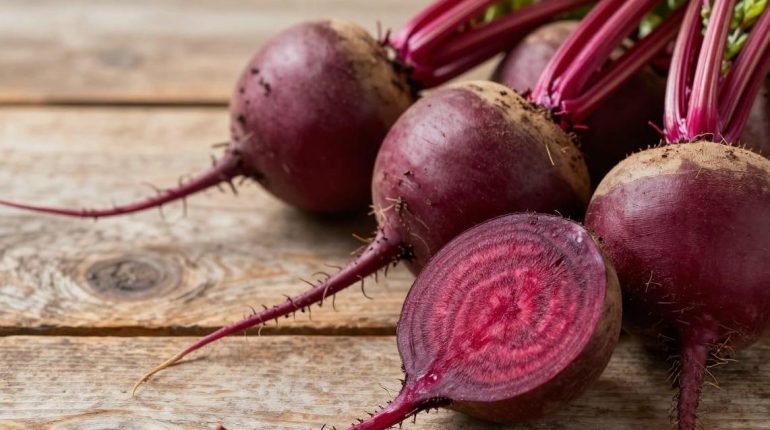
On supermarket shelves, on organic market stalls, in trendy smoothie bars: beetroot is discreetly establishing itself as one of the most present vegetables in the contemporary diet. Roasted as a side dish, grated in salads, or mixed with ginger and apple, it colors plates with a deep red that does not go unnoticed. Beyond its vibrant aesthetics and characteristic earthy taste, this tuber (Beta vulgaris) hides a well-documented scientific reality.
Medical research converges: beetroot effectively supports blood circulation, promotes balanced digestion, and contributes to general well-being, especially as we age. But beware of shortcuts. Unlike over-vitaminized superfoods whose virtues marketing exaggerates, beetroot does not perform instant miracles. It acts deeply, progressively, according to measurable biological mechanisms.
“Beetroot represents a form of gentle medicine,” summarize several nutritionists interviewed about its properties. No spectacular overnight transformation. No fantasized detox effect. Simply a demonstrated ability to nourish the body intelligently, thanks to a synergy of active components — dietary nitrates, fiber, folate, antioxidants — working in concert.
True well-being does not shout its benefits. It settles in with consistency. And sometimes, it wears the color of burgundy.
Nutritional Decoding: The Exceptional Composition Of Beetroot
A cup of cooked beets shows only 58 calories. Behind this modest figure lies a remarkably dense nutritional profile, where each component plays a precise role in the body.
Dietary nitrates constitute the pillar of its vascular action. Once ingested, they transform into nitric oxide, a key molecule for blood vessel health. This biochemical mechanism, validated by numerous studies, explains why beetroot effectively supports circulation — without the need for artificial supplementation.
Fiber (2 to 3 grams per cup) directly feeds the gut microbiota, promoting regular digestion and lasting digestive balance. Folate, or vitamin B9, actively participates in cellular repair and proper nerve function. As for manganese and potassium, they support energy metabolism, muscle function, and fluid balance.
Betanin deserves special attention. This natural antioxidant, responsible for the tuber’s intense red color, protects cells against oxidative stress — a process of cellular wear accelerated by age, pollution, or an unbalanced diet.
Unlike vegetables that shine with a single star nutrient, beetroot offers a synergy. Its components do not work in isolation but combine to produce measurable effects on cardiovascular and digestive health. An optimal nutritional ratio that justifies its growing presence in the recommendations of health professionals.
Cardiovascular Impact: What Studies Reveal About Blood Circulation
The dietary nitrates present in beetroot follow a precise metabolic path. Once absorbed, they pass through the salivary glands where specific bacteria reduce them to nitrites. These nitrites, upon contact with gastric acidity, transform into nitric oxide — a vasodilating molecule that relaxes arterial walls and facilitates blood flow.
This mechanism has been the subject of numerous scientific publications. A 2018 meta-analysis published in Nutrients confirms that regular consumption of beetroot juice significantly reduces systolic blood pressure in adults, with measurable effects as early as two hours after ingestion. Other works demonstrate an improvement in physical endurance and muscle oxygenation, particularly in people over 50.
The clinical relevance increases with age. Natural aging reduces the endogenous production of nitric oxide, which progressively stiffens the arteries. Plant nitrates then offer targeted nutritional support, without the side effects of drug treatments.
Cardiologists insist, however, on one point: beetroot does not replace an existing cardiovascular treatment, but it constitutes an intelligent dietary supplement in a global prevention strategy. Its discrete and cumulative action is part of a logic of sustainable health, where every nutritional gesture counts.
Practical Integration: Why And How To Adopt Beetroot Sustainably
This nutritional approach only works in the long term. The documented cardiovascular benefits result from regular consumption, not a one-off experiment. The question then becomes: how to integrate beetroot without constraint?
Methods vary according to preference. Some prefer fresh juice, which concentrates nitrates and offers maximum bioavailability. Others prefer roasted beets, whose gentle cooking preserves fiber while softening the earthy texture. Grated, marinated, or incorporated into mixed smoothies are also viable options. The key lies in consistency rather than quantity: three to four weekly portions are enough to observe measurable metabolic effects.
Beyond circulation, dietary fiber feeds the gut microbiota and regulates transit. Folate supports cellular repair, particularly important after 40. Potassium and manganese optimize muscle function and fluid balance. This nutritional synergy explains why beetroot is among the most studied vegetables in preventive nutrition.
Nutritionists recall a fundamental principle: no single food guarantees health. Beetroot is part of a global dietary model, rich in varied plants, low in ultra-processed products. Its interest lies precisely in its simplicity — an accessible, affordable vegetable that nourishes without artifice.