Detox juices often have a bad reputation, and it’s largely well-deserved. Most are either bland, or so sugary they lose any nutritional value, or both at once. This one is in a different league: it has a bold character, real texture, and a color that makes you want it even before the first sip.
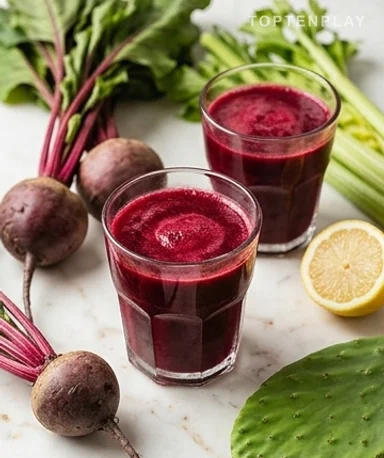
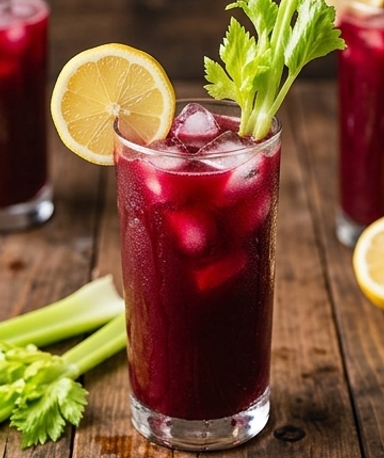
In the glass, it’s a deep red, almost burgundy, with violet highlights where the light passes through. The smell is immediately earthy — the beet asserts its character, slightly sweet, a bit mineral, without apologizing. The celery cuts through that with a crisp vegetable freshness. One sip, and you first feel the lemon attack, then the beet settles in gently, followed by a lightness in the finish that the nopal brings without being truly noticed — it’s what makes the whole thing digestible.
Why you’ll love this recipe
Ingredient Notes
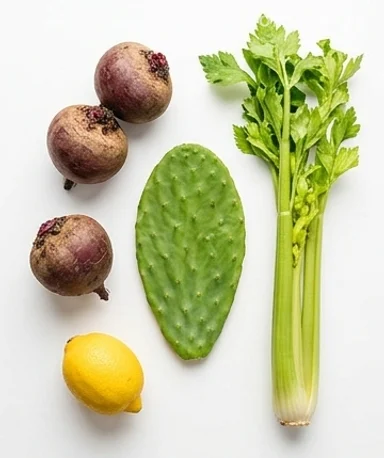
Four ingredients, all easy to find — except perhaps nopal, which can be found in Mexican or health food stores.
- Raw beet : Firm, with no soft spots or wrinkled skin. Forget the pre-cooked vacuum-packed beets from the supermarket — they’ve already lost their nutrients and will produce a juice that is too watery with a baked-earth taste. Market-fresh with the skin intact is what you need. Be warned: it stains everything it touches — hands, boards, towels.
- Nopal (cactus paddle) : You can find it in Mexican grocery stores or good organic shops, sometimes in jars in brine. If using fresh, remove all spines from the entire surface before peeling — one by one with a knife, scraping along the small bumps. If using jarred, rinse thoroughly under cold water, otherwise it brings a vinegary aftertaste to the juice.
- Lemon : Fresh, always. Bottled lemon juice is acidic but flat, lacking the volatile aromas of the zest. If you want more intensity, grate the zest of half a lemon and add it to the blender — it’s optional but it really wakes the whole thing up.
- Celery stalks : The green stalks with leaves, not celeriac. The leaves are the most aromatic part of the plant — don’t throw them away; they go straight into the blender. They bring a light, fresh bitterness that balances the sweetness of the beet.
Prep the ingredients without making life hard
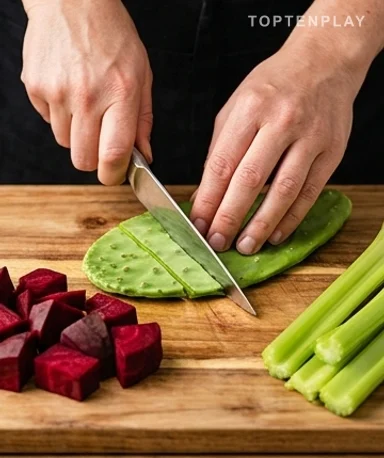
Start with the beet. Peel it under a stream of cold water — this limits the staining on your hands, though it won’t stop it completely. It resists under the knife, dense and firm, almost like a very dry potato. Cut it into coarse chunks; the blender will handle it. Move on to the nopal: edges peeled, spines removed, cut into cubes. Celery into segments, leaves included. Squeeze the lemon directly into the blender before adding everything else.
The blending process
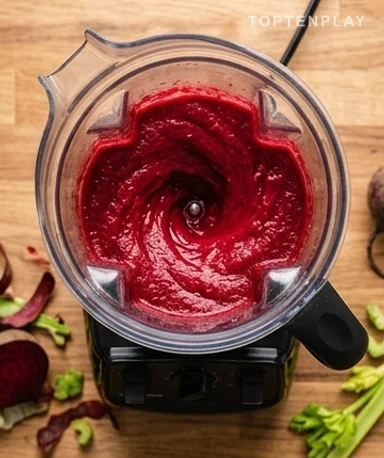
Pour the water into the blender first, then the solid ingredients on top. The beet goes first — it’s the hardest to grind and needs time. Run at full power and let it spin for 30 to 45 seconds. The sound changes over the seconds: from a dry crunching noise to something more fluid, almost liquid. That’s the sign it’s ready. Watching that color gradually take over the white of the blender to become a deep carmine red is quite satisfying.
To strain, or not to strain
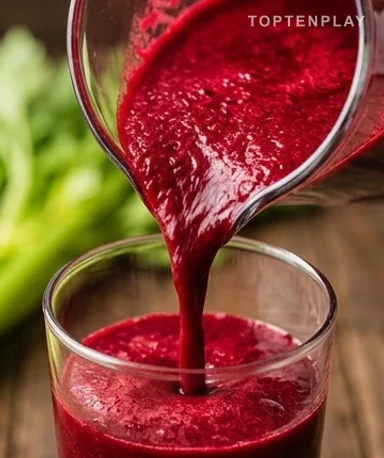
A matter of taste. Unfiltered, the juice is thick, with a texture between a smoothie and a juice — the fiber is there, and it’s filling. With a fine sieve or a clean cloth, you get something more fluid and clear, closer to a true juice. Both versions are worth it. I keep it as-is most of the time. Serve in a large glass with ice cubes for a fresh and vibrant feel, or at room temperature if you want to experience all the aromas of the beet and nopal.
Tips & Tricks
- Drink it in the morning before eating anything — not out of dogma, but because an empty stomach really amplifies the flavors and you feel it settle better.
- If the beet feels too earthy for your taste, add a small green apple to the blender. It softens things without masking the other ingredients.
- Jarred nopal is a good backup, but rinse it very seriously — poorly rinsed nopal means a juice that tastes like pickles, and nobody wants that in their morning glass.
- It keeps for 24 hours in the fridge in an airtight jar. Shake hard before drinking: the beet fibers settle at the bottom within a few hours.
Can I make this juice with an extractor instead of a blender?
Yes, and it’s a good alternative. A centrifugal or cold-press extractor will yield a clearer, more fluid juice. The main difference: you lose the fiber in the process. With the blender, you keep everything and the texture is thicker — it’s a matter of personal preference.
How long does it keep in the fridge?
24 hours maximum in an airtight jar. Beyond that, the beet starts to ferment slightly and the taste changes — it’s not dangerous, but unpleasant. Shake well before serving, as fibers settle quickly at the bottom.
I can’t find nopal. What can I replace it with?
Nopal has a dual role: softening the blend and providing soluble fiber. Half a raw zucchini is the best substitute — similar texture, neutral flavor. Alternatively, a slice of aloe vera (gel only, without the bitter skin) also works.
Why does my juice turn brown after a few hours?
This is the oxidation of the beet in contact with air. Lemon slows the process but doesn’t stop it. To keep the bright red color, store the juice in a jar filled to the brim and sealed airtight — the less air, the better.
Can I add other ingredients?
Fresh ginger (a 2 cm piece) is the best addition — it pairs beautifully with beet and adds a kick. A green apple if you find the taste too earthy, or a carrot for more sweetness. Avoid very sugary fruits that distort the recipe’s profile.
Beet, Nopal and Celery Detox Juice
Healthy Cooking
Drink
A thick and nourishing juice made from raw beet, nopal, celery, and lemon. Ready in 10 minutes, ideally consumed in the morning on an empty stomach.
Ingredients
- 400g raw beets (2 medium beets), peeled and chopped
- 150g fresh nopal (1 cactus paddle) or well-rinsed jarred nopal, cubed
- 100g celery stalks (2 stalks) with leaves, chopped
- 1 lemon, freshly squeezed juice (approx. 30ml)
- 1 litre cold water (adjust based on desired texture)
Instructions
- 1Peel the beets under running cold water and cut them into large chunks.
- 2Remove all spines from the nopal, peel it, and cut it into cubes. If using jarred nopal, rinse thoroughly.
- 3Cut the celery into segments, keeping the leaves. Squeeze the lemon.
- 4Pour the water into the blender, then add the beet, nopal, celery, and lemon juice.
- 5Blend at full power for 30 to 45 seconds until the juice is smooth.
- 6Serve as is or strain through a fine sieve for a clearer result. Add ice cubes if desired.
Notes
• Storage: 24h in the fridge in an airtight jar filled to the brim. Shake before serving.
• If using jarred nopal (in brine), rinse it very well in cold water to avoid a vinegary aftertaste in the juice.
• Zesty variant: add a piece of fresh ginger (2 cm) to the blender. Mild variant: add a green apple to soften the earthy taste of the beet.
Nutrition Facts (per serving, estimated)
| 55 kcalCalories | 2gProtein | 11gCarbs | 0gFat |