📌 Beef Chow Fun: the Cantonese restaurant technique for perfectly stir-fried rice noodles in 10 minutes
Posted 16 January 2026 by: Admin
Beef Chow Fun: A Cantonese Classic Within Everyone’s Reach
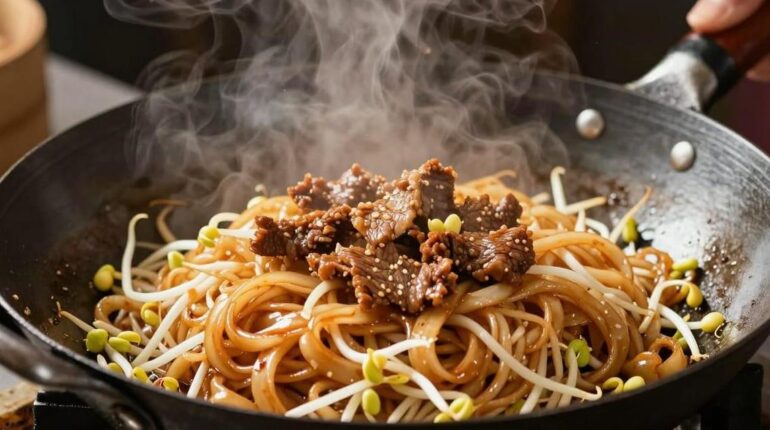
In Cantonese kitchens, Beef Chow Fun has reigned as an undisputed reference for decades. This stir-fried noodle dish combines three fundamental elements: beef slices marinated until they melt in your mouth, wide rice noodles with a silky suppleness, and crunchy bean sprouts that provide necessary freshness. The whole dish is bathed in an umami sauce where light and dark soy sauces marry, creating that caramelized color and deep aromas that signal authenticity.
Contrary to popular belief, this restaurant specialty requires neither professional equipment nor inaccessible techniques. Home cooks can reproduce these characteristic textures by simply respecting the timing and exact proportions. Success lies in methodical preparation: a scientifically calculated marinade to tenderize the meat, a rigorous mise en place of ingredients, and lightning-fast cooking at high temperature.
Timing reveals the efficiency of this recipe: 40 minutes from start to finish, with only 10 minutes of active cooking. This record time is explained by the very nature of the Cantonese wok, designed to sear ingredients quickly while preserving their nutritional and gustatory qualities. The magic happens in this narrow window where the noodles absorb the sauce without becoming mushy, and the beef remains tender without drying out. This temporal precision transforms simple ingredients into a gastronomic experience worthy of Hong Kong’s finest tables.
Strategic Preparation: Marinade And Mise En Place
The marinade constitutes the technical foundation of this dish. The 180 grams of thinly sliced beef undergo a meticulous six-step treatment: a spoonful of light soy for base flavor, a spoonful of dark soy for deep color, a spoonful of oyster sauce providing umami, then 1.5 spoons of cornstarch creating a protective barrier against the wok’s intense heat. Sesame oil and vegetable oil finally seal the whole. The optional but revealing ingredient remains baking soda: half a spoon is enough to slightly break down muscle fibers, guaranteeing that characteristic tenderness of Cantonese restaurants.
Fifteen minutes of marinating allow enzymes and tenderizing agents to perform their chemical transformation. During this time, the mise en place is organized with professional rigor: 80 grams of onion sliced into regular strips, three chopped green onion stalks for the aromatic finish, 50 grams of rinsed and drained mung bean sprouts. The 400 grams of rice noodles wait their turn, already separated to prevent them from sticking during the stir-fry.
The final sauce is prepared in a separate bowl: 1.5 tablespoons of light soy, one spoon of dark soy, half a spoon of sugar to balance the salinity. This pre-mixed sauce will be integrated in seconds during the flash cooking, ensuring even distribution on every noodle. This methodical anticipation transforms the ten minutes of cooking into a choreographed ballet where every gesture counts.
Key Ingredients And Their Exact Proportions
The 400 grams of rice noodles constitute the structural backbone of the dish. These wide, flat ribbons, called sha he fen in Cantonese, absorb the sauce while maintaining their characteristic elastic texture. Their precise weight guarantees the balance between proteins, vegetables, and starches, creating that gustatory harmony sought in authentic Cantonese cuisine.
The marinade relies on a precise orchestration of seven components. The three sauces — light soy, dark soy, oyster — each bring a distinct dimension: salinity, caramel color, umami depth. Cornstarch (1.5 spoons) acts as a thermal shield, while vegetable and sesame oils (optional) seal the whole. Baking soda, used in a homeopathic dose (½ spoon), remains the unknown professional ingredient that transforms ordinary meat into restaurant-quality beef.
Freshness elements complete the composition: 50 grams of mung bean sprouts add the vegetable crunch contrasting with the silky noodles, while 80 grams of sliced onion caramelize slightly under the heat, releasing their natural sugars. The three green onion stalks, reserved for the finish, provide the final aromatic note.
This metronomic calibration for 2-3 people eliminates guesswork. Every measurement contributes to the balance: too much sauce would drown the noodles, too little would leave them bland. Cantonese restaurants have mastered these ratios for generations, now passed down with surgical precision.
Timing And Execution: 10 Minutes Chrono Cooking
The initial fifteen minutes of cutting and mise en place determine the success of the following ten minutes. This preparatory phase requires rigorous spatial organization: all ingredients arranged within reach, the marinated meat, the sliced vegetables, the sauce mixed in a bowl. Cantonese stir-fry tolerates no improvisation once the heat is on.
Express cooking relies on a simple thermal principle: maximum heat, constant movement. The wok must reach the smoking point before adding oil. The marinated beef sears in two minutes over high heat, developing that slight external char while remaining pink in the center. Remove immediately, set aside. The rice noodles follow, heated for thirty seconds with a drizzle of oil to prevent clumping.
The final assembly orchestrates textures in ninety seconds. Onions and bean sprouts join the noodles, the sauce is poured around the periphery of the wok — never in the center — allowing for flash caramelization before incorporation. The beef returns to the composition, three energetic spatula strokes, and freshly ground black pepper brings its pungent heat. The chopped green onions, added off the heat, preserve their aromatic vibrancy.
This timed protocol reproduces the authenticity of open Cantonese kitchens. Forty total minutes separate an ordinary refrigerator from a steaming plate worthy of Hong Kong’s best establishments, demonstrating that culinary excellence depends less on time than on its absolute mastery.