📌 At 8, surgeons removed half her brain — what she does for a living today defies everything doctors predicted
Posted 30 November 2025 by: Admin
The Devastating Diagnosis That Changed Everything
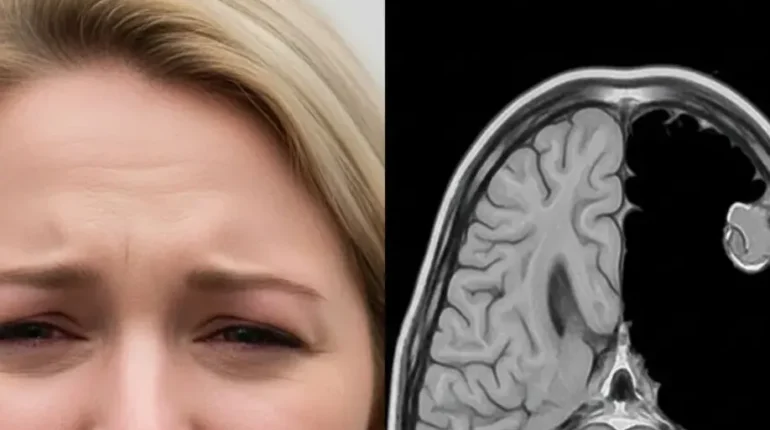
At eight years old, Christina Santhouse’s childhood fractured in an instant. What started as unusual seizures soon unmasked something far more sinister: Rasmussen’s encephalitis, a rare neurological disease that systematically destroys one brain hemisphere. Unlike common childhood illnesses, this condition doesn’t plateau — it progressively worsens, triggering severe seizures, cognitive deterioration, and permanent disability in its wake.
For Christina’s family, the diagnosis meant watching their daughter’s future collapse in real time. Each seizure signaled another piece of her brain under attack. Doctors offered no gentle prognosis, no timeline for recovery. There was only the relentless march of a disease that medical science could rarely stop.
Rasmussen’s encephalitis remains devastatingly rare, yet its impact on those affected is absolute. The inflammation spreads without predictable boundaries, leaving neurologists with limited options and families facing impossible choices. For Christina, this rare disease would soon force her parents into a decision that most could never fathom — one that demanded sacrificing half of her brain to save her life.
The Impossible Choice: A 14-Hour Surgery To Remove Half Her Brain
By the time Christina turned nine, her parents faced an unthinkable decision. The disease ravaging her brain left doctors with only one option: hemispherectomy, a surgical procedure so extreme that it seemed to defy the boundaries of human medicine. Removing or disconnecting an entire hemisphere of the brain offered the only realistic chance of stopping the seizures and halting the neurological destruction.
But survival came with a staggering price. Before the 14-hour operation, her medical team prepared her family for a future that seemed predetermined by devastation. Christina might never walk again. She might never speak again. She might never achieve independence. These weren’t possibilities to consider — they were medical realities her parents had to accept before signing consent forms.
The surgery itself represented an act of controlled desperation. Surgeons would fundamentally alter her brain’s architecture, severing connections that most people rely on their entire lives. Yet without it, Rasmussen’s encephalitis would continue its relentless destruction, leaving her with uncontrollable seizures and progressive cognitive decline.
Her family made the choice that few could endure. What emerged from that operating room was not the girl they’d imagined their daughter might become — but someone far more remarkable than anyone dared predict.
Defying Every Prediction Through Neuroplasticity And Determination
What emerged from that operating room defied medical expectation at every turn. Within weeks of surgery, Christina began the painstaking work of relearning the fundamentals — movements, words, independence — that most children take for granted. Her brain, stripped of half its structure, faced an extraordinary challenge: adapt or surrender.
Yet something remarkable happened. Neuroplasticity, the brain’s remarkable ability to rewire itself and forge new neural pathways, became her greatest ally. Through intensive therapy and relentless determination, Christina accomplished what her doctors had deemed unlikely. She relearned to walk, rebuilding motor control through sheer will and the brain’s adaptive capacity. She regained her speech, reclaiming a voice doctors feared she might lose forever. She returned to school, refusing to let her surgery define her limitations.
The physical costs remained visible — partial paralysis affected her left side, and vision loss in one eye served as a permanent reminder of what the surgery had taken. Yet these obstacles became footnotes in a far more compelling narrative. Christina didn’t just survive; she advanced. Each recovered function became proof that the human brain possesses reserves of resilience most of us never need to discover.
Her recovery transcended medical textbooks. It became evidence that our predicted futures are not our actual ones — that determination, supported by the brain’s neurological flexibility, can rewrite what seemed irreversibly written.
From Patient To Healer: Rebuilding A Complete Life
Christina’s recovery could have ended there — a remarkable medical victory, a survivor’s tale. Instead, it became the foundation for something far more profound. The girl who had to relearn speech transformed that experience into her life’s calling. She pursued higher education with the same determination that had carried her through rehabilitation, earning a bachelor’s degree in speech pathology, then a master’s degree in the same field. Each diploma represented not just academic achievement, but a deliberate choice to turn her greatest vulnerability into her greatest strength.
Today, Christina works as a licensed speech therapist, guiding patients through their own communication challenges — many of whom face obstacles strikingly similar to those she conquered. Her presence alone carries weight these patients cannot ignore: here stands someone who understands, not theoretically, but through lived experience, what it means to reclaim your voice. She drives independently. She maintains her own career. She lives without the protective shadow of constant medical intervention.
What makes her story truly exceptional isn’t merely that she survived a hemispherectomy. Countless patients do. It’s that she transcended survival entirely, converting her ordeal into purpose. With half a brain, she rebuilt not just a life — she built a vocation dedicated to helping others do the same. Her journey from patient to healer stands as quiet proof that our limitations need not confine us; they can, instead, become the compass directing us toward meaning.